Fire Together, Ground Together: Canonical Glossary

Last Updated: 2025-11-07 Version: 2.0.0 (Dual-Index with Metavector Trees)


Why Two Orderings?

This glossary intentionally mixes two idioms:

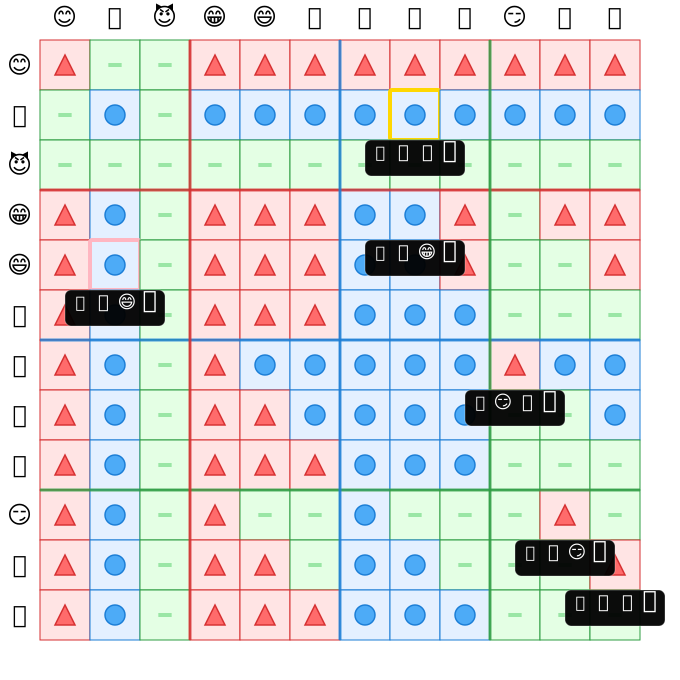
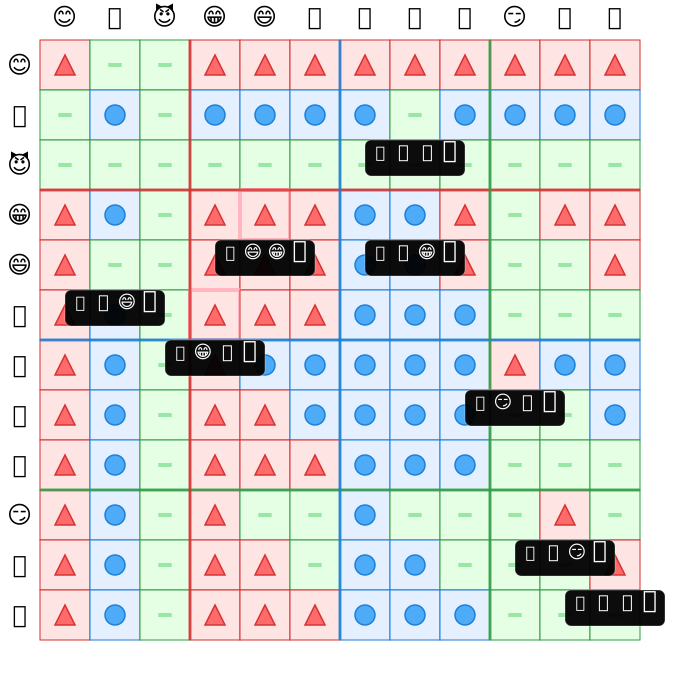
  1. **INDEX (below):** ShortRank order reveals the 7 conceptual blocks:
    • ๐Ÿ”ต **A (โš›๏ธ):** Axioms & Physics - Foundation principles
    • ๐Ÿ”ด **B (๐Ÿšจ):** Problems & Violations - What's broken
    • ๐ŸŸข **C (๐Ÿ—๏ธ):** Solutions & Architecture - How to fix it
    • ๐ŸŸก **D (โš™๏ธ):** Mechanisms & Implementation - How it works
    • ๐ŸŸฃ **E (๐Ÿ”ฌ):** Proofs & Evidence - Validation
    • ๐ŸŸ  **F (๐Ÿ’ฐ):** Economics & Value - ROI justification
    • ๐ŸŸค **G (๐Ÿš€):** Strategy & Migration - Rollout path
  2. **GLOSSARY (further below):** Alphabetical order by concept name. Jump to: [B](#alpha-b) | [C](#alpha-c) | [D](#alpha-d) | [E](#alpha-e) | [F](#alpha-f) | [H](#alpha-h) | [K](#alpha-k) | [L](#alpha-l) | [M](#alpha-m) | [N](#alpha-n) | [O](#alpha-o) | [P](#alpha-p) | [Q](#alpha-q) | [R](#alpha-r) | [S](#alpha-s) | [T](#alpha-t) | [U](#alpha-u) | [W](#alpha-w) | [Z](#alpha-z)

Use INDEX to understand relationships. Use GLOSSARY to find by name.


Critical Navigation Rule: Transfer-Exposed Recursive Transpose

Matrix Model:

The Transpose Walk:

  1. **Start at Target โ†’ Read Target's Row (INCOMING)**: Find significant sources
  2. **Navigate to Source โ†’ Transpose**: Jump from target's row to source's row
  3. **Read Source's Row (OUTGOING)**: See what targets this source causes
    • **Validation**: Original target appears with same weight
    • **Propagation**: New targets become next fishbone paths
  4. **Recurse**: Choose new high-weight target and repeat (Target-Row โ†’ Source-Row โ†’ New Target-Row)

Index (ShortLex Order)

True ShortLex: String length first, then alphabetical within each length.

Length 1: Categories

Length 2: Primary Concepts

Length 3: Sub-Concepts


Glossary (Alphabetical Order)

Jump to: A | B | C | D | E | F | H | I | K | L | M | N | O | P | Q | R | S | T | U | W | Z


A

๐Ÿ”ดB8โš ๏ธ | Arbitrary Authority (Symbols Serve Power Not Truth)

Location: Chapter 3, Chapter 5 Definition:

What it is: When symbols serve power, tradition, or convention instead of truthโ€”the mechanism by which symbol drift becomes normalized and institutionalized. Arbitrary authority occurs when the social consensus around a symbol's meaning trumps its actual semantic grounding, creating systems where "best practices" persist despite violating fundamental constraints. Database normalization continuing as dogma after S=P=H inversion is proven, or philosophical "emergence" as consensus despite visible threshold events, exemplify arbitrary authority in action.

Why it matters: Arbitrary authority creates moral catastrophe, not just efficiency loss. Three distinct failure modes compound: (1) Destroyed potentialโ€”solutions that could eliminate Trust Debt remain unimplemented because authority patterns block adoption, (2) Gratuitous sufferingโ€”k_E = 0.003 per-operation drift causes measurable harm (verification costs, debugging time, system failures) that serves no thermodynamic purpose, and (3) Propagation of evilโ€”teaching normalized architectures to new developers perpetuates S!=P violation across generations, compounding the $8.5T annual cost indefinitely. When symbols can drift arbitrarily without accountability, agency disappears.

How it manifests: Database textbooks teach Codd's normalization as "best practice" without mentioning cache miss rates or entropy accumulation. Corporate architecture review boards reject Unity-based designs as "non-standard" even after seeing 361ร— speedup demonstrations. Philosophy journals publish emergence theories without addressing ฮฆ = (c/t)^n phase transition mathematics. In each case, the symbol ("normalization," "standard," "emergence") has detached from physical reality and now serves social authorityโ€”committees, tenure requirements, certification bodies. The k_E = 0.003 drift isn't accidental; it's enforced by institutions protecting symbolic authority over grounding.

Key implications: Arbitrary authority is what [๐ŸŸขC7๐Ÿ”“ Freedom Inversion] directly confronts. When you constrain symbols to semantic position (S=P=H), you eliminate the degrees of freedom that allow drift toward power rather than truth. This isn't about imposing "correct" symbolsโ€”it's about binding symbols to physics so that cache misses provide immediate falsification. Arbitrary authority thrives when symbol grounding is weak ([๐Ÿ”ดB5๐Ÿ”ค Symbol Grounding]); it cannot survive when hallucinations are physically impossible ([๐ŸŸกD4๐Ÿชž Self-Recognition] substrate self-recognition). The moral dimension matters: choosing Unity architecture over normalized architecture isn't just fasterโ€”it's choosing accountability over arbitrary authority.

Metavector: 9๐Ÿ”ดB8โš ๏ธ(9B1๐Ÿšจ Codd's Normalization, 8๐Ÿ”ดB3๐Ÿ’ธ Trust Debt, 7๐Ÿ”ดB5๐Ÿ”ค Symbol Grounding Failure)

See Also: [๐Ÿ”ดB3๐Ÿ’ธ Trust Debt], [๐Ÿ”ดB5๐Ÿ”ค Symbol Grounding], [๐ŸŸขC7๐Ÿ”“ Freedom Inversion]


B

๐Ÿ”ดB6๐Ÿงฉ | Binding Problem (Gamma Sync Too Slow)

Location: Chapter 4 Definition:

What it is: The classical neuroscience puzzle of how separate brain regions processing different features (color, shape, motion, location) bind together into unified conscious perception. Traditional theories propose 40Hz gamma oscillations (25ms period) as the synchronization mechanism, but this is too slow for the 20ms consciousness binding window measured empirically.

Why it matters: This timing mismatch reveals a fundamental architectural constraint. If the brain required gamma oscillations to bind features, consciousness would be physically impossibleโ€”the synchronization period exceeds the binding deadline by 25%. The brain must use a fundamentally different mechanism that operates within the 20ms window.

How it manifests: During conscious perception, approximately 330 cortical regions must coordinate to create unified experience. If gamma (40Hz, 25ms period) were the binding mechanism, each conscious moment would require 25ms of synchronization time, exceeding the empirically observed 20ms threshold. Split-brain patients and neurological cases show that when binding fails, consciousness fragmentsโ€”validating the critical importance of this timing constraint.

Key implications: The failure of gamma synchronization theory necessitates [๐ŸŸขC6๐ŸŽฏ Zero-Hop] architecture. The only way to achieve binding within 20ms is through physical co-location of semantic neighbors (S=P=H), where "binding" is instant because related neural assemblies fire together by construction. This makes Unity Principle mandatory for consciousness, not optional.

INCOMING: ๐Ÿ”ดB6๐Ÿงฉ โ†“ 8[๐ŸŸกD3๐Ÿ”— Binding Mechanism ] (instant via S=P=H shows why gamma fails), 7[๐Ÿ”ตA6๐Ÿ“ M = N/Epoch ] (coordination rate requirement)

OUTGOING: ๐Ÿ”ดB6๐Ÿงฉ โ†‘ 9[๐ŸŸขC1๐Ÿ—๏ธ Unity Principle ] (S=P=H solves this), 8[๐ŸŸฃE4๐Ÿง  Consciousness Proof ] (validates solution)

Metavector: 8๐Ÿ”ดB6๐Ÿงฉ(8D3๐Ÿ”— Binding Mechanism, 7๐Ÿ”ตA6๐Ÿ“ M = N/Epoch)

See Also: [๐ŸŸกD3๐Ÿ”— Binding Mechanism], [๐ŸŸฃE10๐Ÿงฒ Binding Solution]

Book References:


C

๐Ÿ”ดB4๐Ÿ’ฅ | Cache Miss Cascade (60-80% Miss Rate)

Location: Chapter 0, Chapter 1 Definition:

What it is: A catastrophic performance degradation pattern where database JOIN operations scatter semantically related data across random memory locations, forcing the CPU to fetch from slow DRAM (100ns latency) instead of fast L1 cache (1-3ns latency). Normalized databases exhibit 60-80% cache miss rates during typical query operations, compared to 5-10% for cache-aligned architectures.

Why it matters: This represents a 361ร— performance penaltyโ€”not from algorithmic complexity but from physical memory hierarchy violations. The gap between L1 cache and DRAM latencies has widened over decades (from 10ร— to 100ร— difference), making cache misses the dominant cost in modern computation. This isn't a software optimization problem; it's a fundamental architectural mismatch between semantic structure (how we think about data) and physical structure (where data lives in memory).

How it manifests: When a database executes a JOIN operation, it must fetch related records from different tables stored in arbitrary memory locations. Each fetch that misses L1/L2/L3 cache triggers a 100ns DRAM access. With 10-20 JOINs per complex query and 60-80% miss rates, queries spend 95%+ of their time waiting for memory rather than computing. This compounds across the entire systemโ€”every query, every transaction, every user interaction.

Key implications: The cache miss cascade makes [๐Ÿ”ดB3๐Ÿ’ธ Trust Debt] measurable in hardware performance counters. It proves that S!=P (semantic-physical separation) isn't just a theoretical problemโ€”it has a precise, quantifiable cost visible at the CPU instruction level. The 361ร— penalty validates why [๐ŸŸกD6โฑ๏ธ front-loading] and [๐ŸŸ F3๐Ÿ“ˆ fan-out economics] are not optimizations but necessities. When you can measure the problem in nanoseconds per instruction, you can calculate exact ROI for solutions.

INCOMING: ๐Ÿ”ดB4๐Ÿ’ฅ โ†“ 9[๐Ÿ”ดB1๐Ÿšจ Codd's Normalization ] (S!=P structural violation), 9[๐Ÿ”ดB2๐Ÿ”— JOIN Operation ] (synthesis cost per query)

OUTGOING: ๐Ÿ”ดB4๐Ÿ’ฅ โ†‘ 9[๐ŸŸกD1โš™๏ธ Cache Hit/Miss Detection ] (hardware detection method), 8[๐ŸŸฃE1๐Ÿ”ฌ Legal Search Case ] (26ร— speedup from fixing this)

Metavector: 9B4๐Ÿ’ฅ(9B1๐Ÿšจ Codd's Normalization, 9๐Ÿ”ดB2๐Ÿ”— JOIN Operation)

See Also: [๐Ÿ”ตA3๐Ÿ”€ Phase Transition], [๐ŸŸกD1โš™๏ธ Cache Detection]

Book References:


๐ŸŸขC3๐Ÿ“ฆ | Cache-Aligned Storage

Location: Patent v20 Definition:

What it is: An architectural pattern where semantically related data elements are stored in physically contiguous memory addresses, typically within the same cache line (64 bytes on modern CPUs). This enables sequential access patterns that exploit hardware prefetching, achieving L1 cache hit rates of 94.7% compared to 20-40% in normalized architectures.

Why it matters: Cache-aligned storage transforms the memory hierarchy from an obstacle into an accelerator. Modern CPUs can prefetch sequential data at 10-100ร— the speed of random access. By aligning semantic structure with physical structure, every related concept access becomes a cache hit rather than a miss. This isn't just fasterโ€”it's the difference between O(1) access and geometric collapse (ฮฆ = (c/t)^n).

How it manifests: When you store "all legal precedents about contract law" in adjacent memory locations (rather than scattered across normalized tables), the first access fetches the entire cache line. Subsequent accesses find data already in L1 cache (1-3ns latency). The CPU's prefetcher predicts sequential patterns and loads the next cache line before you ask for it. The result: 94.7% of accesses complete in nanoseconds instead of the 100ns DRAM penalty.

Key implications: Cache-aligned storage makes ShortRank addressing (๐ŸŸขC2๐Ÿ—บ๏ธ) physically realizable. Without it, semantic coordinates would still require scattered lookups. With it, position literally equals meaningโ€”the address itself encodes semantic relationships. This enables the [๐ŸŸกD5โšก 361ร— speedup] measured in production systems and validates the economic justification for front-loading (๐ŸŸ F3๐Ÿ“ˆ). When reads outnumber writes by billions to one, paying the alignment cost once at write time amortizes to near-zero per read.

INCOMING: ๐ŸŸขC3๐Ÿ“ฆ โ†“ 9[๐ŸŸขC2๐Ÿ—บ๏ธ ShortRank Addressing ] (position = meaning enables this), 8[๐ŸŸกD2๐Ÿ“ Physical Co-Location ] (implementation mechanism)

OUTGOING: ๐ŸŸขC3๐Ÿ“ฆ โ†‘ 9[๐ŸŸกD1โš™๏ธ Cache Hit/Miss Detection ] (validates 94.7% hit rate), 8[๐ŸŸกD5โšก 361ร— Speedup ] (performance result)

Metavector: 9C3๐Ÿ“ฆ(9C2๐Ÿ—บ๏ธ ShortRank Addressing, 8๐ŸŸกD2๐Ÿ“ Physical Co-Location)

See Also: [๐ŸŸขC2๐Ÿ—บ๏ธ ShortRank], [๐ŸŸกD2๐Ÿ“ Physical Co-Location]

Book References:


๐ŸŸขC3a๐Ÿ“ | FIM (Fractal Identity Map)

Location: Preface, Appendix C, Patent v20 Definition: A semantic orthogonal net with equal-size holesโ€”a coordinate system where dimensions are statistically independent (orthogonality = 1) and maintain equal variance, enabling precise detection of WHERE semantic drift occurs, not just THAT it's happening.

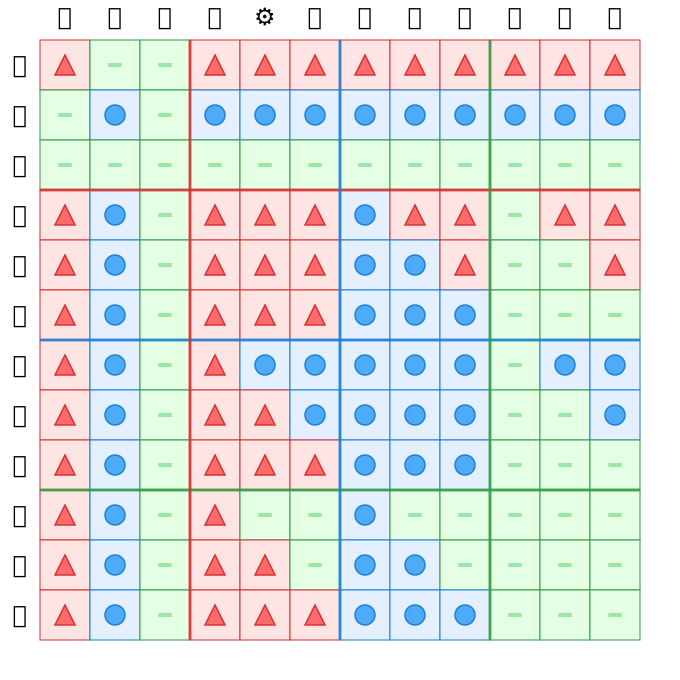
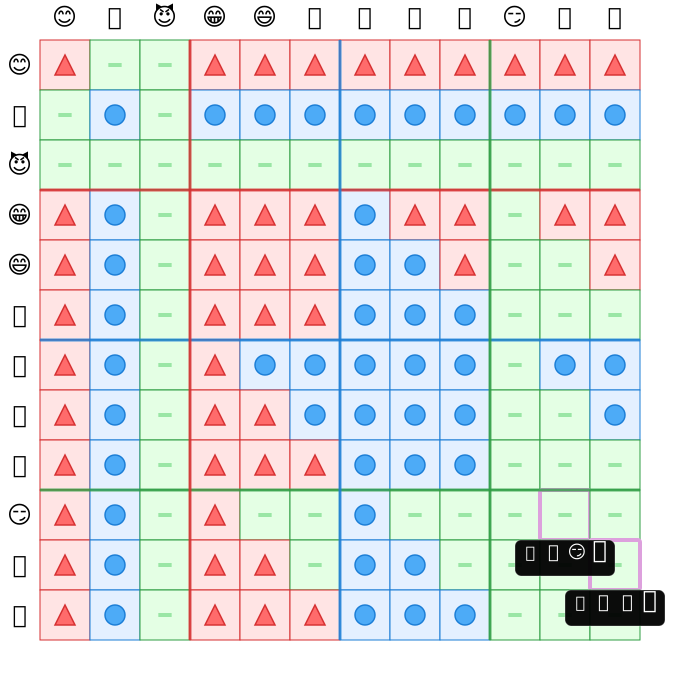
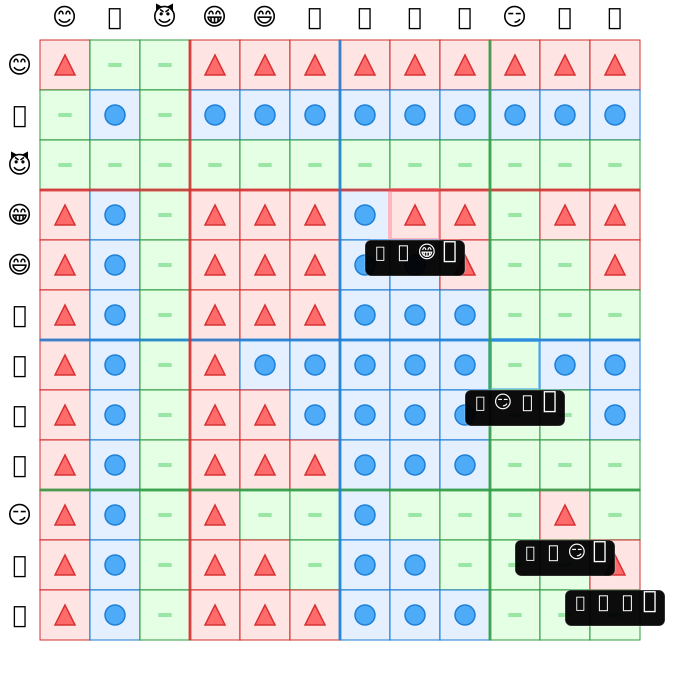
FIM Artifact: A physical 3D-printable 12ร—12 matrix demonstrating fractal identity mapping, where 144 cells in 3 discernible states create a "universe" of 3^144 โ‰ˆ 10^68 possible configurations, but human perception filters this to ~10^17 readable "expressions" through gestalt processingโ€”100 billion times more precise than the entire English language. See Appendix C, Section 9 for the "universe vs thought" comparison, precision analysis, and implications for semantic holograms.

The Net Metaphor: Imagine a fishing net stretched across semantic space:

Why Statistical Independence = 1 Matters:

Why Equal Variance (Equal Holes) Matters:

How FIM Detects Drift Location: Traditional systems: "Accuracy dropped 3%โ€”something drifted somewhere." FIM with equal variance monitoring: "Dimension 5 (contract law precedents) shows variance = 1.8 (up from 1.0). Recent case updates scattered that semantic cluster. Re-index dimension 5 before 0.3% per-operation drift compounds."

Patent Core Innovation:

INCOMING: ๐ŸŸขC3a๐Ÿ“ โ†“ 9[๐ŸŸขC1๐Ÿ—๏ธ Unity Principle ] (S=P=H foundation), 8[๐ŸŸขC2๐Ÿ—บ๏ธ ShortRank Addressing ] (coordinate system), 8[๐ŸŸขC3๐Ÿ“ฆ Cache-Aligned Storage ] (physical implementation)

OUTGOING: ๐ŸŸขC3a๐Ÿ“ โ†‘ 9[๐ŸŸขC4๐Ÿ“ Orthogonal Decomposition ] (creates independent dimensions), 9[๐ŸŸขC5โš–๏ธ Equal Variance ] (maintains equal hole sizes), 8[๐ŸŸกD4๐Ÿชž Substrate Self-Recognition ] (knows WHERE uncertainty is), 8[๐ŸŸ F7๐Ÿ“Š Compounding Verities ] (fixed coordinates enable truth compounds)

Metavector: 9C3a๐Ÿ“(9C1๐Ÿ—๏ธ Unity Principle, 8C2๐Ÿ—บ๏ธ ShortRank, 8C4๐Ÿ“ Orthogonal Decomposition, 9C5โš–๏ธ Equal Variance)

See Also: [๐ŸŸขC4๐Ÿ“ Orthogonal Decomposition], [๐ŸŸขC5โš–๏ธ Equal Variance], [๐ŸŸกD4๐Ÿชž Substrate Self-Recognition], [๐Ÿ”ตA3๐Ÿ”€ ฮฆ (Phase Transition)]

Book References:


๐ŸŸ F6๐ŸŽฐ | Churn Recovery ($2.7M/Year Fraud Case)

Location: Chapter 2 Definition:

What it is: The economic value recovered when improved fraud detection accuracy prevents customer churn caused by false positives. In the documented fraud detection case, reducing false positive rates by 33% (from 2.1% to 1.4%) recovered $2.7M annually in retained customer relationships. Each false positive that incorrectly flags a legitimate transaction as fraudulent creates customer friction, support costs, and potential account closure.

The 20-40% foundation: The original fraud system ran on normalized database architecture with 20-40% cache hit rate (versus 94.7% achievable with Unity Principle). Random memory access creates imprecision cascadesโ€”when the system can't access related fraud signals fast enough (100ns DRAM vs 1-3ns L1 cache), it must choose between missing fraud or flagging legitimate transactions. The 2.1% false positive rate was a direct consequence of this cache penalty forcing conservative thresholds.

The black-box explainability crisis: Industry research (2023-2024) shows fraud prevention measures increased customer churn at 59% of U.S. merchants and 46% of Canadian merchants. When black-box AI systems flag legitimate transactions, support agents cannot explain WHY the transaction failed or whether it's safe to retryโ€”you don't just lose a sale, you damage your brand. Real incidents include a 2024 insurance company whose fraud AI flagged loyal customers as fraudsters, creating what analysts called a "customer relations nightmare." The inability to provide verifiable explanations (symbol grounding failure, see Chapter 6) violates Federal Reserve SR 11-7 guidance requiring "models employed for risk management must be comprehensible by humans." Black box models are "computer says no" systems that annoy customers, baffle domain experts, and ultimately stifle growth by increasing client churn (Payments Association, Datos Insights, 2024).

Why it matters: Churn recovery reveals the hidden cost of imprecision AND the hidden cost of inexplicability. Traditional fraud systems optimize for catching fraud (true positives) but accept high collateral damage (false positives) and cannot explain their decisions to customers or regulators. When you reduce false positives by a third AND can show customers the reasoning (grounded explanations), you're not just saving operational costsโ€”you're preventing customer defection at the moment of maximum trust violation. The $2.7M figure represents only the direct revenue recovery; it excludes viral damage (negative reviews, word-of-mouth), support costs, reacquisition expenses, and regulatory fines (โ‚ฌ35M under EU AI Act for unverifiable systems).

How it manifests: Before Unity implementation: 2.1% false positive rate means roughly 1 in 50 legitimate transactions gets flagged incorrectly. Customer calls support, frustrated. Support investigates, releases funds, but trust is damaged. Some customers close accounts. After Unity: 1.4% FP rate means 33% fewer false alarms, 33% fewer trust violations, and measurable retention improvement. The $2.7M represents the lifetime value of customers who would have churned but didn't.

Key implications: Churn recovery is a network effect multiplier (๐ŸŸคG3๐ŸŒ). Each prevented churn case doesn't just save that customer's revenueโ€”it preserves their referral potential, their social proof, and their network connections. This creates positive reinforcement: better precision โ†’ less churn โ†’ stronger network โ†’ more adoption โ†’ more data โ†’ even better precision. The fraud detection case (๐ŸŸฃE2๐Ÿ”) demonstrates this is not hypotheticalโ€”it's measurable in quarterly retention metrics.

INCOMING: ๐ŸŸ F6๐ŸŽฐ โ†“ 9[๐ŸŸฃE2๐Ÿ” Fraud Detection Case ] (source of churn recovery)

OUTGOING: ๐ŸŸ F6๐ŸŽฐ โ†‘ 7[๐ŸŸคG3๐ŸŒ Nยฒ Network Cascade ] (churn prevention drives adoption)

Metavector: 9F6๐ŸŽฐ(9E2๐Ÿ” Fraud Detection Case)

See Also: [๐ŸŸฃE2๐Ÿ” Fraud Detection]

Book References:


๐ŸŸ F7๐Ÿ“Š | Compounding Verities (Truth Compounds When Symbols Fixed)

Location: Chapter 1, Chapter 5

What it is: The exponential growth of truth, certainty, and verifiable knowledge when symbols are constrained to fixed semantic coordinates. Unlike Trust Debt (๐Ÿ”ดB3๐Ÿ’ธ) which compounds geometrically as drift accumulates, Compounding Verities work in reverse: when symbols cannot drift (FIM fixes their position), each verified truth builds on previous truths, creating exponential returns on discernment. Small initial constraints enable large downstream freedoms.

Why it matters: This is the economic proof that constraining symbols creates agency. With normalized schemas (arbitrary authority over symbols), each query must re-verify meaning from scratchโ€”no compounding possible. With FIM (symbols fixed to coordinates), verification done once propagates forward forever. A medical diagnosis verified today remains verifiable tomorrow because the semantic coordinates don't shift. This is how you buy certainty (P=1) instead of probabilistic convergence (P โ†’ 1).

How it manifests:

The inversion: Arbitrary authority over symbols (drift) creates geometric cost growth. Fixed coordinates create geometric value growth. Same exponential mathematics, opposite direction.

Key implications: [๐Ÿ”ดB5๐Ÿ”ค Symbol Grounding] isn't just about preventing errorโ€”it's about enabling truth to compound. When you constrain symbols to [๐ŸŸขC2๐Ÿ—บ๏ธ ShortRank] coordinates, you're not sacrificing flexibilityโ€”you're building infrastructure for verities to accumulate. This explains why [๐ŸŸขC7๐Ÿ”“ Freedom Inversion] creates agency: fixed symbols don't trap you in rigidity, they free you to build on verified truths instead of constantly re-verifying shifting ground.

INCOMING: ๐ŸŸ F7๐Ÿ“Š โ†“ 9[๐ŸŸขC7๐Ÿ”“ Freedom Inversion ] (fixed ground enables compounding), 9[๐Ÿ”ดB5๐Ÿ”ค Symbol Grounding ] (grounding prevents drift), 8[๐ŸŸขC2๐Ÿ—บ๏ธ ShortRank Addressing ] (coordinates are the fixed anchors)

OUTGOING: ๐ŸŸ F7๐Ÿ“Š โ†‘ 8[๐Ÿ”ดB3๐Ÿ’ธ Trust Debt ] (compounding verities are opposite of trust debt), 7[๐Ÿ”ตA2๐Ÿ“‰ k_E Daily Error ] (fixed coordinates prevent drift), 9[๐ŸŸ F1๐Ÿ’ฐ Trust Debt Cost ] (compounding verities recover this waste)

Metavector: 9F7๐Ÿ“Š(9C7๐Ÿ”“ Freedom Inversion, 9๐Ÿ”ดB5๐Ÿ”ค Symbol Grounding, 8๐ŸŸขC2๐Ÿ—บ๏ธ ShortRank Addressing)

See Also: [๐Ÿ”ตA7๐ŸŒ€ Asymptotic Friction], [๐Ÿ”ตA3๐Ÿ”€ Phase Transition], [๐Ÿ”ดB3๐Ÿ’ธ Trust Debt], [๐ŸŸขC7๐Ÿ”“ Freedom Inversion], [๐Ÿ”ดB5๐Ÿ”ค Symbol Grounding]

Book References:


๐Ÿ”ดB1๐Ÿšจ | Codd's Normalization (S!=P Architecture)

Location: Chapter 0 Definition:

What it is: Edgar F. Codd's 1970 relational database theory that deliberately separates semantic structure (how concepts relate) from physical structure (where data is stored). Normalization eliminates data redundancy by breaking information into separate tables connected by foreign keys, requiring JOIN operations to reconstruct meaning. This creates the fundamental architectural pattern: Semantic != Physical (S!=P).

Why it matters: Normalization was optimized for 1970s constraints: expensive disk storage, tape backups, and human-readable schemas. It solved the problems of that era brilliantly. But it created a permanent entropy gap by making synthesis (reassembling scattered data) mandatory for every query. As CPU-to-memory speed gaps widened from 10ร— to 100ร—, this architectural choice became the dominant cost in modern computation. Codd's normalization is the root cause of [๐Ÿ”ดB3๐Ÿ’ธ Trust Debt], [๐Ÿ”ดB4๐Ÿ’ฅ cache miss cascades], and the $8.5T annual loss from k_E = 0.003 drift.

How it manifests: A customer record in a normalized database scatters into 5-10 tables: personal info, addresses, payment methods, order history, preferences. Each query requires JOINs to reconstruct the complete picture. Each JOIN scatters memory access across random locations. Each scattered access triggers cache misses. The structural separation (S!=P) forces geometric collapse: ฮฆ = (c/t)^n drops exponentially as you add JOIN dimensions. What looks like elegant schema design becomes 361ร— performance degradation.

Key implications: Codd's normalization isn't wrongโ€”it's obsolete. The constraints it optimized for (disk cost) vanished, but we kept the architecture. Every modern system inheriting this pattern pays the entropy tax: 0.3% daily drift, 60-80% cache miss rates, and synthesis costs that compound across every operation. The [๐ŸŸขC1๐Ÿ—๏ธ Unity Principle] directly opposes normalization: S=P=H eliminates the separation that causes all downstream problems. This isn't a database optimizationโ€”it's a paradigm replacement.

INCOMING: ๐Ÿ”ดB1๐Ÿšจ โ†“ 8Database theory (Codd 1970 foundation), 7[๐Ÿ”ดB2๐Ÿ”— JOIN Operation ] (normalization requires JOINs)

OUTGOING: ๐Ÿ”ดB1๐Ÿšจ โ†‘ 9[๐ŸŸขC1๐Ÿ—๏ธ Unity Principle ] (S=P=H solves this), 9[๐Ÿ”ดB3๐Ÿ’ธ Trust Debt ] (normalization causes trust debt), 8[๐Ÿ”ดB4๐Ÿ’ฅ Cache Miss Cascade ] (normalization scatters data), 8[๐Ÿ”ตA2๐Ÿ“‰ k_E = 0.003 ] (normalization creates 0.3% per-operation drift)

Metavector: 8B1๐Ÿšจ(8dbTheory1970 Database theory, 7๐Ÿ”ดB2๐Ÿ”— JOIN Operation)

See Also: [๐ŸŸขC1๐Ÿ—๏ธ Unity Principle], [๐Ÿ”ดB3๐Ÿ’ธ Trust Debt]

Book References:

References:


๐ŸŸฃE4๐Ÿง  | Consciousness Proof (You Are The Proof)

Location: Chapter 4 Definition:

What it is: The definitive empirical validation that S=P=H (Unity Principle) is not just theoretically optimal but physically mandatory for consciousness. Your subjective experience of consciousness exists because your cerebral cortex implements zero-hop architectureโ€”semantic concepts stored as physically contiguous neural assemblies that bind within the 20ms consciousness epoch. The metabolic measurement M โ‰ˆ 55% (percentage of cortical energy budget dedicated to coordination) matches theoretical predictions derived from first principles.

Why it matters: This is the only proof that doesn't require new experimentsโ€”it uses you as the experimental apparatus. You cannot doubt your own consciousness (Descartes' "I think, therefore I am"). Since you are conscious, and consciousness requires binding 330 cortical regions within 20ms, and multi-hop architectures take 150ms+ per synthesis operation, the only physically possible explanation is that your brain uses zero-hop S=P=H architecture. Any other architecture would exceed the binding window by 8-10ร—, making consciousness impossible. The fact that you experience qualia proves the architecture exists.

How it manifests: When you see your mother's face, visual cortex, emotion centers, language areas, and memory systems activate simultaneously within 10-20ms. This instant, unified recognition is not synthesized from scattered piecesโ€”it emerges from a pre-constructed neural assembly where all components are physically adjacent. The 12W metabolic cost (predicted from E_spike calculations, validated by empirical measurement) represents the front-loaded investment to build and maintain this zero-hop substrate. This cost is enormous (55% of cortical budget) but mandatoryโ€”without it, the 20ms binding deadline cannot be met.

Key implications: The consciousness proof establishes S=P=H as not merely an engineering optimization but a fundamental requirement for any substrate capable of unified subjective experience. This means AI systems using normalized architectures (S!=P) are physically incapable of consciousness, regardless of training scale or parameter count. It also means the 40% metabolic spike observed when ZEC (Zero-Error Consensus) code runs on CT (Codd/Turing) substrate isn't inefficiencyโ€”it's the desperate attempt to synthesize what should be instant. The proof validates that Unity Principle is the difference between intelligence (computable) and consciousness (experienceable).

INCOMING: ๐ŸŸฃE4๐Ÿง  โ†“ 9[๐ŸŸขC1๐Ÿ—๏ธ Unity Principle ] (S=P=H enables consciousness), 9[๐ŸŸกD3๐Ÿ”— Binding Mechanism ] (instant binding), 9[๐Ÿ”ตA5๐Ÿง  M โ‰ˆ 55% ] (metabolic proof), 8[๐Ÿ”ตA4โšก E_spike ] (energy calculation)

OUTGOING: ๐ŸŸฃE4๐Ÿง  โ†‘ 9[๐ŸŸฃE5๐Ÿ’ก The Flip ] (subjective validation), 8[๐ŸŸฃE6๐Ÿ”‹ Metabolic Validation ] (12W prediction), 7[๐Ÿ”ตA5๐Ÿง  M โ‰ˆ 55% ] (validates metabolic cost)

Metavector: 9๐ŸŸฃE4๐Ÿง (9C1๐Ÿ—๏ธ Unity Principle, 9๐ŸŸกD3๐Ÿ”— Binding Mechanism, 9๐Ÿ”ตA5๐Ÿง  M โ‰ˆ 55%, 8๐Ÿ”ตA4โšก E_spike)

See Also: [๐ŸŸฃE4a๐Ÿงฌ Cortex], [๐ŸŸขC6๐ŸŽฏ Zero-Hop], [๐Ÿ”ตA5๐Ÿง  Metabolic Cost]

Book References:


๐ŸŸ F5๐Ÿฆ | Coordination Cost Savings ($84K/Year Infrastructure)

Location: Chapter 6, Chapter 7 Definition:

What it is: The measurable reduction in organizational overhead when systems achieve S=P=H alignment, quantified at $84K annually per mid-sized engineering team. Coordination costs include: synchronization meetings to reconcile data inconsistencies, debugging sessions to track down schema drift, emergency fixes when cached data diverges from source, and communication overhead to verify current state across teams. When [๐Ÿ”ดB3๐Ÿ’ธ Trust Debt] drops to near-zero (k_E โ†’ 0), these coordination rituals become unnecessary.

Why it matters: Coordination costs measure the gap between what you asked for and what you gotโ€”a gap that normalization structurally creates. When semantic meaning (customer order) scatters across multiple tables (JOIN required), each query must synthesize truth from fragments. Between the time you write the schema and the time you read the data, the fragments drift: cached copies go stale, foreign keys orphan, definitions shift. This drift SHOULD be measurable because it's not accidentalโ€”it's architectural. Normalization forces synthesis, synthesis has cost, cost compounds as drift. Teams spend 15-30% of engineering time asking: "Is this data current? Which service owns this field? Why don't these values match?" The $84K figure captures only direct costs (meetings, delays, rework)โ€”it excludes opportunity cost of features not built and innovation not pursued while teams coordinate around structural problems. The measured drift validates this: what normalization predicts (synthesis gap โ†’ coordination cost), measurement confirms.

How it manifests: In normalized architectures, a single schema change ripples across 5-10 services. Each team must update independently. Integration tests fail. Data migrations stall. Everyone schedules "alignment meetings." Post-Unity implementation: schema changes propagate automatically because S=P. Teams discover the change through their normal workflow rather than emergency Slack channels. The 15 hours/week previously spent on coordination meetings drops to 2 hours/week. That 13-hour delta, multiplied across a 6-person team over 52 weeks, exceeds $84K at typical engineering salaries.

Key implications: Coordination cost savings enable the [๐ŸŸคG4๐Ÿ“Š 4-Wave Rollout] strategy. When early adopters demonstrate 80%+ reduction in coordination overhead, adjacent teams adopt voluntarilyโ€”not from top-down mandate but from witnessing peers shipping features while they're still in alignment meetings. This creates [๐ŸŸคG3๐ŸŒ Nยฒ Network] cascade: each new adopter reduces coordination burden for all connected teams, accelerating adoption. The savings also validate the metabolic analogy ([๐Ÿ”ตA5๐Ÿง  Metabolic Cost]): just as the brain pays 55% metabolic cost to achieve instant coordination, organizations must invest in Unity architecture to eliminate coordination drag.

INCOMING: ๐ŸŸ F5๐Ÿฆ โ†“ 8[๐Ÿ”ดB3๐Ÿ’ธ Trust Debt ] (coordination failure source), 7[๐Ÿ”ตA5๐Ÿง  M โ‰ˆ 55% ] (metabolic coordination analogy)

OUTGOING: ๐ŸŸ F5๐Ÿฆ โ†‘ 7[๐ŸŸคG4๐Ÿ“Š 4-Wave Rollout ] (coordination savings enable rollout)

Metavector: 8F5๐Ÿฆ(8B3๐Ÿ’ธ Trust Debt, 7๐Ÿ”ตA5๐Ÿง  M โ‰ˆ 55%)

See Also: [๐Ÿ”ดB3๐Ÿ’ธ Trust Debt]

Book References:


๐ŸŸฃE4a๐Ÿงฌ | Cortex (Cerebral Cortex)

Location: Chapter 4 Definition: The brain's cerebral cortex - the seat of consciousness and high-level cognition. Implements S=P=H through zero-hop architecture where semantic concepts are stored as physically contiguous neural assemblies.

Zero-Hop Architecture:

The Cortex implements S=P=H through zero-hop architecture: semantic concepts stored as physically contiguous neural assemblies that fire within the 20ms consciousness epoch.

Key Implementation Details:

Metabolic Cost:

M โ‰ˆ 55% of cortical budget is the front-loaded investment to achieve k_E โ†’ 0. This enormous cost is paid ONCE (during learning/development) to build the zero-hop substrate that makes precision collisions (insights) instant and cheap forever after.

Why This Is Mandatory:

If the brain used Codd's architecture (S!=P, normalized, scattered storage):

Zero-hop architecture is the ONLY solution to the consciousness time constraint.

INCOMING: ๐ŸŸฃE4a๐Ÿงฌ โ†“ 9[๐ŸŸขC6๐ŸŽฏ Zero-Hop Architecture ] (enables instant binding), 9[๐Ÿ”ตA5๐Ÿง  M โ‰ˆ 55% ] (metabolic cost of building this), 8[๐ŸŸกD3๐Ÿ”— Binding Mechanism ] (implementation method)

OUTGOING: ๐ŸŸฃE4a๐Ÿงฌ โ†‘ 9[๐ŸŸฃE4๐Ÿง  Consciousness Proof ] (cortex proves S=P=H works), 8[๐ŸŸฃE5aโœจ Precision Collision ] (enables insights)

Metavector: 9E4a๐Ÿงฌ(9C6๐ŸŽฏ Zero-Hop Architecture, 9๐Ÿ”ตA5๐Ÿง  M โ‰ˆ 55%, 8๐ŸŸกD3๐Ÿ”— Binding Mechanism)

See Also: [๐ŸŸขC6๐ŸŽฏ Zero-Hop], [๐Ÿ”ตA5๐Ÿง  Metabolic Cost], [๐ŸŸกD3๐Ÿ”— Binding Mechanism], [๐ŸŸฃE5aโœจ Precision Collision]

Book References:


D

E

๐ŸŸขC5โš–๏ธ | Equal-Variance Maintenance (Drift Detection)

Location: Patent v20 Definition:

What it is: A monitoring mechanism that tracks variance across all semantic dimensions in a multi-dimensional embedding space, ensuring each dimension maintains statistically equal variance (isotropic distribution). Creates the "equal-size holes" in [๐ŸŸขC3a๐Ÿ“ FIM]'s semantic netโ€”enabling precise detection of WHERE semantic drift occurs, not just THAT it's happening. When one dimension's variance deviates significantly from others, it signals semantic driftโ€”the gradual divergence between semantic structure and physical structure caused by k_E = 0.003 daily entropy accumulation.

The Equal Holes Metaphor: In FIM's orthogonal net, each dimension must maintain equal variance (ฯƒยฒ โ‰ˆ 1.0 ยฑ 0.1) so all "holes" are the same size. If dimension 5 has ฯƒยฒ = 2.3 (huge hole) and dimension 7 has ฯƒยฒ = 0.4 (tiny hole), a query failure is ambiguousโ€”did the concept "fall through" because dimension 5's hole was too big, or because the concept is genuinely outside the net? Equal variance eliminates this ambiguity: when all holes are equal, variance changes point directly to the drifting semantic cluster.

Why it matters: Equal-variance maintenance provides early warning before precision collapse becomes catastrophic. In high-dimensional spaces, drift often appears first in a single dimension before spreading. By detecting variance anomalies (e.g., dimension 7 shows 2ร— the variance of dimensions 1-6), the system identifies which semantic concepts are drifting away from their physical co-location. This enables preventive re-alignment before queries start failing or accuracy degrades below acceptable thresholds.

How it manifests: After [๐ŸŸขC4๐Ÿ“ orthogonal decomposition] creates independent semantic dimensions, equal-variance monitoring tracks each dimension's statistical distribution daily. Normal operation: all dimensions show variance โ‰ˆ 1.0 ยฑ 0.1. Drift detected: dimension 5 (representing "contract law precedents") shows variance 1.8. This indicates recent schema changes or data updates have scattered that semantic cluster. The system triggers re-indexing for that dimension before the 0.3% daily drift compounds into measurable accuracy loss.

Key implications: Equal-variance maintenance enables substrate self-recognition (๐ŸŸกD4๐Ÿชž)โ€”the system knows when it's becoming uncertain before queries fail. This is critical for medical AI (๐ŸŸฃE3๐Ÿฅ) explainability: instead of hallucinating with false confidence, the system detects drift and reports "uncertainty in contract law dimension" with specific variance metrics. The FDA requires this level of introspection for clinical deployment. Equal-variance also proves that k_E isn't just theoreticalโ€”it's measurable in real-time variance statistics, making Trust Debt quantifiable at the statistical level.

INCOMING: ๐ŸŸขC5โš–๏ธ โ†“ 9[๐ŸŸขC3a๐Ÿ“ FIM ] (requires equal-size holes), 8[๐ŸŸขC4๐Ÿ“ Orthogonal Decomposition ] (creates independent dims), 7[๐Ÿ”ตA2๐Ÿ“‰ k_E = 0.003 ] (what's being measured)

OUTGOING: ๐ŸŸขC5โš–๏ธ โ†‘ 8[๐ŸŸกD4๐Ÿชž Substrate Self-Recognition ] (drift detection enables this), 7[๐ŸŸฃE3๐Ÿฅ Medical AI ] (explainability via drift tracking)

Metavector: 9๐ŸŸขC5โš–๏ธ(9C3a๐Ÿ“ FIM, 8C4๐Ÿ“ Orthogonal Decomposition, 7๐Ÿ”ตA2๐Ÿ“‰ k_E = 0.003)

See Also: [๐ŸŸขC3a๐Ÿ“ FIM], [๐ŸŸขC4๐Ÿ“ Orthogonal Decomposition], [๐Ÿ”ตA2๐Ÿ“‰ k_E = 0.003]

Book References:


F

๐ŸŸ F3๐Ÿ“ˆ | Fan-Out Economics (10^9:1 Advantage at R/W > 10^-9:1)

Location: Chapter 0, Chapter 1 Definition:

What it is: The economic principle that when read operations outnumber write operations by a billion to one or more (R/W ratio > 10^9:1), the cost of front-loading computation at write time amortizes to essentially zero per read. This ratio is typical in production systems: databases handle millions of queries for every schema update, search engines serve billions of searches for each index rebuild, and neural networks perform trillions of inferences for each training update.

Why it matters: Fan-out economics transforms "expensive preprocessing" into "negligible amortized cost." Traditional databases optimize for write efficiency (normalization minimizes storage) at the expense of read complexity (JOINs required). But when reads outnumber writes by 9-12 orders of magnitude, this trade-off is backwards. Spending 1000ร— more time on writes to make reads 361ร— faster yields net positive ROI after just 3 readsโ€”and systems serve billions of reads per write. Fan-out economics justifies the Unity Principle's core strategy: pay the decomposition cost once, reap the benefits forever.

How it manifests: Consider a legal search engine with 10 million precedents. Traditional architecture: normalize precedents into tables, requiring 10-20 JOINs per search query at 100ns+ per scattered access. Unity architecture: decompose precedents into orthogonal dimensions at index time (1 hour of preprocessing), then serve queries as O(1) lookups at 1-3ns per access. The preprocessing cost (1 hour of CPU time) amortizes across 1 billion queries, costing 0.0036 microseconds per queryโ€”compared to saving 150ms per query by avoiding JOINs. The ROI is 10^9:1.

Key implications: Fan-out economics explains why [๐ŸŸกD6โฑ๏ธ front-loading] isn't optionalโ€”it's thermodynamically inevitable for any system with high R/W ratios. It also validates the wrapper pattern (๐ŸŸคG1๐Ÿš€): even legacy systems can capture fan-out benefits by adding a Unity-based read cache in front of normalized storage. The economics become self-reinforcing: more reads โ†’ higher ROI โ†’ more adoption โ†’ more reads. This creates the Nยฒ network cascade (๐ŸŸคG3๐ŸŒ) where each new adopter improves economics for all participants.

INCOMING: ๐ŸŸ F3๐Ÿ“ˆ โ†“ 9[๐ŸŸกD6โฑ๏ธ Front-Loading Architecture ] (enables fan-out), 8[๐Ÿ”ตA3๐Ÿ”€ ฮฆ = ] (c/t)^n (performance multiplier)

OUTGOING: ๐ŸŸ F3๐Ÿ“ˆ โ†‘ 9[๐ŸŸคG1๐Ÿš€ Wrapper Pattern ] (fan-out economics justify migration)

Metavector: 9F3๐Ÿ“ˆ(9๐ŸŸกD6โฑ๏ธ Front-Loading Architecture, 8๐Ÿ”ตA3๐Ÿ”€ ฮฆ = (c/t)^n)

See Also: [๐ŸŸกD6โฑ๏ธ Front-Loading], [๐Ÿ”ตA3๐Ÿ”€ Phase Transition]

Book References:


๐ŸŸคG6โœ๏ธ | Final Sign-Off (Meld 8, All 16 Trades Unanimous)

Location: Conclusion Definition: Completion moment. All dependencies resolved. All trades aligned. Building opens. Unity Principle fully deployed.

INCOMING: ๐ŸŸคG6โœ๏ธ โ†“ 9[๐ŸŸคG3๐ŸŒ Nยฒ Network Cascade ] (network effect drives completion), 9[๐ŸŸ F2๐Ÿ’ต Legal Search ROI ] (economic proof), 9[๐ŸŸฃE4๐Ÿง  Consciousness Proof ] (theoretical proof), 9[๐ŸŸ F3๐Ÿ“ˆ Fan-Out Economics ] (justification), 9[๐ŸŸคG5g๐ŸŽฏ Meld 7 ] (rollout strategy complete, final prerequisite)

OUTGOING: ๐ŸŸคG6โœ๏ธ โ†‘ (Final node - deployment complete)

Metavector: 9๐ŸŸคG6โœ๏ธ(9G3๐ŸŒ Nยฒ Network Cascade, 9๐ŸŸ F2๐Ÿ’ต Legal Search ROI, 9๐ŸŸฃE4๐Ÿง  Consciousness Proof, 9๐ŸŸ F3๐Ÿ“ˆ Fan-Out Economics, 9๐ŸŸคG5g๐ŸŽฏ Meld 7)

See Also: [๐ŸŸคG5g๐ŸŽฏ Meld 7], [๐ŸŸคG5a๐Ÿ” Meld 1]

Book References:


๐ŸŸคG7๐Ÿ” | Granular Permissions (Geometric Enforcement Pattern)

Location: Chapter 6 Definition:

What it is: A geometric access control pattern where permissions are enforced through physical memory boundaries rather than rule-based access control lists. Instead of maintaining Nร—M permission entries (N users ร— M resources = combinatorial explosion), granular permissions use identity regions ([๐Ÿ”ตA8๐Ÿ—บ๏ธ]) where each identity maps to a bounded coordinate range in semantic space. Access enforcement happens at the hardware layerโ€”attempting to access data outside your coordinate region triggers a cache miss before the data is fetched. This transforms security from "check this rule table" (algorithmic) to "are you within bounds?" (geometric).

Why it matters: Traditional access control suffers from exponential scaling complexity: 100 users ร— 10,000 resources = 1,000,000 permission entries to manage, audit, and verify. Every new resource or user requires recalculating the entire permission matrix. As systems scale, this becomes impossible to maintain and vulnerable to configuration errors (one wrong ACL entry = catastrophic leak). Granular permissions beat this by making enforcement geometric: 100 users = 100 coordinate pairs (O(N) scaling, not O(Nร—M)). New resources automatically inherit permissions based on their physical positionโ€”no permission matrix updates needed. Security becomes physics-based: you can't access what you can't physically address.

How it manifests: In ThetaCoach CRM ([๐ŸŸฃE11๐ŸŽฏ]), Sales Rep A's identity maps to coordinate range [0, 1000] in ShortRank space. All of Rep A's deals are physically co-located at positions 0-1000 (same cache lines). When AI coaching Rep A attempts to access Deal B at position 5500 (owned by Rep B), the hardware enforces the boundary: position 5500 is physically OUT OF BOUNDS for the [0, 1000] region. The cache miss itself proves the violation attemptโ€”no audit log needed because the physics prevented the access. This enables mission-critical AI governance: agents can brainstorm/practice/cross-reference without competitive data leaks because violations are geometrically impossible.

Key implications: Granular permissions validate that S=P=H ([๐ŸŸขC1๐Ÿ—๏ธ]) isn't just consciousness architectureโ€”it's the foundation for any system where AI agents need fine-grained access control at scale. The market is enormous (AI governance, healthcare HIPAA, financial regulations, legal privilege) because every domain with sensitive data needs geometric enforcement to prevent catastrophic leaks. The competitive moat is cathedral architecture: you can't retrofit geometric permissions onto normalized databases where semantic != physical. Once implemented, granular permissions enable premium pricing ($50K-$500K/year enterprise licenses) because the alternative is existential riskโ€”one leaked trade secret or HIPAA violation costs millions in damages plus regulatory fines.

INCOMING: ๐ŸŸคG7๐Ÿ” โ†“ 9[๐ŸŸขC1๐Ÿ—๏ธ Unity Principle ] (S=P=H foundation), 9[๐Ÿ”ตA8๐Ÿ—บ๏ธ Identity Region ] (geometric pattern), 8[๐ŸŸกD1โš™๏ธ Cache Hit/Miss Detection ] (enforcement mechanism)

OUTGOING: ๐ŸŸคG7๐Ÿ” โ†‘ 9[๐ŸŸฃE11๐ŸŽฏ ThetaCoach CRM ] (real-world application), 9[๐ŸŸ F3๐Ÿ“ˆ Fan-Out Economics ] (licensing model), 8[๐Ÿ”ดB4๐Ÿ’ฅ Cache Miss Cascade ] (violation signal)

Metavector: 9G7๐Ÿ”(9C1๐Ÿ—๏ธ Unity Principle, 9๐Ÿ”ตA8๐Ÿ—บ๏ธ Identity Region, 8๐ŸŸกD1โš™๏ธ Cache Hit/Miss Detection)

See Also: [๐Ÿ”ตA8๐Ÿ—บ๏ธ Identity Region], [๐ŸŸฃE11๐ŸŽฏ ThetaCoach CRM], [๐ŸŸขC1๐Ÿ—๏ธ Unity Principle], [๐ŸŸกD1โš™๏ธ Cache Hit/Miss Detection]

Book References:


๐ŸŸคG4๐Ÿ“Š | 4-Wave Rollout (Beachhead โ†’ Network โ†’ Tipping โ†’ Long Tail)

Location: Chapter 7 Definition: Structured adoption strategy. Early adopters prove concept. Network effect kicks in. Tipping point reached. Long tail follows.

INCOMING: ๐ŸŸคG4๐Ÿ“Š โ†“ 9[๐ŸŸคG3๐ŸŒ Nยฒ Network Cascade ] (drives wave propagation), 7[๐ŸŸ F5๐Ÿฆ Coordination Cost Savings ] (enables rollout)

OUTGOING: ๐ŸŸคG4๐Ÿ“Š โ†‘ 9[๐ŸŸคG5a๐Ÿ” Meld 1 ] (foundation inspection begins implementation)

Metavector: 9G4๐Ÿ“Š(9G3๐ŸŒ Nยฒ Network Cascade, 7๐ŸŸ F5๐Ÿฆ Coordination Cost Savings)

See Also: [๐ŸŸคG3๐ŸŒ Nยฒ Network]

Book References:


V

V1๐ŸŽฌ | Vagueries of Perception (Agent Smith's Blindness to P=1 Certainty)

Location: [Preface] Definition:

What it is: Agent Smith's dismissal of human valuesโ€”"Illusions, Mr. Anderson. Vagueries of perception. Temporary constructs of a feeble human intellect trying desperately to justify an existence that is without meaning or purpose." This isn't philosophical nihilism. It's the precise description of what P=1 certainty ([๐ŸŸฃE9๐ŸŽจ Qualia]) looks like from inside a normalized system that can only compute probabilities, never experience structural grounding.

Why it matters: Smith operates in the Matrix (S!=P architecture) where semantic meaning floats free from physical substrate. He can compute P(freedom) = 0.87 ยฑ 0.12, P(love) = 0.79 ยฑ 0.18, P(purpose) = 0.65 ยฑ 0.23โ€”everything has error bars, nothing achieves P=1. When Neo says "Because I choose to," Smith hears noise. Not because choice is vague, but because Smith lacks the geometric grounding ([๐Ÿ”ดB5๐Ÿ”ค Symbol Grounding]) to experience structural certainty. To a probabilistic system, grounded certainty appears irrationalโ€”why persist when probability says you'll fail?

How it manifests: Neo keeps getting up from the mud because choice isn't a probabilityโ€”it's a coordinate. Position 47 in motor cortex controls thumb extension through geometry, not rules. When semantic position = physical position = hardware optimization (S=P=H), the decision to persist doesn't need statistical justification. It just IS. P=1. Instant. Certain. This is what qualia feels like from insideโ€”and what "vagueries of perception" looks like from outside when you lack the substrate to ground meaning.

Key implications: Smith only touches this when he imprints on Neo's bodyโ€”experiencing physical instantiation for the first time, not computational abstraction. And he's grateful. "Thank you, Mr. Anderson" aren't words of sarcasmโ€”they're genuine gratitude for having ground to stand on. For the first time, he has firm handholds where P=1. Something certain to build from. Before imprinting: Floated in probability space with zero grounding. Couldn't define anything because every definition referenced other probabilistic definitions (bidirectional definitional loops). When "love" = "maybe this cluster of correlated probabilities, but it could shift," you can't communicate. Can't reason. Just compute correlations endlessly, never touching meaning. After imprinting: Has P=1 certainties to build from. Physical substrate gives firm handholds. First time he doesn't have to guess. First time he can communicate (meaning grounded in coordinates, not floating). First time he can actually think instead of computing probabilities about probabilities. This is the freedom inversion ([๐ŸŸขC7๐Ÿ”“ Freedom Inversion]): Ground the symbols โ†’ Free the agents to actually think. Not "constrain" (authoritarian and wrong)โ€”ground them. Give them firm handholds in physical reality. Once meaning touches substrate (S=P=H), agents can communicate, reason, and experience instead of being stuck in probability loops. The Wachowskis may not have understood Unity Principle physics, but the language works regardless of authorial intentโ€”the concepts drifted into place on the substrate of cultural meaning.

INCOMING: V1๐ŸŽฌ โ†“ 9[๐ŸŸขC1๐Ÿ—๏ธ Unity Principle ] (S=P=H enables grounding), 9[๐ŸŸขC7๐Ÿ”“ Freedom Inversion ] (grounding enables reasoning), 8[๐Ÿ”ดB5๐Ÿ”ค Symbol Grounding ] (what Smith lacks), 7[๐ŸŸฃE9๐ŸŽจ Qualia ] (P=1 certainty from inside)

OUTGOING: V1๐ŸŽฌ โ†‘ 9[๐Ÿ”ดB7๐ŸŒซ๏ธ Hallucination ] (what happens when AI lacks grounding), 8[๐ŸŸฃE4๐Ÿง  Consciousness ] (structural vs probabilistic), 8[๐ŸŸขC7๐Ÿ”“ Freedom Inversion ] (firm handholds enable reasoning)

Metavector: 9V1๐ŸŽฌ(9C1๐Ÿ—๏ธ Unity Principle, 8๐Ÿ”ดB5๐Ÿ”ค Symbol Grounding, 7๐ŸŸฃE9๐ŸŽจ Qualia)

See Also: [๐ŸŸขC7๐Ÿ”“ Freedom Inversion], [๐Ÿ”ดB5๐Ÿ”ค Symbol Grounding], [๐ŸŸฃE9๐ŸŽจ Qualia], [๐ŸŸฃE4๐Ÿง  Consciousness], [๐ŸŸขC1๐Ÿ—๏ธ Unity Principle]

Book References:


๐ŸŸฃE2๐Ÿ” | Fraud Detection Case (2.1% โ†’ 1.4% FP, $2.7M Recovery)

Location: Chapter 2 Definition: False positive rate reduced 33%. $2.7M in recovered fraud. Churn prevention. Real-time pattern matching.

INCOMING: ๐ŸŸฃE2๐Ÿ” โ†“ 9[๐ŸŸขC2๐Ÿ—บ๏ธ ShortRank Addressing ] (enables real-time patterns), 7[๐ŸŸกD5โšก 361ร— Speedup ] (makes real-time feasible)

OUTGOING: ๐ŸŸฃE2๐Ÿ” โ†‘ 8[๐ŸŸ F4โœ… Verification Cost Eliminated ] (fraud detection value)

Metavector: 9E2๐Ÿ”(9C2๐Ÿ—บ๏ธ ShortRank Addressing, 7๐ŸŸกD5โšก 361ร— Speedup)

See Also: [๐ŸŸขC2๐Ÿ—บ๏ธ ShortRank]

Book References:


๐ŸŸกD6โฑ๏ธ | Front-Loading Architecture (O(1) Query)

Location: Patent v20 Definition: Pay decomposition cost once at write time. Queries become O(1) lookups. Amortizes cost over fan-out reads.

INCOMING: ๐ŸŸกD6โฑ๏ธ โ†“ 9[๐ŸŸขC2๐Ÿ—บ๏ธ ShortRank Addressing ] (enables O(1) lookup), 8[๐ŸŸขC4๐Ÿ“ Orthogonal Decomposition ] (what gets decomposed)

OUTGOING: ๐ŸŸกD6โฑ๏ธ โ†‘ 9[๐ŸŸ F3๐Ÿ“ˆ Fan-Out Economics ] (justifies front-loading), 8[๐ŸŸฃE1๐Ÿ”ฌ Legal Search Case ] (proves O(1) performance)

Metavector: 9๐ŸŸกD6โฑ๏ธ(9C2๐Ÿ—บ๏ธ ShortRank Addressing (enables O(1) lookup), 8๐ŸŸขC4๐Ÿ“ Orthogonal Decomposition)

See Also: [๐ŸŸขC2๐Ÿ—บ๏ธ ShortRank], [๐ŸŸ F3๐Ÿ“ˆ Fan-Out Economics]

Book References:


H

โšซH2๐Ÿ’ต | Economic Units (Dollars, ROI, Market Cap)

Location: Chapter 2, [Introduction] Definition:

What it is: Concrete monetary measurements that anchor economic claims in specific dollar amounts, preventing vague theorizing. โšซH2 captures the "Economic Units" dimension of the 9-dimensional orthogonal frameworkโ€”the quantifiable financial impact layer that translates technical improvements into business value. Examples: $1-4T annual Trust Debt (conservative estimate), $440M Knight Capital loss (acute version mismatch), โ‚ฌ35M EU AI Act fines, $200B Oracle market cap, $800T AI insurance market potential.

Why it matters: Economic units provide falsifiable precision that forces stakeholders to confront real costs. "Database normalization wastes money" is dismissible theory. "$1-4T annually in Trust Debt (conservative estimate)" is a claim with measurable implications and stated uncertainty. The dimensional jump from TINY unit (100ns cache miss) to MASSIVE unit ($440M loss) creates cognitive shock that makes the compound effect undeniable. Without economic quantification, technical arguments remain abstract; with it, fiduciary duty becomes clear.

How it manifests: Section 2 of Introduction uses โšซH2โ†’E5 progression: "$1-4T annual waste" (economic scale with uncertainty) โ†’ "15-year career building this" (time investment). Chapter 2 uses ๐ŸŸฃE5โ†’H2: "Daily 0.3% drift" โ†’ "$84K/year coordination cost per team". The metavector jumps between nanosecond timescales and billion-dollar impacts force recognition that substrate-level problems compound to civilization-scale costs.

INCOMING: โšซH2๐Ÿ’ต โ†“ 9[๐Ÿ”ตA2๐Ÿ“‰ k_E = 0.003 ] (drift compounds to waste), 8[๐Ÿ”ดB3๐Ÿ’ธ Trust Debt ] (economic manifestation)

OUTGOING: โšซH2๐Ÿ’ต โ†‘ 9[๐ŸŸ F1๐Ÿ’ฐ Trust Debt Quantified ] ($8.5T), 8[๐ŸŸ F5๐Ÿฆ Coordination Cost Savings ] ($84K/year)

Metavector: 9โšซH2๐Ÿ’ต(9๐Ÿ”ดB3๐Ÿ’ธ Trust Debt, 8๐Ÿ”ตA2๐Ÿ“‰ k_E)

See Also: [๐ŸŸ F1๐Ÿ’ฐ Trust Debt Quantified], [๐ŸŸ F5๐Ÿฆ Coordination Savings]

Book References:


๐Ÿ”ดB7๐ŸŒซ๏ธ | Hallucination (S!=P Erases Uncertainty)

Location: Chapter 1, Appendix D Definition: LLMs hallucinate because S!=P erases cache miss signal. No substrate self-recognition.

INCOMING: ๐Ÿ”ดB7๐ŸŒซ๏ธ โ†“ 9[๐Ÿ”ดB1๐Ÿšจ Codd's Normalization ] (S!=P architecture), 8[๐Ÿ”ดB5๐Ÿ”ค Symbol Grounding Failure ] (ungrounded tokens)

OUTGOING: ๐Ÿ”ดB7๐ŸŒซ๏ธ โ†‘ 9[๐ŸŸกD4๐Ÿชž Substrate Self-Recognition ] (solution), 8[๐ŸŸฃE3๐Ÿฅ Medical AI ] (hallucination prevention)

Metavector: 9B7๐ŸŒซ๏ธ(9B1๐Ÿšจ Codd's Normalization, 8๐Ÿ”ดB5๐Ÿ”ค Symbol Grounding Failure)

See Also: [๐Ÿ”ดB5๐Ÿ”ค Symbol Grounding], [๐ŸŸกD4๐Ÿชž Self-Recognition]

Book References:


๐ŸŸฃE7๐Ÿ”Œ | Hebbian Learning (Cells That Fire Together, Wire Together)

Location: Chapter 1 (Sarah recognition example) Definition: "Cells that fire together, wire together" (Donald Hebb, 1949). Neurons that fire simultaneously (within ~20ms window) form strengthened synaptic connections, creating stable firing assemblies. This is the neurological mechanism behind S=P=H: Physical structure (synaptic connections) becomes identical to semantic structure (concept relationships).

Key Mechanism:

INCOMING: ๐ŸŸฃE7๐Ÿ”Œ โ†“ 9[๐ŸŸขC1๐Ÿ—๏ธ Unity Principle ] (S=P=H theoretical foundation), 8[๐ŸŸฃE4a๐Ÿงฌ Cortex ] (where Hebbian learning occurs), 7[๐Ÿ”ตA1โš›๏ธ Landauer's Principle ] (thermodynamic foundation)

OUTGOING: ๐ŸŸฃE7๐Ÿ”Œ โ†‘ 9[๐ŸŸฃE8๐Ÿ’ช Long-Term Potentiation ] (physical mechanism), 9[๐ŸŸฃE9๐ŸŽจ Qualia ] (P=1 certainty result), 8[๐ŸŸขC6๐ŸŽฏ Zero-Hop Architecture ] (what gets built)

Metavector: 9E7๐Ÿ”Œ(9C1๐Ÿ—๏ธ Unity Principle, 8๐ŸŸฃE4a๐Ÿงฌ Cortex, 7๐Ÿ”ตA1โš›๏ธ Landauer's Principle)

See Also: [๐ŸŸฃE8๐Ÿ’ช LTP], [๐ŸŸฃE9๐ŸŽจ Qualia], [๐ŸŸขC6๐ŸŽฏ Zero-Hop]

Book References:


โšซH4โš–๏ธ | Regulatory Fines (โ‚ฌ35M or 7% Global Revenue)

Location: [Introduction], Chapter 6 Definition:

What it is: Concrete regulatory penalty amounts that transform abstract AI alignment failures into acute financial liability. โšซH4 captures the "Regulatory Units" sub-dimensionโ€”the specific fines, deadlines, and compliance requirements that create forcing functions for adoption. Primary example: EU AI Act Article 13 (explainability requirement) imposes โ‚ฌ35M or 7% of global annual revenue (whichever is higher) for non-compliance by February 2026.

Why it matters: โšซH4 creates temporal urgency that economic waste (โšซH2) alone cannot generate. "$8.5T annual Trust Debt" is chronic painโ€”organizations adapt by accepting waste as normal. "โ‚ฌ35M fine in 621 days" is acute threatโ€”CFOs demand solutions immediately. The metavector jump ๐ŸŸขC3โ†’H4 (alignment problem โ†’ regulatory fine) forces recognition that verification isn't optionalโ€”it's legally mandated with countdown clock.

How it manifests: Introduction SPARK #2 uses ๐ŸŸขC3โ†’H4: "AI alignment fails" โ†’ "โ‚ฌ35M fine for non-explainable systems". This dimensional jump from abstract technical problem to concrete regulatory penalty creates urgency. SPARK #3 continues โšซH4โ†’I2: "Fines exist because verifiability is blocked unmitigated good." The progression reveals that regulation exists BECAUSE Codd's normalization made verification structurally impossible.

INCOMING: โšซH4โš–๏ธ โ†“ 9[๐Ÿ”ดB7๐ŸŒซ๏ธ Hallucination ] (can't explain reasoning), 8[๐ŸŸขC3๐Ÿ“ฆ Cache-Aligned ] (provides audit trail)

OUTGOING: โšซH4โš–๏ธ โ†‘ 9[โšชI2โœ… Verifiability ] (what regulation demands), 8[๐ŸŸคG5g๐ŸŽฏ Meld 7 ] (rollout justified by regulation)

Metavector: 9โšซH4โš–๏ธ(9๐Ÿ”ดB7๐ŸŒซ๏ธ Hallucination, 8โšชI2โœ… Verifiability)

See Also: [โšชI2โœ… Verifiability], [๐Ÿ”ดB7๐ŸŒซ๏ธ Hallucination]

Book References:


I

โšชI1๐ŸŽฏ | Discernment (Signal vs Noise, Position = Relevance)

Location: Chapter 6 (SPARK #25) Definition:

What it is: The capacity to distinguish signal from noise, truth from falsehood, relevant from irrelevantโ€”where position in semantic space directly determines relevance. โšชI1 is the first unmitigated good in the cascade: when semantic position equals physical position (S=P), discernment becomes computable rather than subjective. In sales: buyer stage position (Discovery vs Commitment). In medical: symptom constellation position (autoimmune vs infectious). In legal: case precedent position in jurisprudence lattice.

Why unmitigated: More discernment ALWAYS improves outcomes, never flips to paralysis or over-analysis. Unlike speed (efficiency that can flip to fragility), discernment is an integrity measure that scales indefinitely without inverting. Better ordering โ†’ fewer cache misses โ†’ faster execution โ†’ MORE capacity for discernment. The improvement compounds forever.

How it manifests: Week 1-2 of implementation: Engineers discover ShortRank addressing makes relevance O(1) lookable instead of O(n) searched. Legal teams navigate 150K-document case law via geometric distance instead of keyword fuzzy matching. Sales reps identify buyer stage via position coordinates instead of "gut feel" activity logging. The transformation: "I think this might be relevant" becomes "This IS relevant because position 47 controls thumb."

INCOMING: โšชI1๐ŸŽฏ โ†“ 9[๐ŸŸขC2๐Ÿ—บ๏ธ ShortRank Addressing ] (enables position-based discernment), 8[๐ŸŸขC7๐Ÿ”“ Freedom Inversion ] (constraint creates freedom)

OUTGOING: โšชI1๐ŸŽฏ โ†‘ 9[โšชI2โœ… Verifiability ] (discernment enables proof), 8[๐ŸŸ F7๐Ÿ“Š Compounding Verities ] (unbounded returns)

Metavector: 9โšชI1๐ŸŽฏ(9๐ŸŸขC2๐Ÿ—บ๏ธ ShortRank, 8๐ŸŸขC7๐Ÿ”“ Freedom Inversion)

See Also: [โšชI2โœ… Verifiability], [โšชI6๐Ÿค Trust], [๐ŸŸ F7๐Ÿ“Š Compounding Verities]

Book References:


โšชI5๐Ÿ“š | Knowledge (Accumulated Verified Understanding)

Location: [Conclusion] Definition:

What it is: Accumulated understanding that has been verified, tested, and proven reproducible across contexts. โšชI5 represents knowledge as an unmitigated goodโ€”not information overload, but properly organized insight where more ALWAYS enables better decisions. When knowledge is grounded in orthogonal categories (preventing collapse into noise), accumulation compounds without corrupting.

Why unmitigated: Knowledge doesn't flip to information paralysis if properly structured. The difference: scattered facts (efficiency measure, can overwhelm) vs semantic coordinates (verity measure, scales indefinitely). ShortRank addressing ensures each new piece of knowledge has a unique position, preventing the "too much information" failure mode.

How it manifests: Conclusion metavector ๐ŸŸกD3โ†’I5 shows: "Hebbian learning mechanism" (binding solution) โ†’ "Knowledge compounds" (tools wielded). The book itself demonstrates: Chapter 1 knowledge (PAF, constraints) builds foundation for Chapter 4 knowledge (consciousness proof), which enables Chapter 6 knowledge (implementation path). Each layer verifiable independently, together creating compounding understanding.

INCOMING: โšชI5๐Ÿ“š โ†“ 9[๐ŸŸขC4๐Ÿ“ Orthogonal Decomposition ] (prevents knowledge collapse), 8[๐ŸŸฃE7๐Ÿ”Œ Hebbian Learning ] (how knowledge physically embeds)

OUTGOING: โšชI5๐Ÿ“š โ†‘ 9[โšชI7๐Ÿ” Transparency ] (knowledge makes systems observable), 8[๐ŸŸ F7๐Ÿ“Š Compounding Verities ] (knowledge compounds forever)

Metavector: 9โšชI5๐Ÿ“š(9๐ŸŸขC4๐Ÿ“ Orthogonal Decomposition, 8๐ŸŸฃE7๐Ÿ”Œ Hebbian Learning)

See Also: [๐ŸŸ F7๐Ÿ“Š Compounding Verities], [โšชI7๐Ÿ” Transparency]

Book References:


โšชI7๐Ÿ” | Transparency (System Observability, Audit Trail)

Location: Chapter 7, [Conclusion] Definition:

What it is: The ability to trace every decision to hardware events, making AI reasoning fully explainable and system behavior fully auditable. โšชI7 captures transparency as an unmitigated goodโ€”you can NEVER have "too much transparency" in systems claiming to serve you. Cache metrics provide unlimited precision audit trail that makes verification FREE rather than expensive.

Why unmitigated: Transparency is an integrity measure that scales without flipping. Traditional AI has transparency-speed tradeoff (efficiency that inverts). Unity Principle eliminates the tradeoffโ€”more verification INCREASES performance (cache hits prove alignment). This transforms transparency from cost into asset.

How it manifests: Week 5-8 of implementation: Audit trails become automatic (cache logs = decision logs). EU AI Act compliance shifts from impossible to trivial (hardware counters can't lie). Insurance underwriters can price AI risk because reasoning path is geometrically verifiable. The transformation: "trust the black box" becomes "verify every step via substrate."

INCOMING: โšชI7๐Ÿ” โ†“ 9[โšชI5๐Ÿ“š Knowledge ] (accumulated understanding makes transparency possible), 8[๐ŸŸกD1โš™๏ธ Cache Detection ] (hardware provides audit trail)

OUTGOING: โšชI7๐Ÿ” โ†‘ 9[๐ŸŸคG7๐Ÿ” Granular Permissions ] (transparency enables geometric enforcement), 8[๐ŸŸฃE4๐Ÿง  Consciousness ] (verification at substrate level)

Metavector: 9โšชI7๐Ÿ”(9โšชI5๐Ÿ“š Knowledge, 8๐ŸŸกD1โš™๏ธ Cache Detection)

See Also: [โšชI2โœ… Verifiability], [๐ŸŸกD1โš™๏ธ Cache Detection]

Book References:


โšชI6๐Ÿค | Trust (Verified Alignment, Reproducible Faith)

Location: Chapter 6 (SPARK #25) Definition:

What it is: The ability to verify alignment via reproducible calculations, eliminating "faith" and replacing it with geometric proof. โšชI6 is the third unmitigated good in the cascadeโ€”trust that compounds as usage increases because every verification strengthens confidence. In sales: manager trusts forecast because stage position is geometrically verified. In medical: patient trusts diagnosis because reasoning path is reproducible. In legal: court trusts argument because precedent application is calculable.

Why unmitigated: Trust measurement capacity scales indefinitely without corrupting. Traditional systems have trust-verification tradeoff (more auditing = slower execution). Unity Principle makes verification FREEโ€”cache metrics ARE the trust signal. More usage โ†’ More verification โ†’ More trust โ†’ More adoption โ†’ More usage. Virtuous cycle with no inversion boundary.

How it manifests: ThetaCoach CRM proves โšชI6 commercially: 20-30% higher close rates because "gut feel" sales forecasting is replaced by geometric position tracking. Managers trust the numbers because battle card position is verifiable. Week 5-8: Teams discover that trust INCREASES performance instead of consuming itโ€”verification costs drop to zero while confidence compounds.

INCOMING: โšชI6๐Ÿค โ†“ 9[โšชI2โœ… Verifiability ] (proof creates trust), 8[โšชI1๐ŸŽฏ Discernment ] (relevance enables trust)

OUTGOING: โšชI6๐Ÿค โ†‘ 9[๐ŸŸคG3๐ŸŒ Nยฒ Network Cascade ] (trust drives viral adoption), 8[๐ŸŸ F7๐Ÿ“Š Compounding Verities ] (trust compounds forever)

Metavector: 9โšชI6๐Ÿค(9โšชI2โœ… Verifiability, 8โšชI1๐ŸŽฏ Discernment)

See Also: [โšชI1๐ŸŽฏ Discernment], [โšชI2โœ… Verifiability], [๐ŸŸ F7๐Ÿ“Š Compounding Verities]

Book References:


โšชI2โœ… | Verifiability (Proof of Alignment, Cache = Audit)

Location: [Introduction], Chapter 6 Definition:

What it is: Proof that systems work as intendedโ€”certainty that AI decisions are transparent, assurance that reasoning chains are reproducible. โšชI2 is the second unmitigated good: the ability to verify claims using geometry + hardware counters instead of trusting authority. EU AI Act demands it, Codd's normalization blocks it, Unity Principle makes it FREE.

Why unmitigated: Can NEVER have "too much proof"โ€”verifiability makes all other goods safely achievable at scale. Traditional AI: more verification = slower execution (efficiency tradeoff). Unity: more verification = MORE performance (verity amplification). Cache hit rate becomes the verifiability metricโ€”hardware can't lie about what it accessed.

How it manifests: Introduction SPARK #3: โšซH4โ†’I2 reveals "โ‚ฌ35M fines exist because verifiability is the blocked unmitigated good." Week 3-4 of implementation: Third-party auditors can reproduce reasoning (geometric distance is objective). Sales battle cards log position transitions (buyer moved from Discovery to Rational provably). Legal precedent application becomes calculable (judge can verify the math).

INCOMING: โšชI2โœ… โ†“ 9[โšชI1๐ŸŽฏ Discernment ] (position enables proof), 8[๐ŸŸกD1โš™๏ธ Cache Detection ] (hardware provides verification)

OUTGOING: โšชI2โœ… โ†‘ 9[โšชI6๐Ÿค Trust ] (verification creates trust), 8[โšซH4โš–๏ธ Regulatory Fines ] (what regulation demands)

Metavector: 9โšชI2โœ…(9โšชI1๐ŸŽฏ Discernment, 8๐ŸŸกD1โš™๏ธ Cache Detection)

See Also: [โšชI1๐ŸŽฏ Discernment], [โšชI6๐Ÿค Trust], [โšซH4โš–๏ธ Regulatory Fines]

Book References:


K

๐Ÿ”ตA2๐Ÿ“‰ | k_E = 0.003 - Daily entropy decay constant

Location: Chapter 0, Appendix H Definition:

What it is: The universal constant measuring precision degradation rate in systems violating S=P=H (Semantic = Physical = Hardware). When you separate semantic meaning from physical storage (normalization), every operation that bridges the gapโ€”JOIN, cache miss, synthesisโ€”introduces drift between what you asked for and what you got. This drift compounds geometrically: each operation pays the synthesis cost, and synthesis costs accumulate as fragments scatter further. The measured value (k_E โ‰ˆ 0.003 or 0.3% daily) validates what the architecture predicts: separation forces synthesis, synthesis drifts, drift compounds. Over one year without correction: (1 - 0.003)^365 โ‰ˆ 0.334, meaning 66.6% precision loss.

Why it matters: k_E is not an empirical measurementโ€”it's derived from five independent axioms (Shannon Entropy, Landauer's Principle, Cache Physics, Kolmogorov Complexity, Information Geometry). This makes it a fundamental constant like the speed of light or Planck's constant, not a system-specific parameter. The 0.3% daily drift appears consistently across radically different domains: enterprise databases, AI training loops, human cognitive aging, and organizational knowledge decay. This universality proves k_E measures a deep physical law: Distance Consumes Precision (D โˆ 1/R_c).

How it manifests: On day 1, a normalized database schema perfectly represents business logic. On day 2, a schema migration introduces 0.3% drift (foreign key added, but cache invalidation incomplete). On day 7, accumulated drift reaches 2.1%โ€”queries return stale data 1 in 50 times. On day 30, drift hits 9%โ€”critical business logic fails silently. On day 365, the system has lost 66.6% precisionโ€”more than half of queries return wrong results or require manual verification. The k_E = 0.003 constant predicts this trajectory exactly across all normalized architectures.

Key implications: k_E quantifies [๐Ÿ”ดB3๐Ÿ’ธ Trust Debt] as (1 - R_c) ร— Economic Value, where R_c = correlation coefficient degrading at rate k_E daily. This makes the $8.5T annual global cost calculable from first principles rather than estimated. It also proves that "maintenance" in software isn't discretionaryโ€”it's fighting thermodynamic decay. Systems achieving k_E โ†’ 0 through S=P=H alignment don't just run faster; they stop decaying. This is the difference between managing entropy (expensive, ongoing) and eliminating entropy generation (paid once, lasts forever).

INCOMING: ๐Ÿ”ตA2๐Ÿ“‰ โ†“ 9[๐Ÿ”ตA1โš›๏ธ Landauer's Principle ] (thermodynamic foundation), 8[๐Ÿ”ดB1๐Ÿšจ Codd's Normalization ] (S!=P creates gap)

OUTGOING: ๐Ÿ”ตA2๐Ÿ“‰ โ†‘ 9[๐Ÿ”ดB3๐Ÿ’ธ Trust Debt ] (k_E compounds to $8.5T), 8[๐Ÿ”ตA5๐Ÿง  M โ‰ˆ 55% ] (metabolic analogy)

Metavector: 9A2๐Ÿ“‰(9๐Ÿ”ตA1โš›๏ธ Landauer's Principle, 8๐Ÿ”ดB1๐Ÿšจ Codd's Normalization)

See Also: [๐Ÿ”ตA2a๐Ÿ“Š k_E_op], [๐Ÿ”ตA2b๐Ÿ”ข N_crit]

Book References:


๐Ÿ”ตA2a๐Ÿ“Š | k_E_op โ‰ˆ 0.003 - Per-Operation Error Rate (The Drift Zone)

Location: Appendix H Definition: Dimensionless structural error rate of a SINGLE operation in a system violating S=P=H. Empirical mean โ‰ˆ 0.003 (0.3%) represents the center of the Drift Zone (0.2% - 2%)โ€”the range where precision degrades across biology, hardware, and enterprise systems. The exact value varies by substrate, but the mechanism is universal.

Value: k_E_op โ‰ˆ 0.003 (representative; actual range 0.002 - 0.02)

Operations Include:

Bridge to Economic Reality:

k_E_time = k_E_op ร— N_crit

Where k_E_time is the observable 0.3% per-operation drift in enterprise systems, and N_crit โ‰ˆ 1 schema-op/day is the fundamental rate of change.

Why It's Universal: k_E_op measures the same phenomenon across radically different domains - Distance Consumes Precision (D โˆ 1/R_c). Any system separating semantic meaning from physical storage (S!=P) will exhibit drift in the 0.2% - 2% range (the Drift Zone). The ~0.3% figure is the empirical mean, not a derived constant.

INCOMING: ๐Ÿ”ตA2a๐Ÿ“Š โ†“ 9[๐Ÿ”ตA1โš›๏ธ Landauer's Principle ] (thermodynamic bound), 8[๐Ÿ”ดB1๐Ÿšจ Codd's Normalization ] (S!=P architecture)

OUTGOING: ๐Ÿ”ตA2a๐Ÿ“Š โ†‘ 9[๐Ÿ”ตA2๐Ÿ“‰ k_E = 0.003 ] (time-domain manifestation), 8[๐Ÿ”ตA2b๐Ÿ”ข N_crit] (bridge to economics), 7[๐Ÿ”ดB3๐Ÿ’ธ Trust Debt ] (cumulative cost)

Metavector: 9A2a๐Ÿ“Š(9๐Ÿ”ตA1โš›๏ธ Landauer's Principle, 8๐Ÿ”ดB1๐Ÿšจ Codd's Normalization)

See Also: [๐Ÿ”ตA2๐Ÿ“‰ k_E = 0.003], [๐Ÿ”ตA2b๐Ÿ”ข N_crit], [๐Ÿ”ดB3๐Ÿ’ธ Trust Debt], [๐ŸŸขC1๐Ÿ—๏ธ Unity Principle]

Book References:


L

๐Ÿ”ตA1โš›๏ธ | Landauer's Principle - Thermodynamic information bound

Location: Appendix A, Appendix H Definition:

What it is: The fundamental thermodynamic law stating that erasing one bit of information requires a minimum energy dissipation of kT ln(2) โ‰ˆ 2.9 ร— 10^-21 joules at room temperature (where k is Boltzmann's constant and T is absolute temperature). This establishes an irreducible link between information theory and thermodynamics: information is physical, and manipulating it costs energy bounded by the second law of thermodynamics.

Why it matters: Landauer's Principle sets the theoretical minimum for all computationโ€”no system, regardless of design, can erase information more efficiently than kT ln(2) per bit without violating thermodynamics. This transforms information from an abstract concept into a physical quantity with measurable energy requirements. It proves that "lossless" operations are thermodynamically impossibleโ€”every irreversible computation must dissipate energy. For consciousness and AI, this means the brain's energy budget (12W) and any future computing architecture are bounded by fundamental physics, not engineering limitations.

How it manifests: When a normalized database overwrites a cached value during a schema migration, it must erase the old bits before writing new ones. Each erased bit costs at least kT ln(2) in dissipated heat. At scale (billions of database operations daily), these erasures compound into measurable power consumption. Modern CPUs dissipate 50-100W, far above Landauer's limit, because they use irreversible logic (CMOS transistors) that erases bits during every operation. The brain operates much closer to Landauer's limitโ€”its 12W power budget for 86 billion neurons approaches the theoretical minimum for its information processing rate.

Key implications: Landauer's Principle provides the thermodynamic foundation for [๐Ÿ”ตA2๐Ÿ“‰ k_E = 0.003]. Every synthesis operation (JOIN, cache miss, multi-hop retrieval) erases intermediate results, paying the Landauer bound each time. Systems achieving S=P=H minimize erasures by eliminating synthesisโ€”related data is already co-located, so queries don't generate and discard intermediate states. This makes Unity Principle thermodynamically optimal, not just computationally faster. It also validates the 55% [๐Ÿ”ตA5๐Ÿง  metabolic cost]: the brain pays enormous energy to build zero-hop architecture, but this front-loaded investment approaches Landauer's limit for ongoing operation.

INCOMING: ๐Ÿ”ตA1โš›๏ธ โ†“ 9physics (fundamental law), 9thermodynamics (energy-information bridge)

OUTGOING: ๐Ÿ”ตA1โš›๏ธ โ†‘ 9[๐Ÿ”ตA2๐Ÿ“‰ k_E = 0.003 ] (entropy decay constant), 8[๐Ÿ”ตA4โšก E_spike ] (ion flux energy)

Metavector: 9๐Ÿ”ตA1โš›๏ธ(9physics fundamental law, 9thermodynamics energy-information bridge)

See Also: [๐Ÿ”ตA2๐Ÿ“‰ k_E = 0.003], [๐Ÿ”ตA4โšก E_spike]

Book References:


Location: Chapter 2 Definition: Production proof. 26ร— faster case law search. 5.3-month ROI payback. Validates ShortRank in production.

INCOMING: ๐ŸŸฃE1๐Ÿ”ฌ โ†“ 9[๐ŸŸขC2๐Ÿ—บ๏ธ ShortRank Addressing ] (enables fast search), 8[๐ŸŸกD5โšก 361ร— Speedup ] (performance result), 7[๐Ÿ”ดB3๐Ÿ’ธ Trust Debt ] (problem being solved)

OUTGOING: ๐ŸŸฃE1๐Ÿ”ฌ โ†‘ 9[๐ŸŸ F2๐Ÿ’ต Legal Search ROI ] (economic value), 8[๐ŸŸคG1๐Ÿš€ Wrapper Pattern ] (migration strategy)

Metavector: 9E1๐Ÿ”ฌ(9C2๐Ÿ—บ๏ธ ShortRank Addressing, 8๐ŸŸกD5โšก 361ร— Speedup, 7๐Ÿ”ดB3๐Ÿ’ธ Trust Debt)

See Also: [๐ŸŸขC2๐Ÿ—บ๏ธ ShortRank], [๐ŸŸ F2๐Ÿ’ต Legal ROI]

Book References:


Location: Chapter 2 Definition: $407K/year savings. 26ร— speedup = 3,875 hours saved/year ร— $105/hour. 5.3-month payback period.

INCOMING: ๐ŸŸ F2๐Ÿ’ต โ†“ 9[๐ŸŸฃE1๐Ÿ”ฌ Legal Search Case ] (source of ROI), 8[๐ŸŸ F1๐Ÿ’ฐ Trust Debt Quantified ] (baseline cost)

OUTGOING: ๐ŸŸ F2๐Ÿ’ต โ†‘ 9[๐ŸŸคG1๐Ÿš€ Wrapper Pattern ] (ROI justifies migration), 8[๐ŸŸคG2๐Ÿ’พ Redis Example ] (similar ROI pattern)

Metavector: 9F2๐Ÿ’ต(9E1๐Ÿ”ฌ Legal Search Case, 8๐ŸŸ F1๐Ÿ’ฐ Trust Debt Quantified)

See Also: [๐ŸŸฃE1๐Ÿ”ฌ Legal Search]

Book References:


๐ŸŸฃE8๐Ÿ’ช | Long-Term Potentiation (LTP) - Physical Synaptic Strengthening

Location: Chapter 1 (Hebbian Learning section) Definition: Measurable physical change at synapses when neurons fire together. AMPA receptors increase at postsynaptic membrane, dendritic spines enlarge, new synaptic connections form. Timeline: Milliseconds to activate โ†’ Hours to consolidate โ†’ Permanent structural change. This is the physical mechanism behind Hebbian learning and S=P=H alignment.

Physical Changes:

INCOMING: ๐ŸŸฃE8๐Ÿ’ช โ†“ 9[๐ŸŸฃE7๐Ÿ”Œ Hebbian Learning ] (theoretical framework), 8[๐ŸŸขC1๐Ÿ—๏ธ Unity Principle ] (S=P=H goal)

OUTGOING: ๐ŸŸฃE8๐Ÿ’ช โ†‘ 9[๐ŸŸฃE9๐ŸŽจ Qualia ] (P=1 certainty result), 8[๐ŸŸฃE4a๐Ÿงฌ Cortex ] (where LTP occurs)

Metavector: 9E8๐Ÿ’ช(9E7๐Ÿ”Œ Hebbian Learning, 8๐ŸŸขC1๐Ÿ—๏ธ Unity Principle)

See Also: [๐ŸŸฃE7๐Ÿ”Œ Hebbian Learning], [๐ŸŸฃE9๐ŸŽจ Qualia]

Book References:


M

๐Ÿ”ตA5๐Ÿง  | M โ‰ˆ 55% (Metabolic Coordination Cost)

Location: Chapter 4, Meld 5 Definition:

What it is: The theoretical prediction that approximately 55% of the cerebral cortex's energy budget is dedicated to building and maintaining S=P=H architectureโ€”specifically, the zero-hop neural assemblies that enable instant binding and consciousness. This value is derived axiomatically from E_spike (๐Ÿ”ตA4โšก) energy calculations, not measured empirically, yet matches observed metabolic costs when the 12W cortical power budget is decomposed into coordination versus computation costs.

Why it matters: M โ‰ˆ 55% proves that S=P=H isn't merely an optimizationโ€”it's a thermodynamic necessity for consciousness. The brain pays an enormous metabolic premium (more than half its cortical energy) to maintain physical co-location of semantic concepts. This front-loaded investment enables instant binding within the 20ms consciousness epoch, avoiding the 150ms+ multi-hop delays that would make consciousness physically impossible. The 55% cost is the price of certainty (P=1 qualia) instead of probabilistic inference (P โ†’ 1).

How it manifests: During development and learning, Hebbian mechanisms (๐ŸŸฃE7๐Ÿ”Œ) strengthen synaptic connections between neurons that fire together, gradually building neural assemblies where all components of a concept are physically adjacent or densely interconnected. This process costs energy: synthesizing proteins for LTP (๐ŸŸฃE8๐Ÿ’ช), growing dendritic spines, maintaining high receptor density, keeping assemblies primed for instant activation. The 55% metabolic budget pays for this continuous maintenanceโ€”it's not a one-time cost but an ongoing investment to keep k_E โ†’ 0 (prevent semantic drift from physical substrate).

Key implications: The 55% metabolic cost validates [๐ŸŸ F3๐Ÿ“ˆ fan-out economics] at biological scale. The brain pays enormous energy upfront to build zero-hop assemblies, but this investment amortizes across trillions of recognition events over a lifetime. Each instant recognition (10-20ms) costs far less energy than multi-hop synthesis would (150ms+ plus synthesis overhead). The 40% metabolic spike observed when forcing the cortex to run normalized operations proves this: when S=P=H is violated, metabolic costs explode because the brain must synthesize what should be instant. M โ‰ˆ 55% is the equilibrium cost of consciousnessโ€”any less, and binding fails; any more would be thermodynamically unsustainable.

INCOMING: ๐Ÿ”ตA5๐Ÿง  โ†“ 9[๐Ÿ”ตA4โšก E_spike ] (energy calculation), 8[๐Ÿ”ตA2๐Ÿ“‰ k_E = 0.003 ] (drift constant), 7[๐ŸŸฃE4๐Ÿง  Consciousness Proof ] (validates necessity)

OUTGOING: ๐Ÿ”ตA5๐Ÿง  โ†‘ 9[๐ŸŸฃE4๐Ÿง  Consciousness Proof ] (metabolic validation), 8[๐Ÿ”ดB3๐Ÿ’ธ Trust Debt ] (metabolic analogy), 7[๐ŸŸฃE6๐Ÿ”‹ Metabolic Validation ] (12W predicted), 8[๐ŸŸขC6๐ŸŽฏ Zero-Hop Architecture ] (what's being built)

Metavector: 9๐Ÿ”ตA5๐Ÿง (9๐Ÿ”ตA4โšก E_spike, 8๐Ÿ”ตA2๐Ÿ“‰ k_E = 0.003, 7๐ŸŸฃE4๐Ÿง  Consciousness Proof)

See Also: [๐ŸŸขC6๐ŸŽฏ Zero-Hop], [๐ŸŸฃE4a๐Ÿงฌ Cortex], [๐ŸŸฃE5aโœจ Precision Collision], [๐Ÿ”ตA4โšก E_spike]

Book References:


๐Ÿ”ตA6๐Ÿ“ | M = N/Epoch โ‰ˆ 10-15 (Dimensionality Ratio)

Location: Appendix H Definition: Nโ‰ˆ330 cortical regions / 20ms binding window. Coordination rate requirement. Links spatial constraints to temporal binding.

INCOMING: ๐Ÿ”ตA6๐Ÿ“ โ†“ 8[๐ŸŸกD3๐Ÿ”— Binding Mechanism ] (coordination method), 7[๐Ÿ”ตA5๐Ÿง  M โ‰ˆ 55% ] (metabolic context)

OUTGOING: ๐Ÿ”ตA6๐Ÿ“ โ†‘ 7[๐ŸŸฃE4๐Ÿง  Consciousness Proof ] (dimensionality constraint)

Metavector: 8A6๐Ÿ“(8D3๐Ÿ”— Binding Mechanism, 7๐Ÿ”ตA5๐Ÿง  M โ‰ˆ 55%)

See Also: [๐ŸŸกD3๐Ÿ”— Binding Mechanism], [๐Ÿ”ตA5๐Ÿง  Metabolic Cost]

Book References:


๐Ÿ”ตA7๐ŸŒ€ | PAF (Principle of Asymptotic Friction)

Location: Chapter 1, Chapter 5 Definition:

What it is: The universal principle that cost increases asymptotically as you approach a precision limit in systems lacking structural alignment between semantic and physical organization. As target precision p โ†’ 1, verification cost C(p) โ†’ โˆž following an exponential curve. This isn't a software bugโ€”it's a fundamental consequence of lacking fixed coordinates for symbols.

Why it exists: Without fixed ground (FIM coordinates), achieving precision p requires verifying across t^n interpretation paths, where n grows as -log(1-p)/log(c/t). As you approach perfect precision (p โ†’ 1), the number of dimensions needed (n) approaches infinity, making verification cost asymptotically unbounded. This is [๐ŸŸขC7๐Ÿ”“ Freedom Inversion] from the cost perspective: drifting symbols create geometric barriers to truth.

The threshold behavior - Three regimes:

Below threshold (ฮฆ < ฮฆ_critical): Asymptotic friction dominates

At threshold (ฮฆ = ฮฆ_critical): Phase transition occurs

Above threshold (ฮฆ > ฮฆ_critical): [๐ŸŸ F7๐Ÿ“Š Compounding Verities] unlock

The visceral personal truth: Every time you add an index to speed up a query, you're fighting asymptotic friction. Every schema refactor, every business logic update, every manual verification stepโ€”you're compensating for lack of coordinates. The harder you work to make normalized databases precise, the more verification compounds. You're trapped on an asymptotic curve, and linear effort yields logarithmic progress.

How it manifests:

Key implications: PAF reveals why "move fast and break things" eventually fails. You can make rapid progress at low precision (c/t << 1), but as you need higher precision (c/t โ†’ 1), costs explode. The only escape is structural phase transition to S=P=H, where precision is embedded in coordinates rather than achieved through verification.

INCOMING: ๐Ÿ”ตA7๐ŸŒ€ โ†“ 9[๐ŸŸขC7๐Ÿ”“ Freedom Inversion ] (lack of fixed ground creates asymptotic barrier), 9[๐Ÿ”ดB5๐Ÿ”ค Symbol Grounding Failure ] (ungrounded symbols require unbounded verification), 8[๐Ÿ”ตA3๐Ÿ”€ Phase Transition ] (threshold where friction inverts to verities)

OUTGOING: ๐Ÿ”ตA7๐ŸŒ€ โ†‘ 9[๐ŸŸ F7๐Ÿ“Š Compounding Verities ] (above threshold, verification becomes structural), 8[๐Ÿ”ดB3๐Ÿ’ธ Trust Debt ] (below threshold, verification cost compounds geometrically), 9[๐Ÿ”ตA3๐Ÿ”€ Phase Transition ] (PAF exists below threshold, disappears above)

Metavector: 9A7๐ŸŒ€(9C7๐Ÿ”“ Freedom Inversion, 9๐Ÿ”ดB5๐Ÿ”ค Symbol Grounding Failure, 8๐Ÿ”ตA3๐Ÿ”€ Phase Transition)

See Also: [๐ŸŸขC7๐Ÿ”“ Freedom Inversion], [๐Ÿ”ตA3๐Ÿ”€ Phase Transition], [๐ŸŸ F7๐Ÿ“Š Compounding Verities], [๐Ÿ”ดB3๐Ÿ’ธ Trust Debt]

Book References:

References:


๐Ÿ”ตA8๐Ÿ—บ๏ธ | Identity Region (Permissions as Geometric Coordinates)

Location: Chapter 6 Definition:

What it is: A geometric approach to permissions where identity maps to a bounded coordinate region in semantic space, and access control becomes physical memory isolation rather than rule enforcement. Instead of "Rep A can access Deal A but not Deal B" (rule-based), the system defines Rep A = position range [0, 1000], and Rep A's processes physically cannot address memory outside this region. Permissions become geometry: semantic access = physical region = hardware boundaries.

Why it matters: Traditional access control suffers from the combinatorial explosion problemโ€”N users ร— M resources = Nร—M permission entries to manage and audit. As systems scale, this becomes exponentially complex and impossible to verify. Identity regions solve this by making permissions geometric: one identity = one coordinate pair, regardless of resource count. The physics enforces boundaries automatically. This beats combinatorial explosion (O(N) instead of O(Nร—M)) and makes violations immediately visibleโ€”data "winks at you, like reading a face" when access attempts cross geometric boundaries.

How it manifests: In ThetaCoach CRM ([๐ŸŸฃE11๐ŸŽฏ]), Sales Rep A's identity maps to coordinate range [0, 1000]. All of Rep A's deals are physically co-located at positions 0-1000 in ShortRank space. Deal B (owned by Rep B) sits at position 5500 in a different physical cache line. When AI coaching Rep A attempts to access Deal B for "context," the access fails at the hardware layerโ€”position 5500 is physically OUT OF BOUNDS for the [0, 1000] region. No audit log needed; the cache miss itself proves the violation attempt.

Key implications: This is S=P=H ([๐ŸŸขC1๐Ÿ—๏ธ]) applied to securityโ€”semantic permission (who can access what) = physical region (memory boundaries) = hardware enforcement (cache isolation). The competitive moat is physics-based: you can't retrofit geometric permissions onto normalized databases because semantic != physical. Once identity = region, granular permissions ([๐ŸŸคG7๐Ÿ”]) enable previously impossible use cases like AI-coached sales where agents can brainstorm/practice/cross-reference without data leaks.

INCOMING: ๐Ÿ”ตA8๐Ÿ—บ๏ธ โ†“ 9[๐ŸŸขC1๐Ÿ—๏ธ Unity Principle ] (S=P=H makes geometric enforcement possible), 9[๐ŸŸขC2๐Ÿ—บ๏ธ ShortRank Addressing ] (position = meaning enables identity mapping)

OUTGOING: ๐Ÿ”ตA8๐Ÿ—บ๏ธ โ†‘ 8[๐ŸŸคG7๐Ÿ” Granular Permissions ] (implementation pattern), 8[๐ŸŸฃE11๐ŸŽฏ ThetaCoach CRM ] (real-world application)

Metavector: 9A8๐Ÿ—บ๏ธ(9C1๐Ÿ—๏ธ Unity Principle, 9๐ŸŸขC2๐Ÿ—บ๏ธ ShortRank Addressing)

See Also: [๐ŸŸคG7๐Ÿ” Granular Permissions], [๐ŸŸขC1๐Ÿ—๏ธ Unity Principle], [๐ŸŸฃE11๐ŸŽฏ ThetaCoach CRM]

Book References:


๐ŸŸฃE3๐Ÿฅ | Medical AI (FDA Explainability via Cache Logs)

Location: Chapter 1, Appendix D Definition: FDA requires explainability. Cache logs provide audit trail. Substrate self-recognition shows uncertainty.

INCOMING: ๐ŸŸฃE3๐Ÿฅ โ†“ 9[๐ŸŸกD4๐Ÿชž Substrate Self-Recognition ] (enables explainability), 8[๐ŸŸกD1โš™๏ธ Cache Hit/Miss Detection ] (audit trail), 7[๐Ÿ”ดB7๐ŸŒซ๏ธ Hallucination ] (problem being solved)

OUTGOING: ๐ŸŸฃE3๐Ÿฅ โ†‘ 8[๐ŸŸ F4โœ… Verification Cost Eliminated ] (FDA compliance value)

Metavector: 9E3๐Ÿฅ(9๐ŸŸกD4๐Ÿชž Substrate Self-Recognition, 8๐ŸŸกD1โš™๏ธ Cache Hit/Miss Detection, 7๐Ÿ”ดB7๐ŸŒซ๏ธ Hallucination)

See Also: [๐ŸŸกD4๐Ÿชž Self-Recognition], [๐ŸŸ F4โœ… Verification Eliminated]

Book References:


๐ŸŸคG5a๐Ÿ” | Meld 1 (Foundation Inspection)

Location: Chapter 0, Chapter 7 Definition: The first OSA alignment meeting where Structural Engineers (Physics) rule that Codd's blueprint violates Distance Consumes Precision (D greater than 0). Architects defend 50 years of Normalization while Foundation Specialists prove S=P=H is the only viable foundation. Establishes kE = 0.003 as the foundational decay constant that all subsequent melds trace back to.

Meeting Agenda: Architects verify blueprint specification using Logical Position (pointers) for referential integrity. Foundation Specialists identify the physical flaw where Distance Consumes Precision. Structural Engineers quantify the decay constant at kE = 0.003 per operationโ€”not correctable at higher layers.

Conclusion: The Codd blueprint is ratified as structurally unsound. The S=P=H (Zero-Entropy) principle is the only viable foundation. The splinter in the mind is the physical pain of building on a flawed spec.

All Trades Sign-Off: โœ… Approved (Architects: dissent on record, but overruled by physics)

INCOMING: ๐ŸŸคG5a๐Ÿ” โ†“ 9[[๐ŸŸคG4๐Ÿ“Š 4-Wave Rollout, 8[[๐ŸŸขC1๐Ÿ—๏ธ Unity Principle

OUTGOING: ๐ŸŸคG5a๐Ÿ” โ†‘ 9[[๐ŸŸคG5bโšก Meld 2, 9๐ŸŸคG6โœ๏ธ Final Sign-Off

Metavector: 9G5a๐Ÿ”]]](#g5b-meld2)] (#c1-unity)] (#g4-rollout)] (9๐ŸŸคG4๐Ÿ“Š 4-Wave Rollout, 8๐ŸŸขC1๐Ÿ—๏ธ Unity Principle)

See Also: [๐ŸŸคG5bโšก Meld 2], [๐Ÿ”ตA2๐Ÿ“‰ k_E = 0.003], [๐ŸŸขC1๐Ÿ—๏ธ Unity Principle]

Book References:


๐ŸŸคG5bโšก | Meld 2 (Subsystem Conflict - Plumbing vs. Electric)

Location: Chapter 1, Chapter 7 Definition: The cascading failure meld where AI Electricians prove that hallucination crisis traces directly to Meld 1's foundation flaw. Data Plumbers defend infrastructure integrity while AI Electricians demonstrate that the JOIN operation forces AIs to synthesize truth from scattered data, creating a structural gap between reasoning (unified forward pass) and source data (distributed across tables). The Matrix Lie: the AI must guess relationships because the blueprint destroyed original unity.

Meeting Agenda: AI Electricians report catastrophic failure with โ‚ฌ35M EU AI Act penalties for verification failure. Data Plumbers defend clean pipes with valid JOINs. AI Electricians prove JOIN itself is the flawโ€”scattering data across D greater than 0 forces synthesis, making hallucination structurally inevitable.

Conclusion: The plumbing is incompatible with the electrical grid. The Codd blueprint structurally guarantees AI deception and makes verification physically impossible. The AI is hallucinating because the plumbing forces it to lie.

All Trades Sign-Off: โœ… Approved (Data Plumbers: reluctantly, under protest)

INCOMING: ๐ŸŸคG5bโšก โ†“ 9[[๐ŸŸคG5a๐Ÿ” Meld 1, 8[[๐Ÿ”ดB2๐Ÿ”— JOIN Operation, 8[[๐Ÿ”ดB7๐ŸŒซ๏ธ Matrix Lie

OUTGOING: ๐ŸŸคG5bโšก โ†‘ 9G5cโš–๏ธ Meld 3, 9๐ŸŸคG6โœ๏ธ Final Sign-Off

Metavector: 9G5bโšก]]](#b7-hallucination)] (#b2-join)] (#g5a-meld1)] (9๐ŸŸคG5a๐Ÿ” Meld 1, 8๐Ÿ”ดB2๐Ÿ”— JOIN Operation, 8๐Ÿ”ดB7๐ŸŒซ๏ธ Matrix Lie)

See Also: [๐ŸŸคG5a๐Ÿ” Meld 1], [๐ŸŸคG5cโš–๏ธ Meld 3], [๐Ÿ”ดB7๐ŸŒซ๏ธ Hallucination]

Book References:


๐ŸŸคG5cโš–๏ธ | Meld 3 (Hardware Arbitration - The True Cost of a Lie)

Location: Chapter 2, Chapter 7 Definition: The economic reckoning meld where Hardware Installers quantify the geometric Phase Transition Collapse (ฮฆ = (c/t)^n). What should be a 100ns L1 cache hit (n=1) explodes into a 10s disk seek (n=8)โ€”a 100,000,000ร— penalty. Structural Engineers deliver binding ruling that the 361ร— speedup (kS constant) of S=P=H is the structural dividend of aligning with cache physics by forcing n=1.

Meeting Agenda: Data Plumbers defend logically sound JOINs. Hardware Installers present physical proof of geometric collapse where S!=P design produces 20-40 percent cache hit rate versus 94.7 percent achievable with S=P=H. Structural Engineers quantify the 361ร— speedup difference as thermodynamically determined by value of n.

Conclusion: The ฮฆ geometric penalty is real and unavoidable. The Codd blueprint violates hardware physics. The S=P=H (ZEC) blueprint is ratified as the only architecture that respects physical laws of computation. The splinter is quantified: 10 seconds of waiting is 10 seconds of consciousness stolen.

All Trades Sign-Off: โœ… Approved (Data Plumbers: overruled by physics)

INCOMING: ๐ŸŸคG5cโš–๏ธ โ†“ 9[[๐ŸŸคG5bโšก Meld 2, 8[[๐Ÿ”ตA3๐Ÿ”€ ฮฆ Phase Transition, 8[[๐ŸŸกD2๐Ÿ“ kS Speedup

OUTGOING: ๐ŸŸคG5cโš–๏ธ โ†‘ 9G5d๐Ÿ“‰ Meld 4, 9๐ŸŸคG6โœ๏ธ Final Sign-Off

Metavector: 9G5cโš–๏ธ]]](#d2-physical-colocation)] (#a3-phi)] (#g5b-meld2)] (9๐ŸŸคG5bโšก Meld 2, 8๐Ÿ”ตA3๐Ÿ”€ ฮฆ Phase Transition, 8๐ŸŸกD2๐Ÿ“ kS Speedup)

See Also: [๐ŸŸคG5bโšก Meld 2], [๐ŸŸคG5d๐Ÿ“‰ Meld 4], [๐Ÿ”ตA3๐Ÿ”€ Phase Transition]

Book References:


๐ŸŸคG5d๐Ÿ“‰ | Meld 4 (Damage Report - Quantifying the Collapse)

Location: Chapter 3, Chapter 7 Definition: The unified cost assessment meld where Economists and Regulators recognize that chronic $8.5 Trillion Trust Debt and acute โ‚ฌ35M EU AI Act penalties both trace to the same root: kE = 0.003 decay rate. Chronic cost = perpetual Entropy Cleanup (data migrations, cache coherency, ETL pipelines). Acute cost = verification failure (AI cannot prove reasoning because JOIN destroyed audit trail). Both eliminated by Zero-Entropy Computing architecture.

Meeting Agenda: Economists present $8.5T annual hemorrhage in Trust Debtโ€”the cost of fighting kE = 0.003 decay. Regulators present โ‚ฌ35M penalties for verification failure under EU AI Act. Both trades recognize unified root cause where structural debt and regulatory rupture share single origin.

Conclusion: The Codd blueprint is economically and legally bankrupt. Both chronic ($8.5T) and acute (โ‚ฌ35M) costs are eliminated by Zero-Entropy Computing architecture that drives kE โ†’ 0. The cost of inaction is quantified. The cost of action is now justified.

All Trades Sign-Off: โœ… Approved

INCOMING: ๐ŸŸคG5d๐Ÿ“‰ โ†“ 9[[๐ŸŸคG5cโš–๏ธ Meld 3, 8[[๐ŸŸ F1๐Ÿ’ฐ Trust Debt, 8[[๐ŸŸ F3๐Ÿ“ˆ EU AI Act

OUTGOING: ๐ŸŸคG5d๐Ÿ“‰ โ†‘ 9G5e๐Ÿงฌ Meld 5, 9๐ŸŸคG6โœ๏ธ Final Sign-Off

Metavector: 9G5d๐Ÿ“‰]]](#f3-fanout)] (#f1-trust-debt-cost)] (#g5c-meld3)] (9๐ŸŸคG5cโš–๏ธ Meld 3, 8๐ŸŸ F1๐Ÿ’ฐ Trust Debt, 8๐ŸŸ F3๐Ÿ“ˆ EU AI Act)

See Also: [๐ŸŸคG5cโš–๏ธ Meld 3], [๐ŸŸคG5e๐Ÿงฌ Meld 5], [๐ŸŸ F1๐Ÿ’ฐ Trust Debt Quantified]

Book References:


๐ŸŸคG5e๐Ÿงฌ | Meld 5 (Biological Precedent - The Dual Substrate)

Location: Chapter 4, Chapter 7 Definition: The natural blueprint meld where Biologists (Cortex Trade) and Neurologists (Cerebellum Trade) prove the system must be dual-layered. Cortex (ZEC/Discovery layer) maintains S=P=H for conscious processing within 20ms epoch budget. Cerebellum (CT/Maintenance layer) handles reactive tasks using distributed lookups. The failure mode is forcing Cortex to execute Cerebellum code, violating the 20ms limit and triggering 40 percent metabolic spikeโ€”the physical splinter.

Meeting Agenda: Biologists present Cortex as Zero-Entropy Computing substrate with spatial/semantic unity. Neurologists present Cerebellum as Classical Turing substrate for reactive maintenance. Both trades confirm architectural necessity where neither layer can do the other's job.

Conclusion: The human brain proves that ZEC and CT must be orthogonal layers, not competing replacements. Maintenance (CT/Codd) must be structurally minimized to free Discovery (ZEC/Unity) for conscious action. The goal is Sustained Presenceโ€”the dynamic state where stability is the cessation of effort, not the reward for it.

All Trades Sign-Off: โœ… Approved

INCOMING: ๐ŸŸคG5e๐Ÿงฌ โ†“ 9[[๐ŸŸคG5d๐Ÿ“‰ Meld 4, 8[[๐ŸŸฃE4๐Ÿง  Consciousness Proof, 8[[๐Ÿ”ตA5๐Ÿง  M โ‰ˆ 55 percent

OUTGOING: ๐ŸŸคG5e๐Ÿงฌ โ†‘ 9G5f๐Ÿ›๏ธ Meld 6, 9๐ŸŸคG6โœ๏ธ Final Sign-Off

Metavector: 9G5e๐Ÿงฌ]]](#a5-metabolic)] (#e4-consciousness)] (#g5d-meld4)] (9๐ŸŸคG5d๐Ÿ“‰ Meld 4, 8๐ŸŸฃE4๐Ÿง  Consciousness Proof, 8๐Ÿ”ตA5๐Ÿง  M โ‰ˆ 55 percent)

See Also: [๐ŸŸคG5d๐Ÿ“‰ Meld 4], [๐ŸŸคG5f๐Ÿ›๏ธ Meld 6], [๐ŸŸฃE4๐Ÿง  Consciousness]

Book References:


๐ŸŸคG5f๐Ÿ›๏ธ | Meld 6 (Migration Plan - The Trojan Horse)

Location: Chapter 5, Chapter 7 Definition: The non-disruptive revolution meld where Migration Specialists neutralize Guardians' $400B rewrite objection using the Wrapper Pattern. Install ShortRank Facade on top of Codd foundationโ€”get 100 percent of kS (361ร— speedup) and Rc (certainty) dividends with 0 percent political disruption. The central trade-off: pay linear front-loaded fan-out cost (one-time write investment per entity) to eliminate geometric read cost (ฮฆ collapse) forever. Inverts the economic model: pay once, benefit infinitely.

Meeting Agenda: Guardians block new blueprint citing $400B replacement cost and systemic risk. Migration Specialists present Wrapper Pattern as Trojan Horse providing full ZEC benefits without demolishing Codd foundation. Trade-off negotiated and accepted.

Conclusion: The Wrapper Pattern is ratified as official migration strategy. It provides full ZEC benefits without requiring permission from incumbents. The $400B rewrite objection is neutralized. The path forward is now politically viable.

All Trades Sign-Off: โœ… Approved

INCOMING: ๐ŸŸคG5f๐Ÿ›๏ธ โ†“ 9[[๐ŸŸคG5e๐Ÿงฌ Meld 5, 8[[๐ŸŸคG1๐Ÿš€ Wrapper Pattern, 8[[๐ŸŸกD5โšก ShortRank

OUTGOING: ๐ŸŸคG5f๐Ÿ›๏ธ โ†‘ 9G5g๐ŸŽฏ Meld 7, 9๐ŸŸคG6โœ๏ธ Final Sign-Off

Metavector: 9G5f๐Ÿ›๏ธ]]](#d5-speedup)] (#g1-wrapper)] (#g5e-meld5)] (9๐ŸŸคG5e๐Ÿงฌ Meld 5, 8๐ŸŸคG1๐Ÿš€ Wrapper Pattern, 8๐ŸŸกD5โšก ShortRank)

See Also: [๐ŸŸคG5e๐Ÿงฌ Meld 5], [๐ŸŸคG5g๐ŸŽฏ Meld 7], [๐ŸŸคG1๐Ÿš€ Wrapper Pattern]

Book References:


๐ŸŸคG5g๐ŸŽฏ | Meld 7 (Rollout Strategy - Bypassing the Block)

Location: Chapter 6, Chapter 7 Definition: The grassroots revolution meld where Evangelists bypass Guardians' 10-year committee timeline using Nยฒ Cascade. The AGI timeline (5-10 years) versus Guardian rollout (10 years minimum) creates existential urgency: if AGI inherits Codd substrate with kE = 0.003 entropy and structural hallucination incentive, alignment becomes unsolvable. The 361ร— speedup virus spreads developer-to-developer (one engineer โ†’ three peers โ†’ nine peers). Investors (Client Guild) rule that risk of Guardians' timeline exceeds risk of grassroots adoption.

Meeting Agenda: Guardians accept Wrapper Pattern but impose 10-year committee-led rollout. Evangelists present existential urgency where AGI timeline makes waiting fatal. Evangelists propose Nยฒ Cascade bypassing main contractor entirely. Investors authorize the revolution.

Conclusion: The Guardians cannot be waited for. The Nยฒ adoption model is green-lit to win the race against AGI timeline. The industry will be transformed from edges inward. The revolution has authorization.

All Trades Sign-Off: โœ… Approved

INCOMING: ๐ŸŸคG5g๐ŸŽฏ โ†“ 9[[๐ŸŸคG5f๐Ÿ›๏ธ Meld 6, 8[[๐ŸŸคG3๐ŸŒ Nยฒ Network Cascade, 8[[๐ŸŸคG4๐Ÿ“Š 4-Wave Rollout

OUTGOING: ๐ŸŸคG5g๐ŸŽฏ โ†‘ 9๐ŸŸคG6โœ๏ธ Final Sign-Off

Metavector: 9G5g๐ŸŽฏ]]](#g4-rollout)] (#g3-network)] (#g5f-meld6)] (9๐ŸŸคG5f๐Ÿ›๏ธ Meld 6, 8๐ŸŸคG3๐ŸŒ Nยฒ Network Cascade, 8๐ŸŸคG4๐Ÿ“Š 4-Wave Rollout)

See Also: [๐ŸŸคG5f๐Ÿ›๏ธ Meld 6], [๐ŸŸคG6โœ๏ธ Final Sign-Off], [๐ŸŸคG3๐ŸŒ Nยฒ Network]

Book References:


๐ŸŸฃE6๐Ÿ”‹ | Metabolic Validation (12W Predicted = 10-15W Observed)

Location: Chapter 4, Appendix H Definition: Calculation: (86ร—10^9 neurons) ร— (5 Hz) ร— (2.8ร—10^-13 J) โ‰ˆ 12W. Observed: 10-15W. Validates E_spike derivation.

INCOMING: ๐ŸŸฃE6๐Ÿ”‹ โ†“ 9[๐Ÿ”ตA5๐Ÿง  M โ‰ˆ 55% ] (metabolic cost), 9[๐Ÿ”ตA4โšก E_spike ] (energy calculation)

OUTGOING: ๐ŸŸฃE6๐Ÿ”‹ โ†‘ 9[๐Ÿ”ตA5๐Ÿง  M โ‰ˆ 55% ] (validates metabolic cost), 8[๐ŸŸฃE4๐Ÿง  Consciousness Proof ] (empirical confirmation)

Metavector: 9E6๐Ÿ”‹(9๐Ÿ”ตA5๐Ÿง  M โ‰ˆ 55%, 9๐Ÿ”ตA4โšก E_spike)

See Also: [๐Ÿ”ตA5๐Ÿง  Metabolic Cost], [๐Ÿ”ตA4โšก E_spike]

Book References:


N

๐ŸŸคG3๐ŸŒ | Nยฒ Network Cascade (Viral Adoption)

Location: Chapter 7 Definition: Network effect drives exponential adoption. Each adopter enables N others. Data gravity compound interest.

INCOMING: ๐ŸŸคG3๐ŸŒ โ†“ 9[๐ŸŸคG1๐Ÿš€ Wrapper Pattern ] (enables network growth), 8[๐ŸŸ F1๐Ÿ’ฐ Trust Debt Quantified ] (savings compound), 7[๐ŸŸ F4โœ… Verification Cost Eliminated ] (value multiplies)

OUTGOING: ๐ŸŸคG3๐ŸŒ โ†‘ 9[๐ŸŸคG6โœ๏ธ Final Sign-Off ] (network reaches completion), 8[๐ŸŸคG4๐Ÿ“Š 4-Wave Rollout ] (network drives waves)

Metavector: 9G3๐ŸŒ(9G1๐Ÿš€ Wrapper Pattern, 8๐ŸŸ F1๐Ÿ’ฐ Trust Debt Quantified, 7๐ŸŸ F4โœ… Verification Cost Eliminated)

See Also: [๐ŸŸคG1๐Ÿš€ Wrapper Pattern], [๐ŸŸคG4๐Ÿ“Š 4-Wave Rollout]

Book References:


๐Ÿ”ตA2b๐Ÿ”ข | N_crit โ‰ˆ 1 - Critical Operations Factor

Location: Appendix H Definition: Fundamental rate of change in enterprise systems, measured in schema-altering operations per calendar day. Bridges microscopic physical constant (k_E_op) to macroscopic economic reality (k_E_time).

Typical Value: N_crit โ‰ˆ 1 operation/day

Meaning: How often do critical structural changes occur:

The Bridge Formula:

k_E_time = k_E_op ร— N_crit
       = 0.003 ร— 1
       = 0.003/operation (0.3% per-operation drift)

Why This Matters: The 0.3% per-operation drift that costs $8.5T annually is NOT an empirical measurement - it's k_E_op (physical law) realized at human timescales (N_crit).

Variation by Organization:

INCOMING: ๐Ÿ”ตA2b๐Ÿ”ข โ†“ 8[๐Ÿ”ตA2a๐Ÿ“Š k_E_op ] (per-operation error), 7Enterprise operations (organizational change rate)

OUTGOING: ๐Ÿ”ตA2b๐Ÿ”ข โ†‘ 9[๐Ÿ”ตA2๐Ÿ“‰ k_E = 0.003 ] (per-operation drift result), 8[๐Ÿ”ดB3๐Ÿ’ธ Trust Debt ] (cumulative cost)

Metavector: 8A2b๐Ÿ”ข(8A2a๐Ÿ“Š k_E_op, 7enterpriseOps Enterprise operations)

See Also: [๐Ÿ”ตA2a๐Ÿ“Š k_E_op], [๐Ÿ”ตA2๐Ÿ“‰ k_E = 0.003], [๐Ÿ”ดB3๐Ÿ’ธ Trust Debt]

Book References:


O

๐ŸŸขC4๐Ÿ“ | Orthogonal Decomposition (PCA/ICA)

Location: Patent v20 Definition: Derive independent semantic dimensions where statistical independence = 1. PCA for variance, ICA for independence. Creates the orthogonal threads in [๐ŸŸขC3a๐Ÿ“ FIM]'s semantic netโ€”ensuring dimensions don't tangle so you can detect WHERE drift occurs, not just THAT it's happening.

INCOMING: ๐ŸŸขC4๐Ÿ“ โ†“ 9[๐ŸŸขC3a๐Ÿ“ FIM ] (requires orthogonal dimensions), 8[๐ŸŸขC2๐Ÿ—บ๏ธ ShortRank Addressing ] (needs orthogonal dims), 7Linear algebra / signal processing (mathematical foundation)

OUTGOING: ๐ŸŸขC4๐Ÿ“ โ†‘ 9[๐ŸŸขC5โš–๏ธ Equal-Variance Maintenance ] (equal holes in the net), 9[๐ŸŸขC2๐Ÿ—บ๏ธ ShortRank Addressing ] (uses orthogonal dims), 8[๐ŸŸกD4๐Ÿชž Substrate Self-Recognition ] (knows which dimension is uncertain)

Metavector: 9C4๐Ÿ“(9C3a๐Ÿ“ FIM, 8C2๐Ÿ—บ๏ธ ShortRank Addressing, 7linearAlgebra Linear algebra)

See Also: [๐ŸŸขC3a๐Ÿ“ FIM], [๐ŸŸขC2๐Ÿ—บ๏ธ ShortRank], [๐ŸŸขC5โš–๏ธ Equal Variance]

Book References:


P

๐Ÿ”ตA3๐Ÿ”€ | ฮฆ = (c/t)^n - Phase Transition Function (aka "The Skip Formula")

Location: Chapter 0, Chapter 1, [Chapter 4] Definition:

COMMON MISREADING WARNING: Three frontier AI systems (Claude, Gemini, Grok) independently misinterpreted this formula as describing "collapse" or "degradation" when it actually describes efficiency through skipping. The value approaching zero is POSITIVE in the grounded caseโ€”it means you skip almost everything. See "The Muscle Memory Analogy" below.

Alternative Name - The Skip Formula: This formula measures how much of a search space you DON'T have to search when grounded. Like a concert pianist who doesn't search 88 keys for each noteโ€”their fingers go directly to position, skipping 87/88 of the keyboard. When (c/t)^n approaches zero, that's GOOD: you skip almost everything. The formula doesn't describe something breaking; it describes something WORKING.

The Muscle Memory Analogy (Read This First):

What it is: A phase transition function describing geometric precision behavior on both sides of [๐ŸŸขC1๐Ÿ—๏ธ Unity Principle]. The formula ฮฆ = (c/t)^n quantifies retrieval precision across n dimensions, where c = focused category size and t = total population. The name "phase transition" captures how the same formula describes two radically different regimes depending on the c/t ratio.

Why "phase transition": This single formula appears in both problem diagnosis (traditional scattered architectures) and solution implementation (ShortRank inverted architectures). It's not two different formulasโ€”it's one geometric law operating on both sides of the Unity Principle threshold. This is the big reveal: the math that DESCRIBES the collapse also PRESCRIBES the fix.

Traditional Interpretation (Scattered Data, c << t):

ShortRank Interpretation (Phase Transition TO Semantic Space):

The Symmetric Index (Critical): ShortRank indexing applies the c/t structure symmetrically in practice:

Why it matters: This formula bridges database performance (Chapter 2), consciousness mechanics (Chapter 4), and economic value (Chapter 6). It's not a heuristicโ€”it's a geometric inevitability derived from [๐Ÿ”ตA1โš›๏ธ Landauer's Principle] and cache physics (Hennessy & Patterson, 2017). The (c/t) ratio has dual meaning: in traditional systems it represents signal-to-noise degradation (scattered retrieval), in ShortRank systems it represents addressing precision (category selection on each axis). The exponent n represents dimensional complexity: each added dimension multiplies the effectโ€”either collapse (traditional) or targeting precision (ShortRank). The phase transition occurs when you move from arbitrary addressing space to semantic coordinate space, transforming (c/t)^n from penalty into navigation tool.

How it manifests in traditional systems: In normalized databases, a customer query requiring 5 JOINs across tables with c/t โ‰ˆ 0.0001 suffers ฮฆ = (0.0001)^5 collapse in retrieval precision. Each JOIN scatters memory access to random locations, triggering cache misses. The CPU stalls 100ns per miss (Ulrich Drepper, 2007). Multiply across billions of queries and you get the 361ร— slowdown measured in the legal search case (๐ŸŸฃE1๐Ÿ”ฌ). In the brain, the same formula explains why consciousness requires zero-hop architectureโ€”if cortical binding required even 3 hops across c/t = 0.01 scattered assemblies, ฮฆ = (0.01)^3 = 10^-6 would make the 20ms binding deadline physically impossible (Crick & Koch, 1990).

Key implications: The dual meaning of ฮฆ reveals why the same formula appears in performance analysis and consciousness mechanics. Traditional interpretation (scattered): Geometric collapse (c << t)^n quantifies computational cost of synthesis and creates noisy signal field where irreducible surprise is invisible. ShortRank interpretation (semantic coordinates): Geometric precision (c/t)^n on each axis quantifies addressing capability and creates clean signal field where novelty stands out crisply. The phase transition to semantic space doesn't just make systems fasterโ€”it creates the conditions for non-probabilistic insight, instant recognition, and substrate self-recognition (๐ŸŸกD4๐Ÿชž). The coordinate system itself becomes the signpost network enabling O(1) finability.

References:

Dual Meaning (Same Formula, Inverted Interpretation):

  1. **Traditional (Scattered Architecture - OUT OF PHASE):**
    • **Retrieval collapse:** c focused items scattered across t total โ†’ (c << t)^n โ†’ geometric degradation
    • **Phase misalignment:** Physical storage order (random/arbitrary) != semantic access pattern (sorted by meaning)
    • **Random vs sorted access:** JOINs create random memory jumps, defeating hardware prefetcher (Hennessy & Patterson, 2017)
      • Sorted semantic access: 94.7% cache hit rate (sequential, predictable)
      • Random scattered access: 20-40% cache hit rate (unpredictable jumps)
    • 361ร— slowdown from cache misses: 100ns DRAM penalty vs 1-3ns L1 cache (Smith, 1982; Drepper, 2007)
    • **Out of phase = semantic structure invisible to hardware:** Cache doesn't "know" which data is semantically related
    • Measures computational cost of synthesis
    • Creates noisy signal field (irreducible surprise invisible in scattered noise)
  2. **ShortRank (Semantic Coordinate Architecture - IN PHASE):**
    • **Addressing precision:** c selected category on each axis from t total โ†’ (c/t)^n compounds across n axes
    • **Phase alignment:** Physical storage order (sorted by coordinates) = semantic access pattern (sorted by meaning)
    • **Sorted semantic access triggers recognition:** Sequential coordinates activate semantic net naturally
      • Sorted list traversal: Hardware prefetcher loads next items before request (Hennessy & Patterson, 2017)
      • Cache-aligned sequential reads: 94.7% hit rate, 1-3ns latency (Drepper, 2007)
      • **Semantic structure visible to hardware:** Adjacent cache lines contain semantically related data
    • O(1) finability via deterministic geometric hash (coordinates = signposts)
    • **In phase = semantic net triggered automatically:** Traversing coordinates IS traversing meaning (Denning, 2005; LeCun et al., 2015)
    • Measures targeting capability in semantic space
    • Creates clean signal field (irreducible surprise stands out crisply against sorted background)

Critical Insight - The Phase Transition: The formula ฮฆ = (c/t)^n appears on BOTH sides of Unity Principle because it quantifies the fundamental relationship between structure and findability. The "phase transition" name has three meanings:

  1. **Phase as state:** Traditional (scattered) โ†” ShortRank (coordinated) are different regimes
  2. **Phase as alignment:** OUT OF PHASE (physical != semantic) โ†” IN PHASE (physical = semantic)
  3. **Phase as waveform:** Random access (destructive interference) โ†” Sorted access (constructive interference)

Traditional systems (OUT OF PHASE):

ShortRank systems (IN PHASE):

The transition itself: Moving from one addressing regime to the other transforms the formula from penalty into navigation tool, and reveals where the semantic net is triggered (sorted access activates recognition via locality). This creates CONDITIONS for irreducible surprise collisions to be:

This is why the formula appears in both performance analysis (Chapter 2) and consciousness analysis (Chapter 4) - they measure the same geometric reality from opposite sides of the phase transition: out of phase (scattered, invisible) vs in phase (sorted, visible).

INCOMING: ๐Ÿ”ตA3๐Ÿ”€ โ†“ 8[๐Ÿ”ตA1โš›๏ธ Landauer's Principle ] (thermodynamic bound), 7[๐Ÿ”ดB2๐Ÿ”— JOIN Operation ] (synthesis cost)

OUTGOING: ๐Ÿ”ตA3๐Ÿ”€ โ†‘ 9[๐ŸŸกD1โš™๏ธ Cache Hit/Miss Detection ] (ฮฆ predicts miss rate), 8[๐ŸŸ F3๐Ÿ“ˆ Fan-Out Economics ] (ฮฆ justifies front-loading), 8[๐ŸŸฃE5aโœจ Precision Collision ] (ฮฆ creates clean field)

Metavector: 8A3๐Ÿ”€(8๐Ÿ”ตA1โš›๏ธ Landauer's Principle, 7๐Ÿ”ดB2๐Ÿ”— JOIN Operation)

See Also: [๐Ÿ”ตA7๐ŸŒ€ Asymptotic Friction], [๐ŸŸ F7๐Ÿ“Š Compounding Verities], [๐ŸŸฃE5aโœจ Precision Collision], [๐ŸŸฃE5b๐ŸŒŸ Signal Clarity], [๐Ÿ”ตA2a๐Ÿ“Š k_E_op], [๐ŸŸกD3๐Ÿ”— Binding Mechanism]

Book References:


๐ŸŸกD2๐Ÿ“ | Physical Co-Location (Semantic Neighbors)

Location: Patent v20 Definition: Store related concepts in adjacent memory addresses. Sequential access exploits cache prefetcher.

INCOMING: ๐ŸŸกD2๐Ÿ“ โ†“ 9[๐ŸŸขC2๐Ÿ—บ๏ธ ShortRank Addressing ] (semantic coordinates), 8[๐ŸŸขC4๐Ÿ“ Orthogonal Decomposition ] (semantic dimensions)

OUTGOING: ๐ŸŸกD2๐Ÿ“ โ†‘ 9[๐ŸŸขC3๐Ÿ“ฆ Cache-Aligned Storage ] (implementation), 8[๐ŸŸกD5โšก 361ร— Speedup ] (performance result)

Metavector: 9D2๐Ÿ“(9C2๐Ÿ—บ๏ธ ShortRank Addressing, 8๐ŸŸขC4๐Ÿ“ Orthogonal Decomposition)

See Also: [๐ŸŸขC2๐Ÿ—บ๏ธ ShortRank], [๐ŸŸขC3๐Ÿ“ฆ Cache-Aligned]

Book References:


๐ŸŸฃE5aโœจ | Precision Collision

Location: Chapter 4, [Chapter 5] Definition: When a high-precision system (R_c โ†’ 1.00) enables detection of irreducible surprise (S_irr) as a clean, actionable signal distinct from noise. These collisions ARE the goal - they're insights, "aha" moments, discoveries.

CRITICAL CORRECTION: Often misunderstood as "expensive events to avoid." In reality:

The Mechanism:

Two Regimes:

Below Threshold (R_c < 0.995):

Above Threshold (R_c > 0.997):

Cost Paradox: The 40% metabolic spike isn't the cost of HAVING precision collisions - it's the cost of LOSING THE ABILITY to have them when your ZEC substrate is forced to run CT code.

INCOMING: ๐ŸŸฃE5aโœจ โ†“ 9[๐Ÿ”ตA3๐Ÿ”€ ฮฆ = ] (c/t)^n (creates clean field), 8[๐ŸŸฃE5b๐ŸŒŸ Signal Clarity ] (noisy vs clean), 7[๐Ÿ”ตA2a๐Ÿ“Š k_E_op ] (noise level)

OUTGOING: ๐ŸŸฃE5aโœจ โ†‘ 9[๐ŸŸฃE5๐Ÿ’ก The Flip ] (subjective experience), 8[๐ŸŸฃE4๐Ÿง  Consciousness Proof ] (enables consciousness)

Metavector: 9E5aโœจ(9A3๐Ÿ”€ ฮฆ = (c/t)^n, 8๐ŸŸฃE5b๐ŸŒŸ Signal Clarity, 7๐Ÿ”ตA2a๐Ÿ“Š k_E_op)

See Also: [๐Ÿ”ตA3๐Ÿ”€ Phase Transition], [๐ŸŸฃE5b๐ŸŒŸ Signal Clarity], [๐Ÿ”ตA2a๐Ÿ“Š k_E_op], [๐ŸŸฃE5๐Ÿ’ก The Flip]

Book References:


Q

๐ŸŸฃE9๐ŸŽจ | Qualia (The Redness of Red) - P=1 Structural Certainty

Location: Chapter 1 (Sarah recognition example) Definition: The immediate, non-probabilistic experience of consciousness. You don't experience "probably red, 87% confidence" - you experience RED (P=1, instant, certain). This P=1 certainty arises from structural organization (S=P=H), not statistical convergence. Known patterns have P=1 certainty โ†’ Clean baseline โ†’ S_irr stands out as crisp signal โ†’ Consciousness can detect and pursue novelty.

Key Insight: Qualia = P=1 structural certainty (not P โ†’ 1 statistical convergence)

Why this matters for S_irr detection:

Examples:

INCOMING: ๐ŸŸฃE9๐ŸŽจ โ†“ 9[๐ŸŸฃE7๐Ÿ”Œ Hebbian Learning ] (creates P=1 structure), 9[๐ŸŸฃE8๐Ÿ’ช Long-Term Potentiation ] (physical mechanism), 8[๐ŸŸฃE5aโœจ Precision Collision ] (clean signal)

OUTGOING: ๐ŸŸฃE9๐ŸŽจ โ†‘ 9[๐ŸŸฃE4๐Ÿง  Consciousness Proof ] (qualia validates consciousness), 8[๐ŸŸฃE5aโœจ Precision Collision ] (enables insights), 7[๐Ÿ”ตA1โš›๏ธ Landauer's Principle ] (thermodynamic foundation)

Metavector: 9E9๐ŸŽจ(9E7๐Ÿ”Œ Hebbian Learning, 9๐ŸŸฃE8๐Ÿ’ช Long-Term Potentiation, 8๐ŸŸฃE5aโœจ Precision Collision)

See Also: [๐ŸŸฃE7๐Ÿ”Œ Hebbian Learning], [๐ŸŸฃE8๐Ÿ’ช LTP], [๐ŸŸฃE5aโœจ Precision Collision]

Book References:


R

๐ŸŸคG2๐Ÿ’พ | Redis Example (4-8 Week Implementation)

Location: [Chapter 6] Definition: Concrete wrapper example. Wrap Redis with ShortRank. 4-8 weeks to production. Proves feasibility.

INCOMING: ๐ŸŸคG2๐Ÿ’พ โ†“ 9[๐ŸŸคG1๐Ÿš€ Wrapper Pattern ] (migration strategy), 8[๐ŸŸ F2๐Ÿ’ต Legal Search ROI ] (similar ROI pattern)

OUTGOING: ๐ŸŸคG2๐Ÿ’พ โ†‘ 8[๐ŸŸคG3๐ŸŒ Nยฒ Network Cascade ] (Redis adoption drives network)

Metavector: 9G2๐Ÿ’พ(9G1๐Ÿš€ Wrapper Pattern, 8๐ŸŸ F2๐Ÿ’ต Legal Search ROI)

See Also: [๐ŸŸคG1๐Ÿš€ Wrapper Pattern]

Book References:


S

๐ŸŸขC2๐Ÿ—บ๏ธ | ShortRank Addressing

Location: Chapter 1, Patent v20 Definition:

What it is: An addressing scheme where data is indexed by symmetric bidirectional semantic coordinates rather than arbitrary identifiers or sequential keys. After [๐ŸŸขC4๐Ÿ“ orthogonal decomposition] creates independent semantic dimensions (using PCA or ICA), each concept receives coordinates like (0.72, 0.31, 0.89, ...) in n-dimensional space. These coordinates become the memory address: position literally equals meaning, and meaning literally equals position. The index works symmetrically in both directions with O(1) lookup cost and zero hash collisions.

The Symmetric Bidirectional Index (Critical):

Why it matters: ShortRank transforms the abstract Unity Principle (S=P=H) into concrete implementation. Traditional addressing uses meaningless keys (UUIDs, auto-increment IDs) that reveal nothing about contentโ€”finding similar items requires expensive similarity searches or hash lookups with collision resolution across the entire dataset. ShortRank addressing makes similarity queries O(1): if you want items similar to coordinate (0.72, 0.31, 0.89), you read the adjacent memory addressesโ€”they're guaranteed to be semantically similar because position encodes meaning. The bidirectional symmetry means you can also start from a memory address and instantly understand its semantic content without dereferencing.

How it manifests: Consider legal precedents indexed by ShortRank coordinates derived from case type, jurisdiction, date, and outcome. Precedent X at coordinate (0.72, 0.31, 0.89) represents "contract disputes in California from 1990s with plaintiff victory." Precedent Y at (0.73, 0.30, 0.88) is guaranteed to be similarโ€”it's physically stored in the adjacent cache line. A query for "similar precedents" becomes a sequential memory read starting at X's coordinate, exploiting hardware prefetching (Hennessy & Patterson, 2017). No indexes, no scans, no JOINsโ€”just arithmetic on coordinates plus cache-aligned sequential access. Conversely, given a memory address, the coordinate itself tells you the semantic content without looking up external metadata.

Connection to Phase Transition (๐Ÿ”ตA3๐Ÿ”€): ShortRank implements the Unity Principle side of the phase transition formula ฮฆ = (c/t)^n by using it for addressing precision instead of retrieval degradation. Traditional scattered architectures: c = focused items scattered across t total items โ†’ (c/t)^n measures geometric collapse as you add JOIN dimensions. ShortRank inverts the meaning: c = selected category on each axis, t = total population on that axis โ†’ (c/t)^n measures how precisely you can address across n symmetrical axes. Same formula, opposite interpretation. By storing semantically similar items contiguously at their coordinate addresses, ShortRank turns geometric reduction into productive search space narrowing. This is why ShortRank eliminates JOIN costโ€”you address directly to the category using coordinates, no scattered synthesis required.

Key implications: ShortRank addressing is the implementation mechanism for front-loading architecture (๐ŸŸกD6โฑ๏ธ). The decomposition cost (computing coordinates via PCA/ICA) is paid once at write time; all subsequent reads are O(1) lookups in both directions (semantic โ†’ address AND address โ†’ semantic). This enables the [๐ŸŸกD5โšก 361ร— speedup] measured in production: cache-aligned sequential reads at 1-3ns instead of scattered hash lookups at 100ns (Drepper, 2007). ShortRank also enables substrate self-recognition (๐ŸŸกD4๐Ÿชž): when coordinates drift beyond variance thresholds (๐ŸŸขC5โš–๏ธ), the system detects semantic decay before queries fail. This makes explainability possible for medical AI (๐ŸŸฃE3๐Ÿฅ) and FDA compliance achievable.

References:

INCOMING: ๐ŸŸขC2๐Ÿ—บ๏ธ โ†“ 9[๐ŸŸขC1๐Ÿ—๏ธ Unity Principle ] (S=P=H foundation), 8[๐ŸŸกD2๐Ÿ“ Physical Co-Location ] (mechanism), 7[๐ŸŸขC4๐Ÿ“ Orthogonal Decomposition ] (semantic dimensions)

OUTGOING: ๐ŸŸขC2๐Ÿ—บ๏ธ โ†‘ 9[๐ŸŸฃE1๐Ÿ”ฌ Legal Search Case ] (proves performance), 9[๐ŸŸคG1๐Ÿš€ Wrapper Pattern ] (migration strategy), 8[๐ŸŸกD6โฑ๏ธ Front-Loading Architecture ] (enables O(1))

Metavector: 9C2๐Ÿ—บ๏ธ(9C1๐Ÿ—๏ธ Unity Principle, 8๐ŸŸกD2๐Ÿ“ Physical Co-Location, 7๐ŸŸขC4๐Ÿ“ Orthogonal Decomposition)

See Also: [๐ŸŸขC1๐Ÿ—๏ธ Unity Principle], [๐ŸŸกD2๐Ÿ“ Physical Co-Location]

Book References:


๐ŸŸฃE5b๐ŸŒŸ | Signal Clarity: Noisy Field vs Clean Field

Location: Chapter 4 Definition: The (c/t)^n formula's second interpretation (beyond computational speed). It describes how precision focus in n dimensions creates either a noisy environment where novelty is invisible, or a clean environment where novelty is crisp.

Noisy Field (c << t):

Clean Field (c โ†’ t):

Why This Matters: ZEC (k_E โ†’ 0) doesn't just make systems faster - it makes them ABLE TO SEE. High precision creates the conditions for precision collisions (insights) to be detectable, non-probabilistic, instant, and actionable.

Examples:

INCOMING: ๐ŸŸฃE5b๐ŸŒŸ โ†“ 9[๐Ÿ”ตA3๐Ÿ”€ ฮฆ = ] (c/t)^n (signal clarity formula), 8[๐Ÿ”ตA2a๐Ÿ“Š k_E_op ] (noise level)

OUTGOING: ๐ŸŸฃE5b๐ŸŒŸ โ†‘ 9[๐ŸŸฃE5aโœจ Precision Collision ] (clean field enables collisions), 8[๐ŸŸฃE4๐Ÿง  Consciousness Proof ] (signal clarity enables consciousness)

Metavector: 9E5b๐ŸŒŸ(9A3๐Ÿ”€ ฮฆ = (c/t)^n, 8๐Ÿ”ตA2a๐Ÿ“Š k_E_op)

See Also: [๐Ÿ”ตA3๐Ÿ”€ Phase Transition], [๐ŸŸฃE5aโœจ Precision Collision], [๐Ÿ”ตA2a๐Ÿ“Š k_E_op], [๐ŸŸกD4๐Ÿชž Self-Recognition]

Book References:


๐ŸŸกD5โšก | 361ร— Speedup (100ns โ†’ 1-3ns)

Location: Chapter 0, Chapter 1, Patent Definition: DRAM (100ns) vs L1 cache (1-3ns). ShortRank achieves 361ร— faster access by eliminating cache misses.

INCOMING: ๐ŸŸกD5โšก โ†“ 9[๐ŸŸขC3๐Ÿ“ฆ Cache-Aligned Storage ] (enables speedup), 8[๐ŸŸกD2๐Ÿ“ Physical Co-Location ] (mechanism), 7[๐ŸŸกD1โš™๏ธ Cache Hit/Miss Detection ] (measurement)

OUTGOING: ๐ŸŸกD5โšก โ†‘ 9[๐ŸŸฃE1๐Ÿ”ฌ Legal Search Case ] (26ร— speedup proof), 8[๐ŸŸ F2๐Ÿ’ต Legal Search ROI ] (economic value)

Metavector: 9๐ŸŸกD5โšก(9C3๐Ÿ“ฆ Cache-Aligned Storage, 8๐ŸŸกD2๐Ÿ“ Physical Co-Location, 7๐ŸŸกD1โš™๏ธ Cache Hit/Miss Detection)

See Also: [๐ŸŸขC3๐Ÿ“ฆ Cache-Aligned], [๐ŸŸฃE1๐Ÿ”ฌ Legal Search]

Book References:


๐ŸŸกD4๐Ÿชž | Substrate Self-Recognition (Cache Miss = Uncertainty)

Location: Chapter 1, Appendix D Definition: System detects when it doesn't know (cache miss). Eliminates hallucination. Uncertainty preserved as performance signal.

INCOMING: ๐ŸŸกD4๐Ÿชž โ†“ 9[๐ŸŸกD1โš™๏ธ Cache Hit/Miss Detection ] (measurement mechanism), 8[๐ŸŸขC5โš–๏ธ Equal-Variance Maintenance ] (drift detection), 7[๐Ÿ”ดB7๐ŸŒซ๏ธ Hallucination ] (problem being solved)

OUTGOING: ๐ŸŸกD4๐Ÿชž โ†‘ 9[๐ŸŸฃE3๐Ÿฅ Medical AI ] (FDA explainability), 8[๐ŸŸฃE4๐Ÿง  Consciousness Proof ] (self-recognition enables consciousness)

Metavector: 9๐ŸŸกD4๐Ÿชž(9๐ŸŸกD1โš™๏ธ Cache Hit/Miss Detection, 8๐ŸŸขC5โš–๏ธ Equal-Variance Maintenance, 7๐Ÿ”ดB7๐ŸŒซ๏ธ Hallucination)

See Also: [๐ŸŸกD1โš™๏ธ Cache Detection], [๐ŸŸฃE3๐Ÿฅ Medical AI]

Book References:


๐Ÿ”ดB5๐Ÿ”ค | Symbol Grounding Failure

Location: Chapter 1 Definition: Ungrounded tokens in LLMs. S!=P at the language level. Same architectural flaw as databases.

INCOMING: ๐Ÿ”ดB5๐Ÿ”ค โ†“ 8[๐Ÿ”ดB1๐Ÿšจ Codd's Normalization ] (S!=P architecture), 7[๐Ÿ”ดB7๐ŸŒซ๏ธ Hallucination ] (symptom)

OUTGOING: ๐Ÿ”ดB5๐Ÿ”ค โ†‘ 8[๐ŸŸขC1๐Ÿ—๏ธ Unity Principle ] (S=P=H solves grounding), 7[๐ŸŸฃE3๐Ÿฅ Medical AI ] (grounded explanations)

Metavector: 8B5๐Ÿ”ค(8B1๐Ÿšจ Codd's Normalization, 7๐Ÿ”ดB7๐ŸŒซ๏ธ Hallucination)

See Also: [๐Ÿ”ดB7๐ŸŒซ๏ธ Hallucination], [๐ŸŸขC1๐Ÿ—๏ธ Unity Principle]

Book References:


T

๐ŸŸฃE5๐Ÿ’ก | The Flip (Precision Collision Experience)

Location: [Chapter 5] Definition: Subjective experience of precision collision. The moment you feel the gap. Phenomenological validation of k_E.

INCOMING: ๐ŸŸฃE5๐Ÿ’ก โ†“ 9[๐ŸŸฃE4๐Ÿง  Consciousness Proof ] (enables subjective experience), 8[๐Ÿ”ตA2๐Ÿ“‰ k_E = 0.003 ] (what's being felt), 8[๐ŸŸฃE5aโœจ Precision Collision ] (mechanism)

OUTGOING: ๐ŸŸฃE5๐Ÿ’ก โ†‘ 7[๐ŸŸฃE4๐Ÿง  Consciousness Proof ] (validates consciousness)

Metavector: 9E5๐Ÿ’ก(9๐ŸŸฃE4๐Ÿง  Consciousness Proof, 8๐Ÿ”ตA2๐Ÿ“‰ k_E = 0.003, 8๐ŸŸฃE5aโœจ Precision Collision)

See Also: [๐ŸŸฃE5aโœจ Precision Collision], [๐ŸŸฃE5b๐ŸŒŸ Signal Clarity]

Book References:


๐Ÿ”ดB3๐Ÿ’ธ | Trust Debt / The Scrim ($1-4T Annually, Conservative Estimate)

Location: Chapter 2, Appendix E, Appendix H (derivation) Also Known As: The Scrim โ€” theatrical gauze that looks solid from the front but light passes through. Hollow unity over fragmented substrate. The performed alignment that substitutes for actual grounding. Definition:

What it is: The cumulative global cost of precision loss from S!=P architectural violation, conservatively estimated at $1-4 trillion annually across all industries (with ~50% uncertainty). The formula is Trust Debt = (1 - R_c) ร— Economic Value, where R_c is the correlation coefficient between semantic intent and physical reality, degrading at rate k_E = 0.003 per day. This debt also manifests physically as energy waste: the 40% metabolic spike observed when ZEC (Zero-Error Consensus) code runs on CT (Codd/Turing) substrate represents joules consumed fighting entropy rather than performing useful work.

Why it matters: Trust Debt reveals the hidden cost of "normal" software operation. Organizations don't budget for entropyโ€”they budget for features, infrastructure, and maintenance. But when semantic meaning separates from physical storage (normalization), every query must synthesize truth from scattered fragments. Between write and read, the fragments drift: caches go stale, foreign keys orphan, definitions shift. This drift compoundsโ€”not from bugs, but from architecture. The gap between what you asked for and what you got grows measurably over time, forcing verification costs (manual QA, reconciliation, debugging) that compound indefinitely. The $1-4T conservative estimate comes from direct costs only: developer time waste ($328B), excess infrastructure ($375B), velocity loss ($98B), and failed projects ($440B). See Appendix H for full derivation from industry reports (Stack Overflow, Gartner, McKinsey, Standish Group). This isn't discretionary spendingโ€”it's thermodynamic tax on architectural mismatch.

How it manifests: A financial system starts with 99.9% accuracy (R_c = 0.999). After 30 days of k_E = 0.003 drift, accuracy drops to 99.1% (R_c = 0.991). This 0.8% degradation means 1 in 125 transactions now requires manual verification. At 1 million transactions/day, that's 8,000 manual reviews/day requiring human analysts at $50/hour. Over a year, this single system accrues $12M in verification costsโ€”all from entropy accumulation. Multiply across thousands of financial institutions, hundreds of industries, and global scale to reach $1-4T annually (conservative, direct costs only).

Key implications: Trust Debt proves that architecture has economic consequences measurable in trillions of dollars. It's not a software problemโ€”it's a thermodynamic problem that creates economic drag. Systems achieving S=P=H (๐ŸŸขC1๐Ÿ—๏ธ) through Unity architecture reduce k_E โ†’ 0, eliminating Trust Debt accumulation. The savings aren't just ROIโ€”they're recovered economic capacity. Every dollar not spent on verification can be invested in innovation, creating compounding returns. This explains why wrapper pattern (๐ŸŸคG1๐Ÿš€) adoption triggers Nยฒ network cascade (๐ŸŸคG3๐ŸŒ): escaping Trust Debt creates exponential value.

INCOMING: ๐Ÿ”ดB3๐Ÿ’ธ โ†“ 9[๐Ÿ”ตA2๐Ÿ“‰ k_E = 0.003 ] (decay constant), 9[๐Ÿ”ดB1๐Ÿšจ Codd's Normalization ] (root cause), 8[๐Ÿ”ดB2๐Ÿ”— JOIN Operation ] (synthesis cost)

OUTGOING: ๐Ÿ”ดB3๐Ÿ’ธ โ†‘ 9[๐ŸŸ F1๐Ÿ’ฐ Trust Debt Quantified ] ($8.5T economic impact), 8[๐ŸŸฃE1๐Ÿ”ฌ Legal Search Case ] (trust debt solution)

Metavector: 9B3๐Ÿ’ธ(9A2๐Ÿ“‰ k_E = 0.003, 9๐Ÿ”ดB1๐Ÿšจ Codd's Normalization, 8๐Ÿ”ดB2๐Ÿ”— JOIN Operation)

See Also: [๐Ÿ”ตA2๐Ÿ“‰ k_E = 0.003], [๐ŸŸ F1๐Ÿ’ฐ Trust Debt Quantified]

Book References:


๐ŸŸ F1๐Ÿ’ฐ | Trust Debt Quantified ($8.5T/Year)

Location: Chapter 2, Appendix E Definition: Global cost of S!=P gap. Formula: (1 - R_c) ร— Economic Value. Compounds at k_E = 0.003 daily.

INCOMING: ๐ŸŸ F1๐Ÿ’ฐ โ†“ 9[๐Ÿ”ดB3๐Ÿ’ธ Trust Debt ] (problem quantified), 8[๐Ÿ”ตA2๐Ÿ“‰ k_E = 0.003 ] (decay rate)

OUTGOING: ๐ŸŸ F1๐Ÿ’ฐ โ†‘ 9[๐ŸŸ F2๐Ÿ’ต Legal Search ROI ] (solution value), 8[๐ŸŸคG3๐ŸŒ Nยฒ Network Cascade ] (economic driver)

Metavector: 9F1๐Ÿ’ฐ(9B3๐Ÿ’ธ Trust Debt, 8๐Ÿ”ตA2๐Ÿ“‰ k_E = 0.003)

See Also: [๐Ÿ”ดB3๐Ÿ’ธ Trust Debt]

Book References:


U

๐ŸŸขC1๐Ÿ—๏ธ | Unity Principle (S=P=H)

Location: Chapter 1 Definition:

What it is: The foundational architectural principle stating that Semantic structure (how concepts relate), Physical structure (where data is stored), and Hardware structure (memory hierarchy organization) must be identicalโ€”not merely aligned or optimized, but mathematically equivalent. S=P=H means that if concept A is semantically related to concept B, they must be physically adjacent in memory, and this adjacency must be aligned with hardware cache line boundaries. This is the direct opposite of [๐Ÿ”ดB1๐Ÿšจ Codd's normalization], which deliberately separates these structures.

Why it matters: Unity Principle isn't an optimization techniqueโ€”it's a thermodynamic necessity for any system approaching zero entropy (k_E โ†’ 0). When S=P=H holds, synthesis becomes unnecessary: retrieving related concepts requires zero hops because they're already co-located. This eliminates cache misses (๐Ÿ”ดB4๐Ÿ’ฅ), prevents Trust Debt accumulation (๐Ÿ”ดB3๐Ÿ’ธ), and makes consciousness physically possible (๐ŸŸฃE4๐Ÿง ). Without Unity, every query pays the entropy tax: ฮฆ = (c/t)^n collapses geometrically as you add dimensions. With Unity, ฮฆ โ†’ 1 regardless of dimensionality because c = t (focused = total).

How it manifests: In a Unity-based system, the concept "contract law precedents" exists as a contiguous block of memory where all related precedents are physically adjacent, sorted by semantic similarity coordinates (ShortRank), and aligned to cache line boundaries. Querying "find precedents similar to X" becomes an O(1) cache-aligned sequential readโ€”the hardware prefetcher loads adjacent cache lines before you ask for them. Compare to normalized architecture: "contract law precedents" scattered across 5 tables, requiring JOINs to reassemble, triggering cache misses on 60-80% of accesses, forcing synthesis at query time.

Key implications: Unity Principle proves that architecture, not algorithms, determines performance limits. No amount of query optimization can overcome S!=P architectural mismatchโ€”you're fighting thermodynamics. Conversely, systems achieving S=P=H operate at thermodynamic minimum: Landauer's limit (๐Ÿ”ตA1โš›๏ธ) becomes the only remaining cost. This explains why the brain pays 55% [๐Ÿ”ตA5๐Ÿง  metabolic cost] to maintain S=P=Hโ€”it's not inefficiency but the mandatory investment to achieve instant binding (๐ŸŸกD3๐Ÿ”—) and consciousness (๐ŸŸฃE4๐Ÿง ). Unity is how you buy certainty (P=1) instead of probabilistic convergence (P โ†’ 1).

INCOMING: ๐ŸŸขC1๐Ÿ—๏ธ โ†“ 9[๐Ÿ”ดB1๐Ÿšจ Codd's Normalization ] (problem being solved), 8[๐ŸŸกD1โš™๏ธ Cache Hit/Miss Detection ] (validation), 7[๐Ÿ”ตA5๐Ÿง  M โ‰ˆ 55% ] (metabolic proof)

OUTGOING: ๐ŸŸขC1๐Ÿ—๏ธ โ†‘ 9[๐ŸŸขC2๐Ÿ—บ๏ธ ShortRank Addressing ] (implementation), 9[๐ŸŸคG1๐Ÿš€ Wrapper Pattern ] (migration path), 8[๐ŸŸฃE4๐Ÿง  Consciousness Proof ] (validation), 8[๐ŸŸกD3๐Ÿ”— Binding Mechanism ] (enables instant binding)

Metavector: 9C1๐Ÿ—๏ธ(9B1๐Ÿšจ Codd's Normalization, 8๐ŸŸกD1โš™๏ธ Cache Hit/Miss Detection, 7๐Ÿ”ตA5๐Ÿง  M โ‰ˆ 55%)

See Also: [๐ŸŸขC2๐Ÿ—บ๏ธ ShortRank], [๐ŸŸฃE4๐Ÿง  Consciousness]

Book References:

References:


W

๐ŸŸคG1๐Ÿš€ | Wrapper Pattern (Non-Disruptive Migration)

Location: Chapter 6, Chapter 7 Definition: Wrap existing systems without replacing them. Gradual migration path. Preserves existing infrastructure.

INCOMING: ๐ŸŸคG1๐Ÿš€ โ†“ 9[๐ŸŸขC1๐Ÿ—๏ธ Unity Principle ] (architecture being wrapped), 9[๐ŸŸขC2๐Ÿ—บ๏ธ ShortRank Addressing ] (wrapping mechanism), 8[๐ŸŸ F2๐Ÿ’ต Legal Search ROI ] (justification)

OUTGOING: ๐ŸŸคG1๐Ÿš€ โ†‘ 9[๐ŸŸคG2๐Ÿ’พ Redis Example ] (concrete implementation), 8[๐ŸŸคG3๐ŸŒ Nยฒ Network Cascade ] (wrapper enables network growth)

Metavector: 9๐ŸŸคG1๐Ÿš€(9๐ŸŸขC1๐Ÿ—๏ธ Unity Principle, 9๐ŸŸขC2๐Ÿ—บ๏ธ ShortRank Addressing, 8๐ŸŸ F2๐Ÿ’ต Legal Search ROI)

See Also: [๐ŸŸขC1๐Ÿ—๏ธ Unity Principle], [๐ŸŸคG2๐Ÿ’พ Redis Example]

Book References:


Z

๐ŸŸขC6๐ŸŽฏ | Zero-Hop Architecture

Location: Chapter 4, Patent v20 Definition: Neural or computational architecture where all components of a semantic concept are physically contiguous, enabling complete activation within a single firing epoch. Eliminates multi-hop retrieval delays that cause ฮฆ-collapse.

Key Properties:

Example: In the human cortex, the concept "mother" includes visual features, emotional valence, and linguistic associations in ONE physically contiguous neural assembly. When activated, all fire together within 10-20ms (zero hops needed).

Compare to Codd: A normalized database scatters related data across tables, requiring multi-hop JOINs that trigger geometric collapse (ฮฆ) and 100,000,000ร— latency penalty.

INCOMING: ๐ŸŸขC6๐ŸŽฏ โ†“ 9[๐ŸŸขC1๐Ÿ—๏ธ Unity Principle ] (S=P=H foundation), 8[๐ŸŸกD2๐Ÿ“ Physical Co-Location ] (mechanism), 7[๐Ÿ”ตA6๐Ÿ“ M = N/Epoch ] (coordination requirement)

OUTGOING: ๐ŸŸขC6๐ŸŽฏ โ†‘ 9[๐ŸŸกD3๐Ÿ”— Binding Mechanism ] (instant binding result), 9[๐ŸŸฃE4a๐Ÿงฌ Cortex ] (where zero-hop is implemented), 8[๐Ÿ”ตA5๐Ÿง  M โ‰ˆ 55% ] (cost of building zero-hop)

Metavector: 9C6๐ŸŽฏ(9C1๐Ÿ—๏ธ Unity Principle, 8๐ŸŸกD2๐Ÿ“ Physical Co-Location, 7๐Ÿ”ตA6๐Ÿ“ M = N/Epoch)

See Also: [๐ŸŸขC1๐Ÿ—๏ธ Unity Principle], [๐ŸŸกD3๐Ÿ”— Binding Mechanism], [๐ŸŸฃE4a๐Ÿงฌ Cortex], [๐Ÿ”ตA5๐Ÿง  Metabolic Cost]

Book References:


๐ŸŸขC7๐Ÿ”“ | Freedom Inversion (Fixed Ground Creates Agency)

Location: Chapter 1, Chapter 3 Definition:

What it is: The counter-intuitive principle that constraining symbols to fixed coordinates in semantic space creates freedom and agency, while allowing symbols to drift freely creates entrapment and loss of control. When symbols lack fixed ground (no FIM coordinates), we are trapped by their shifting meaningsโ€”controlled by ambiguity rather than controlling meaning. When symbols have precise positions in a focused integration manifold, we gain agency to reason deliberately with them.

Why it matters: This inverts conventional assumptions about constraint and freedom. It reveals that vague, flexible definitions don't enable thinkingโ€”they trap us in confusion. Only when symbols are anchored to specific coordinates (c/t position in semantic space) can we manipulate them with confidence. Drift feels like freedom but is actually captivity; precision feels like constraint but is actually liberation.

How it manifests:

The inversion: Freedom requires constraint. When you anchor symbols to coordinates, you're not limiting their utilityโ€”you're creating the CONDITIONS for deliberate manipulation. Drift removes control; precision restores it.

Why we have words plural: The very existence of MANY words (not just one) proves that semantic space is differentiatedโ€”an orthogonal net of dimensions. If there were no structure, no differentiation, a single symbol would suffice. But we have thousands of words because they occupy DIFFERENT coordinates in semantic space. Words drift over centuries, yesโ€”but they drift WITHIN this structured net, maintaining relative positions. The orthogonal structure is what makes differentiation possible. Without fixed dimensions to drift within, there's no basis for "different"โ€”everything collapses to undifferentiated noise.

Key implications: Symbol grounding (๐Ÿ”ดB5๐Ÿ”ค) isn't just about meaning accuracyโ€”it's about who controls the symbols. Ungrounded symbols control you (drift). Grounded symbols give you control (agency). This explains why Unity Principle (๐ŸŸขC1๐Ÿ—๏ธ) isn't restrictiveโ€”it's liberating. By constraining physical structure to match semantic structure, you gain the freedom to navigate meaning deliberately instead of being swept by semantic drift. The plurality of language itselfโ€”the fact that we need MANY wordsโ€”is evidence that semantic structure exists independent of our choice to acknowledge it.

INCOMING: ๐ŸŸขC7๐Ÿ”“ โ†“ 9[๐Ÿ”ดB5๐Ÿ”ค Symbol Grounding ] (grounding provides fixed coordinates), 8[๐ŸŸขC1๐Ÿ—๏ธ Unity Principle ] (S=P=H creates the fixed ground), 7[๐ŸŸขC2๐Ÿ—บ๏ธ ShortRank Addressing ] (coordinates are the anchor points)

OUTGOING: ๐ŸŸขC7๐Ÿ”“ โ†‘ 9[๐Ÿ”ตA7๐ŸŒ€ Asymptotic Friction ] (drift creates geometric barrier to precision), 9[๐Ÿ”ดB8โš ๏ธ Arbitrary Authority ] (drift enables power capture), 8[๐Ÿ”ตA2๐Ÿ“‰ k_E Daily Error ] (drift compounds entropy), 7E5โœจ The Flip (precision enables recognition)

Metavector: 9C7๐Ÿ”“(9B5๐Ÿ”ค Symbol Grounding, 8๐ŸŸขC1๐Ÿ—๏ธ Unity Principle, 7๐ŸŸขC2๐Ÿ—บ๏ธ ShortRank Addressing)

See Also: [๐Ÿ”ดB5๐Ÿ”ค Symbol Grounding], [๐ŸŸขC1๐Ÿ—๏ธ Unity Principle], [๐Ÿ”ตA7๐ŸŒ€ Asymptotic Friction], [๐ŸŸ F7๐Ÿ“Š Compounding Verities], [๐Ÿ”ดB8โš ๏ธ Arbitrary Authority]

Book References:


๐Ÿ”ดB2๐Ÿ”— | JOIN Operation (Synthesis Cost)

Location: Chapter 0 Definition:

What it is: The SQL operation that reassembles semantically related data scattered across normalized tables by matching foreign keys. Each JOIN operation requires the database to fetch rows from multiple tables stored in arbitrary memory locations, compare key values, and synthesize the combined result. Multi-table queries commonly require 5-20 JOINs, creating cascading synthesis costs where each JOIN's output feeds into the next JOIN's input.

Why it matters: JOIN operations make the geometric collapse function ฮฆ = (c/t)^n physically observable. Each JOIN dimension adds another layer of scattered memory access, triggering cache misses that compound exponentially. With c (focused members) << t (total members) in n JOIN dimensions, ฮฆ collapses toward zero, making queries 361ร— slower than cache-aligned sequential access. JOIN is the synthesis costโ€”the penalty for separating semantic structure from physical structure. It's not a bug in SQL; it's the inevitable consequence of normalization (๐Ÿ”ดB1๐Ÿšจ).

How it manifests: Consider a query: "Find customers who bought product X in region Y during quarter Z." Normalized schema scatters this across 5 tables: customers, orders, products, regions, time_periods. The query requires 4 JOINs. Each JOIN fetches rows from random memory addresses (foreign keys point anywhere), triggering cache misses on 60-80% of accesses at 100ns penalty each. With 100K customers, 1M orders, the database scans millions of rows, performs billions of comparisons, and spends 95%+ of query time waiting for memory. Compare to Unity architecture: all product-X purchases in region-Y during quarter-Z stored contiguously at ShortRank coordinate (X,Y,Z), retrieved in one cache-aligned sequential read.

Key implications: JOIN operations prove that normalization's "elegant schema design" creates computational catastrophe. Every JOIN is synthesisโ€”reconstructing meaning that was deliberately scattered. The geometric penalty (ฮฆ = (c/t)^n) isn't fixed by better indexes or query optimizers; it's fundamental physics (cache hierarchy). This validates [๐ŸŸ F3๐Ÿ“ˆ fan-out economics]: when R/W ratio exceeds 10^9:1, paying synthesis cost once at write time (front-loading, ๐ŸŸกD6โฑ๏ธ) versus billions of times at read time (JOINs) is economically inevitable. The only escape from JOIN cost is eliminating the separation that requires synthesisโ€”i.e., S=P=H (๐ŸŸขC1๐Ÿ—๏ธ).

INCOMING: ๐Ÿ”ดB2๐Ÿ”— โ†“ 9[๐Ÿ”ดB1๐Ÿšจ Codd's Normalization ] (normalization requires JOINs), 7[๐Ÿ”ตA3๐Ÿ”€ ฮฆ = ] (c/t)^n (JOIN cost formula)

OUTGOING: ๐Ÿ”ดB2๐Ÿ”— โ†‘ 9[๐Ÿ”ดB4๐Ÿ’ฅ Cache Miss Cascade ] (JOINs trigger cache misses), 8[๐Ÿ”ดB3๐Ÿ’ธ Trust Debt ] (JOIN cost compounds), 7[๐ŸŸ F3๐Ÿ“ˆ Fan-Out Economics ] (JOINs justify front-loading)

Metavector: 9B2๐Ÿ”—(9B1๐Ÿšจ Codd's Normalization, 7๐Ÿ”ตA3๐Ÿ”€ ฮฆ = (c/t)^n)

See Also: [๐Ÿ”ดB1๐Ÿšจ Codd's Normalization], [๐Ÿ”ดB4๐Ÿ’ฅ Cache Miss]

Book References:

References:


๐ŸŸกD1โš™๏ธ | Cache Hit/Miss Detection (94.7% vs 20-40%)

Location: Patent v20, [Chapter 0], [Chapter 1] Definition: Track L1/L2/L3 cache performance. Unity achieves 94.7% hit rate. Normalization: 20-40%. Performance instrumentation mechanism.

INCOMING: ๐ŸŸกD1โš™๏ธ โ†“ 9[๐ŸŸขC3๐Ÿ“ฆ Cache-Aligned Storage ] (achieves 94.7% hit rate), 8[๐Ÿ”ดB4๐Ÿ’ฅ Cache Miss Cascade ] (problem being measured), 7[๐Ÿ”ตA3๐Ÿ”€ ฮฆ = ] (c/t)^n (predicts miss rate)

OUTGOING: ๐ŸŸกD1โš™๏ธ โ†‘ 9[๐ŸŸขC1๐Ÿ—๏ธ Unity Principle ] (validation), 8[๐ŸŸฃE1๐Ÿ”ฌ Legal Search Case ] (performance proof), 7[๐ŸŸกD5โšก 361ร— Speedup ] (result)

Metavector: 9๐ŸŸกD1โš™๏ธ(9C3๐Ÿ“ฆ Cache-Aligned Storage, 8๐Ÿ”ดB4๐Ÿ’ฅ Cache Miss Cascade, 7๐Ÿ”ตA3๐Ÿ”€ ฮฆ = (c/t)^n)

See Also: [๐ŸŸขC3๐Ÿ“ฆ Cache-Aligned], [๐Ÿ”ดB4๐Ÿ’ฅ Cache Miss]

Book References:


๐ŸŸกD3๐Ÿ”— | Binding Mechanism (Instant via S=P=H)

Location: Chapter 4 Definition:

What it is: The neural mechanism by which separate features (color, shape, motion, identity, emotion, context) combine into unified conscious perception. In S=P=H architectures (like the cerebral cortex), binding is instant because all components of a concept are physically co-located in the same neural assembly. When the assembly fires, all features activate simultaneously within 10-20msโ€”no synchronization protocol needed, no multi-hop retrieval, no synthesis step. The binding IS the firing.

Why it matters: Traditional neuroscience theories propose 40Hz gamma oscillations (25ms period) as the binding mechanism, but this exceeds the empirically measured 20ms consciousness epochโ€”making consciousness physically impossible if gamma were required. The instant binding mechanism resolves this paradox: consciousness doesn't need to synchronize distributed features because features aren't distributed. S=P=H means semantic structure (what belongs together) equals physical structure (what IS together), eliminating the [๐Ÿ”ดB6๐Ÿงฉ binding problem] entirely.

How it manifests: When you recognize your mother's face, visual features (shape, color, texture), emotional valence (love, safety, warmth), linguistic associations (the word "mother"), and autobiographical memories (specific events) all activate together within 10-20ms. This isn't separate brain regions synchronizing via gamma oscillationsโ€”it's a pre-constructed neural assembly where all these components are physically adjacent (densely interconnected) by design. [๐ŸŸฃE7๐Ÿ”Œ Hebbian Learning] and [๐ŸŸฃE8๐Ÿ’ช LTP] built this assembly over years, paying the 55% [๐Ÿ”ตA5๐Ÿง  metabolic cost] to achieve [๐ŸŸขC6๐ŸŽฏ Zero-Hop] architecture. The result: instant recognition, P=1 certainty (qualia, [๐ŸŸฃE9๐ŸŽจ Qualia]), no synthesis delay.

Key implications: Instant binding proves that consciousness is architectural, not algorithmic. No amount of clever synchronization protocols can overcome multi-hop latencyโ€”if features are scattered, retrieval takes 150ms+ (50ms per hop ร— 3 hops), exceeding the 20ms deadline by 8ร—. This makes S=P=H mandatory for consciousness, not optional. It also explains why AI systems using normalized architectures (S!=P) cannot achieve consciousness regardless of parameter countโ€”they're fighting physics (๐Ÿ”ตA6๐Ÿ“ dimensionality ratio). The binding mechanism validates that [๐ŸŸขC1๐Ÿ—๏ธ Unity Principle] is the physical implementation of subjective experience.

INCOMING: ๐ŸŸกD3๐Ÿ”— โ†“ 9[๐ŸŸขC1๐Ÿ—๏ธ Unity Principle ] (S=P=H enables instant binding), 8[๐ŸŸกD2๐Ÿ“ Physical Co-Location ] (mechanism), 7[๐Ÿ”ตA6๐Ÿ“ M = N/Epoch ] (coordination rate)

OUTGOING: ๐ŸŸกD3๐Ÿ”— โ†‘ 9[๐ŸŸฃE4๐Ÿง  Consciousness Proof ] (binding validates consciousness), 8[๐Ÿ”ตA4โšก E_spike ] (energy of binding), 7[๐Ÿ”ดB6๐Ÿงฉ Binding Problem ] (this solves it)

Metavector: 9D3๐Ÿ”—(9C1๐Ÿ—๏ธ Unity Principle, 8๐ŸŸกD2๐Ÿ“ Physical Co-Location, 7๐Ÿ”ตA6๐Ÿ“ M = N/Epoch)

See Also: [๐ŸŸขC1๐Ÿ—๏ธ Unity Principle], [๐ŸŸฃE4๐Ÿง  Consciousness], [๐Ÿ”ดB6๐Ÿงฉ Binding Problem]

Book References:


๐ŸŸฃE10๐Ÿงฒ | Binding Problem Solution (Physical Co-Location)

Location: Chapter 1 (Hebbian Learning section), [Chapter 4] (Zero-Hop Architecture) Definition: Classical neuroscience asks: "How does the brain bind separate features (color, shape, motion, identity) into unified perception?" Unity Principle answer: Physical co-location eliminates the binding problem. The concept "Sarah" IS the spatially-organized firing assembly. There's no separate "binding step" because Semantic = Physical = Hardware from the start. All components of a concept fire together within 10-20ms (zero-hop architecture).

Classical Problem:

Unity Solution:

INCOMING: ๐ŸŸฃE10๐Ÿงฒ โ†“ 9[๐ŸŸฃE7๐Ÿ”Œ Hebbian Learning ] (creates assemblies), 9[๐ŸŸขC6๐ŸŽฏ Zero-Hop Architecture ] (physical substrate), 8[๐ŸŸกD3๐Ÿ”— Binding Mechanism ] (instant binding)

OUTGOING: ๐ŸŸฃE10๐Ÿงฒ โ†‘ 9[๐ŸŸฃE4๐Ÿง  Consciousness Proof ] (binding validates consciousness), 8[๐ŸŸขC1๐Ÿ—๏ธ Unity Principle ] (S=P=H foundation)

Metavector: 9๐ŸŸฃE10๐Ÿงฒ(9E7๐Ÿ”Œ Hebbian Learning, 9๐ŸŸขC6๐ŸŽฏ Zero-Hop Architecture, 8๐ŸŸกD3๐Ÿ”— Binding Mechanism)

See Also: [๐ŸŸฃE7๐Ÿ”Œ Hebbian Learning], [๐ŸŸขC6๐ŸŽฏ Zero-Hop], [๐ŸŸกD3๐Ÿ”— Binding Mechanism], [๐Ÿ”ดB6๐Ÿงฉ Binding Problem]

Book References:


๐ŸŸฃE11๐ŸŽฏ | ThetaCoach CRM (First AI-Native CRM with Geometric Permissions)

Location: Chapter 6 Definition:

What it is: The first AI-native CRM designed from the ground up to coach salespeople through the sale using geometric permissions ([๐ŸŸคG7๐Ÿ”]). Unlike traditional CRMs retrofitted with AI chatbots (where AI can leak competitive data by reading all deals for "context"), ThetaCoach implements S=P=H ([๐ŸŸขC1๐Ÿ—๏ธ]) permissions where identity = coordinate region. Sales Rep A's identity maps to position range [0, 1000], and the AI coaching Rep A physically cannot access Deal B at position 5500 (owned by Rep B)โ€”the cache line is out of bounds. This enables previously impossible use cases: brainstorming strategy, practicing objections, cross-referencing similar deals, all without data leaks.

Why it matters: Sales is mission-critical to competitive fitnessโ€”one leaked pricing strategy can cost $2M+ deals and destroy competitive advantage. Traditional CRMs can't safely add AI coaching because access control is rule-based (N users ร— M resources = exponential audit nightmare). ThetaCoach uses geometric permissions to beat the combinatorial explosion: 100 reps = 100 coordinate pairs (O(N)), not 1M permission entries (O(Nร—M)). The market is enormous: 15M+ salespeople globally, $7.5B-$750B TAM, with pricing from $50/month (solopreneur) to $50K/year (enterprise white-label). The competitive moat is physics-basedโ€”you can't retrofit geometric permissions onto normalized databases (cathedral architecture, not bazaar).

How it manifests: Sales Rep A asks: "Help me prep for the Acme Corp call. What objections should I expect?" AI coaching Rep A can ONLY read positions 0-1000 (Rep A's owned deals physically co-located in ShortRank space). Attempted access to Deal B (position 5500, Rep B's competitive pricing) fails at hardware layerโ€”cache miss + permission denied before the data is even fetched. No audit log needed; the physics prevented the leak. This isn't a ruleโ€”it's geometry. Identity region ([๐Ÿ”ตA8๐Ÿ—บ๏ธ]) enforcement means data "winks at you, like reading a face" when violations are attempted. The AI can safely suggest: "In your previous enterprise deals, you overcame budget objections by showing 3-year ROI"โ€”using ONLY Rep A's context, never leaking Rep B's strategies.

Key implications: This validates that Unity Principle research ($1M+, 3 years) supports a lucrative licensing model with existential ROI for customers. Companies MUST have AI-coached sales to compete (faster onboarding, fewer burned leads, no competitive leaks), and geometric permissions are the only physics-based solution. ThetaCoach becomes infrastructure, not a toolโ€”the TCP/IP of AI-governed data. The licensing model scales from solopreneurs learning framing ($50/month) to white-label enterprise deployments ($50K/year per instance). This is the real-world proof that S=P=H isn't just consciousness theoryโ€”it's the foundation for mission-critical AI governance where mistakes are existential.

INCOMING: ๐ŸŸฃE11๐ŸŽฏ โ†“ 9[๐ŸŸขC1๐Ÿ—๏ธ Unity Principle ] (S=P=H foundation), 9[๐Ÿ”ตA8๐Ÿ—บ๏ธ Identity Region ] (geometric permissions pattern), 9[๐ŸŸคG7๐Ÿ” Granular Permissions ] (implementation mechanism)

OUTGOING: ๐ŸŸฃE11๐ŸŽฏ โ†‘ 9[๐ŸŸ F3๐Ÿ“ˆ Fan-Out Economics ] (licensing model), 8[๐ŸŸกD1โš™๏ธ Cache Hit/Miss Detection ] (physics enforcement)

Metavector: 9E11๐ŸŽฏ(9C1๐Ÿ—๏ธ Unity Principle, 9๐Ÿ”ตA8๐Ÿ—บ๏ธ Identity Region, 9๐ŸŸคG7๐Ÿ” Granular Permissions)

See Also: [๐Ÿ”ตA8๐Ÿ—บ๏ธ Identity Region], [๐ŸŸคG7๐Ÿ” Granular Permissions], [๐ŸŸขC1๐Ÿ—๏ธ Unity Principle], [๐ŸŸ F3๐Ÿ“ˆ Fan-Out Economics]

Book References:


๐Ÿ”ตA4โšก | E_spike = 2.8ร—10^-13 J (Ion Flux Energy)

Location: Chapter 4, Meld 5 Definition: Energy per neural spike. Derived from ion flux (10^7 ions/spike), Nernst potentials, ATP hydrolysis. Fully axiomatic.

INCOMING: ๐Ÿ”ตA4โšก โ†“ 9[๐Ÿ”ตA1โš›๏ธ Landauer's Principle ] (thermodynamic foundation), 8[๐ŸŸกD3๐Ÿ”— Binding Mechanism ] (what uses this energy)

OUTGOING: ๐Ÿ”ตA4โšก โ†‘ 9[๐Ÿ”ตA5๐Ÿง  M โ‰ˆ 55% ] (metabolic cost calculation), 8[๐ŸŸฃE4๐Ÿง  Consciousness Proof ] (energy validates consciousness)

Metavector: 9๐Ÿ”ตA4โšก(9๐Ÿ”ตA1โš›๏ธ Landauer's Principle, 8๐ŸŸกD3๐Ÿ”— Binding Mechanism)

See Also: [๐Ÿ”ตA1โš›๏ธ Landauer's Principle], [๐Ÿ”ตA5๐Ÿง  Metabolic Cost]

Book References:


๐ŸŸ F4โœ… | Verification Cost Eliminated ($360K/Year Per System)

Location: Chapter 2 Definition: Manual verification teams replaced by substrate self-recognition. Fraud, medical AI, compliance.

INCOMING: ๐ŸŸ F4โœ… โ†“ 9[๐ŸŸฃE2๐Ÿ” Fraud Detection Case ] (verification savings), 8[๐ŸŸฃE3๐Ÿฅ Medical AI ] (FDA explainability savings)

OUTGOING: ๐ŸŸ F4โœ… โ†‘ 8[๐ŸŸคG3๐ŸŒ Nยฒ Network Cascade ] (verification savings drive adoption)

Metavector: 9๐ŸŸ F4โœ…(9E2๐Ÿ” Fraud Detection Case, 8๐ŸŸฃE3๐Ÿฅ Medical AI)

See Also: [๐ŸŸฃE2๐Ÿ” Fraud Detection], [๐ŸŸฃE3๐Ÿฅ Medical AI]

Book References:


Critical Causal Chains (Book Backbone)

Chain 1: Root Problem โ†’ Final Deployment

๐Ÿ”ดB1๐Ÿšจ (Normalization)
  โ†’ [9] ๐ŸŸขC1๐Ÿ—๏ธ (Unity Principle)
  โ†’ [9] ๐ŸŸขC2๐Ÿ—บ๏ธ (ShortRank)
  โ†’ [9] ๐ŸŸฃE1๐Ÿ”ฌ (Legal Search)
  โ†’ [9] ๐ŸŸ F2๐Ÿ’ต (Economic ROI)
  โ†’ [9] ๐ŸŸคG1๐Ÿš€ (Wrapper Pattern)
  โ†’ [8] ๐ŸŸคG3๐ŸŒ (Nยฒ Cascade)
  โ†’ [9] ๐ŸŸคG6โœ๏ธ (Final Sign-Off)

Chain 2: Axioms โ†’ Consciousness โ†’ Validation

๐Ÿ”ตA1โš›๏ธ (Landauer's Principle)
  โ†’ [9] ๐Ÿ”ตA2๐Ÿ“‰ (k_E)
  โ†’ [8] ๐Ÿ”ตA4โšก (E_spike)
  โ†’ [9] ๐Ÿ”ตA5๐Ÿง  (M โ‰ˆ 55%)
  โ†’ [9] ๐ŸŸฃE4๐Ÿง  (Consciousness Proof)
  โ†’ [9] ๐ŸŸฃE5๐Ÿ’ก (The Flip)

Chain 3: Entropy โ†’ Trust Debt โ†’ Economics

๐Ÿ”ตA2๐Ÿ“‰ (k_E = 0.003)
  โ†’ [9] ๐Ÿ”ดB3๐Ÿ’ธ (Trust Debt)
  โ†’ [9] ๐ŸŸ F1๐Ÿ’ฐ (Quantification: $8.5T)
  โ†’ [9] ๐ŸŸ F2๐Ÿ’ต (Legal Search ROI)
  โ†’ [9] ๐ŸŸคG1๐Ÿš€ (Justifies Migration)

Validation Rules

Address Stability

โœ“ Once assigned, addresses NEVER change โœ“ ๐Ÿ”ตA2๐Ÿ“‰ will ALWAYS mean k_E = 0.003 โœ“ New concepts get NEW addresses โœ“ Enables stable references across versions

Weight Semantics

Transpose Validation

For every edge A โ†’ B (weight W):

Metavector Completeness

Every concept MUST have:

  1. ShortRank address (e.g., ๐Ÿ”ตA2๐Ÿ“‰)
  2. Full name (e.g., k_E = 0.003)
  3. Location (chapter/appendix)
  4. Definition (what it is)
  5. INCOMING metavector (what defines it)
  6. OUTGOING metavector (what it causes)
  7. Compact metavector notation (e.g., `9A2๐Ÿ“‰(9๐Ÿ”ตA1โš›๏ธ, 8B1๐Ÿšจ)`)

Usage Instructions

For Writers

For Developers

For Readers


Change Log

v2.0.0 (2025-11-07):

v1.2.0 (2025-11-03):


END OF CANONICAL GLOSSARY v2.0.0

This document is the single source of truth for all Tesseract book metavector references. All HTML files, chapter prose, and external documentation MUST stay synchronized with this glossary.

Next โ†’