you    › /steer  one CSS class on the pricing card
agent  › … fourteen files …
Δ      › landed C1,B3 · Operations.Grid × Tactics.Signal · 6 blocks from the basin you declared
       › 📋 Copy Run Summary — on the pull request before you open the diff

It saves you tokens: your coding agent stops re-sending the whole conversation every turn — a worker boots cold from a 1,500-token row, not the chat, and a meter prints what was not re-sent.
Double-entry bookkeeping for autonomy: every commit your agent makes gets a second entry the agent did not write — a record you can recompute, not a claim you have to believe — for your own commits and your agent's autonomy work alike; the smaller benefit is that a countersigned row is the one thing a risk officer can price, which is what makes the work insurable. The measurement is free (MIT); the countersignature is what you pay for, and the licence is what keeps it built. In VS Code press ⇧⌘X (Ctrl+Shift+X) and search exactly ThetaCog Steer (id thetadriven.thetacog-mcp, publisher ThetaDriven, free) — Review it on the Marketplace → · on Cursor, VSCodium or Windsurf, install the same file from thetadriven.com/vsx →
Ask the insurance industry why they will not insure AI.
In finance the word is alpha — an unfair contact with reality, and it is upstream of everything else
The sovereign and the market both want an answer about your agents, and they are not asking the same question. The sovereign asks whether: a licence, a pause, a certificate that the model is safe. Rice closed that question in 1953 — no program decides it about another — so the only instrument left is permission. The market asks what: where the work landed against what was declared. That is a coordinate. It comes with a receipt. It is the only one of the two questions that can be settled.
Your strongest engineer will defend your AI this week by calling it deterministic, to reassure the room. It will work, and everyone will move on.
“Our systems are deterministic.”
They are. Completely. Same weights, same seed, same sampler — byte-identical output, every run. Determinism is a property of the replay. Autonomy is the part where nobody fixed the input. You can replay yesterday. Nobody has ever replayed tomorrow.
When it goes wrong, the loss lands on the company. Whether oversight was even possible lands on you — and it is the first question your insurer asks.
How a system catches an input nobody fixed, without averaging it away — that is today’s chapter. Read it as the mechanism of the sentence above, not as homework.
The Slip Between Substrate and Class
The polymorph case is a perfect map and a misleading one. Perfect because it shows the shape: formula preserved, layout drifted, meaning destroyed. Misleading because if you carry the case across the boundary into silicon without the right edit, you arrive at a wrong floor and you build the wrong door out.
Ritonavir's substrate broke. The crystal lattice that held the molecule changed. The atoms in the bottle were the same atoms; the geometry they occupied was a different geometry. The substrate, in the literal physical sense, was not the substrate the lab signed off on. The matter had moved.
Silicon does not do this. The wafer in your data center does not crystallize into a slower lattice between Tuesday and Thursday. The doping does not migrate. The clock holds. The cache lines are where the foundry put them. The transistor that switched at noon switches at midnight at the same coordinate, in the same nanoseconds, by the same physics. The hardware is not failing.
And the AI model on top of that hardware is drifting anyway.
This is the slip. The substrate did not corrupt; the substrate executed flawlessly. What drifted is not the silicon — what drifted is the position the model occupies inside the space the silicon makes available. The hardware is correctly executing a shift inside an enormous state space. The shift is not a bug at the layer below; it is a degree of freedom the layer below permits. That is a different sentence with the same shape and a different fix.
Be exact about the difference, because an engineer will be. Nobody pushed the crystal; thermodynamics found the lower basin on its own. Something did push the model: the input it was handed, evaluated by the weights it was given, exactly as specified. One is a phase change, the other is a function doing its job on a domain nobody fenced. Grant all of that. It changes nothing about the audit, because the audit never read the crystal or the weights. It read the label. In both cases the label was preserved while the thing under it moved, and a check that reads labels is blind to both by the same mechanism.
You give: The picture of silicon rotting like tin.
You get: Silicon executing perfectly while the model drifts inside it.
The reach for the right name for what is shared is what closes the trap. The thing the model and its verifier share, when both of them are written in software that runs as instructions on the same Turing-complete CPU, is not the chip. The chip is innocent. The thing they share is the computational class. They both occupy the class of systems that can mutate state at runtime, hold a program counter, branch, loop, allocate, rewrite. Anything that lives inside that class can express any other thing inside that class. That is what made the class powerful in 1936. That is what makes it indistinguishable from itself in 2026. Two programs in the same class, running on the same chip, sharing the same instruction set, are not in separate failure domains by construction. Nothing about the class puts them in one; anything that does was added by hand, and has to be audited by hand.
That is a narrower sentence than it sounds, and the narrowness is the point. Fifty years of isolation engineering are real: page tables, privilege rings, a microkernel with a machine-checked proof. Every one of them separates what a program may touch. None of them separates how a checker can be wrong. seL4 proves the kernel does what its specification says; it does not prove the specification says what you meant, and a checker with a proof and a wrong specification is wrong with a certificate. Rice is not the objection here either. A bounded program can decide, perfectly well, whether a trace crossed a line somebody wrote down. The question this chapter asks is about the somebody, and about whether the thing doing the deciding can go wrong through the same mechanism as the thing it decides about.
This is what the Turing regress is, stated without ornament. It is not a comment about silicon. It is a comment about a class of systems and what those systems can and cannot say about each other from inside.
Once the failure domain is named correctly, the architectural exit becomes obvious. You do not need a separate chip. You do not need a separate building. You do not need a separate universe. You need a verifier that does not live in the Turing-complete class. A combinational gate. An XOR at the address-fetch path. A piece of hardware whose output is determined by its inputs and settles inside a clock, with no program counter, no branch, no allocation, no rewrite. Casimir's plates measured a force in a vacuum the equations called empty; the gap between computational classes on the same wafer is the same kind of space. Combinational logic is in a different class from a Turing-complete program even when it is etched into the same square millimeter of silicon. They share a substrate. They do not share the failure mode.
Say what the gate reads, so nobody has to guess. It does not read meaning. A gate cannot tell an unauthorised refund from an authorised one, and this book never asks it to. It reads a position: the address a run landed at, against the address a lane was declared at, before the run began. The reduction from a policy in plain words to a lane on the map is done by a person, in the open, ahead of time, and it is lossy — that is not a confession, it is the design. What the gate then settles is where, and where is the one question it settles without a program counter. Whether the work was any good is a different question, undecidable by anything, and the receipt says so on its face rather than letting you assume it.
That is what makes the patent legally serious under Article 14, and the reason is not the one people expect. Article 14 does not name a gate, a chip, or a log format, and any reading that says it does will not survive counsel. It asks for oversight a natural person can actually exercise — understand the output, resist the reflex to wave it through, stop the thing. The quiet word in that sentence is actually. A person whose only window is the system's own account of itself has been handed the amnesia and told it is the oversight. So the Article does not require separate failure domains. Meeting it, at the speed the agent runs, does. Physical separation is one way to get there and not the only way. Class separation is the other way and the only one that scales. The polymorph picture, carried directly across, would tell you that you need a separate factory; that picture is the wrong picture for silicon. The right picture is a different door cut into the same wall, opening into a hallway the corridor on the other side cannot walk through.
The principle underneath is older than silicon, and everybody in finance has lived by it since 1494. Be careful what Pacioli actually gave you, because it is less than the legend and more useful. Double-entry was one clerk, one firm, one conservation law: every entry lands twice and the two landings must agree. It catches the slip of the pen. It never caught the merchant who wrote the same lie in both columns, and it was never meant to. The second reader came three centuries later, and the auditor is the part of the tradition this chapter is actually about. The auditor is not valuable for being cleverer than the CFO — the auditor frequently is not — but for not answering to the same control channel as the person being audited. The moment they do, you have one book with two covers, and the error both records share is the only kind that was ever going to hurt you.
So the general rule, said plainly: a checker is worth exactly the independence of its failure domain from the thing it checks. Everything else about it is decoration — the vendor, the language, the price, the rack.
Which is why hardware good, software bad is the wrong reading of this chapter, and a weaker claim than the one actually on the page. A second copy of the same computation is not an independent audit because it runs on a different processor. Two Turing-complete programs agreeing tells you very little, because anything one of them can express the other can express, the mistake included. Move the verifier to another rack and you have bought a rack.
This book arrives at hardware for a reason narrower than a preference for metal, and narrower than the sentence people expect here. Two independently written Turing-complete programs can differ in their failure modes — that much is true, and any claim that they cannot is a claim 1936 does not support. What they cannot do is guarantee it. Nothing about writing the checker separately tells you whether it shares the computational mechanism through which the thing being checked is able to go wrong, and from the outside the two cases are indistinguishable: you have bought either a real second opinion or an expensive echo, and no inspection of the agreement tells you which.
That indistinguishability is the whole problem, because a control you have to audit before you can rely on it is not yet a control. So the question is not whether independence is possible in that class. It is whether independence is structural — whether it follows from what the verifier is, rather than from how carefully somebody built it.
Combinational logic answers structurally. A class that cannot loop, cannot branch, cannot allocate and cannot be redirected by the data it is checking does not fail in the way the thing it measures fails, and it does not fail that way on a bad day either. Independence you have to audit is a promise. Independence that falls out of the class is a property. The independence is the requirement, the class is how you get it as a property rather than a promise, and the silicon is only where combinational logic happens to live.
You give: The faith that the chip is the failure domain.
You get: The class as the failure domain. The same chip can hold the verifier when the verifier is not in the class.
The reason the polymorph case still belongs at the head of this chapter is that it teaches the reader the shape — formula preserved, geometry drifted, meaning destroyed, audit blind — without yet correcting for the substrate it actually occurs in. The shape is right. The substrate is wrong if you carry it past the bottle. Ritonavir is the proof that the shape is real. Silicon is where the shape repeats, with a substrate that does not break, inside a class that does. The instrument that closes the loop has to live where the class does not reach. That is the only door the regress does not follow you through.
They were being precise. The person who said it is not being loose; they are being precise.
Now read their own sentence back and notice what it says. It says the machine repeats itself. It does not say the machine does what you asked. Anyone who has written a line of code has watched a deterministic program crash, loop forever, corrupt the table and halt on the wrong branch — identically, every run, exactly as designed and nothing like intended. Determinism has never once meant a system is under control. It just means it does the exact same thing twice.
And there is a smaller sentence hiding inside the big one. What is a deterministic autonomous agent, exactly? Fix the weights, the seed and the sampler, and the same input returns the same output; the input is the part nobody fixed. Its input is the morning — an inbox that moved, a file rewritten under it, a tool that answered differently than it did on Tuesday.
When you hear those two words in the same breath, pay attention. It is the most reliable tell in the room that somebody has been asked for a guarantee nobody can give and has reached for the nearest word that sounds like one. They are usually the strongest engineer in the building, which is precisely why the sentence goes unchallenged.
The computing sense is the version you can prove with your logs. The English sense — predictable, under control, will do what we intended — is the version the audit committee and your regulator are reading out of those same logs.
Lorenz settled it in 1963 with a weather model that was fully deterministic and, past a horizon, unpredictable in principle. The two determinisms · the river is the prompt. Determinism reassures a room rather than confusing it — and that is what makes it the expensive word.
You just read where the eviction is held: in the slot, at the clock of the write. Your logs were written afterwards, by the thing they are about. That is where the law starts.
Am I personally liable for what my agents did?
The financial loss lands on the company. The question of whether meaningful oversight was even possible lands on you.
That phrase — meaningful human oversight — is the one the EU AI Act turns on, and it is not defined anywhere in the Act. It will be defined the way every undefined standard is defined: by the first people who have to argue about one. There are two roads out and no third.
If meaningful oversight was possible and you did not have it, that is the easy case. Your insurer declines for negligence.
If meaningful oversight was impossible — if nothing you owned could have told you where that agent went — then you were never in a position to be responsible for it. And an owner who cannot be responsible is not given command of an asset. The liability has your name on it.
You are the captain. The crew is autonomous. No underwriter in three hundred years has asked a captain for a better crew. They ask for the logbook — the record the crew does not get to write after the fact.
You already have a control environment, and it is not a bad one. The prompts are versioned. The models are pinned. The eval suite runs in CI and goes red when it should. Every action the agent takes is written down with a timestamp and retained for seven years. Ask the industry what more you could possibly do and you get a longer version of that same list.
There is one property that list does not have, and no amount of doing it better will add it. Every record on it was produced by the process it describes. The agent reports its own actions. The eval was written by the team that wrote the thing it grades. An account of a run, produced by that run, cannot contain what the run never noticed — and that is not a claim about anybody’s honesty. It is a claim about where the account came from.
Which is a solved problem, and it was solved in 1494. Double-entry bookkeeping never asked a merchant to be honest — nobody has ever claimed it did. It required the second entry to come from somebody who did not write the first, and that one requirement is why a stranger will lend you money. Your AI keeps one book. So does everyone’s.
The industry’s answer is to build better first entries: more evals, more guardrails, another model watching the first one — each of them written from inside the same boundary as the thing it watches. We went the other way and put the instrument on the far side of it, so the record is one the agent did not author. That is the entire difference, and it is why the claims that follow sound outlandish coming from a small shop. It is not cleverness. It is where the instrument is standing.
And if it is wrong, it is wrong in one specific place, so here is the sentence to swing at. Name one record in your stack that was not produced by the thing it is about. Reply with it and you have taken this apart in public — and we will publish that you did.


Insurance never prevented a single fire; it made fire a number. Your logs already say something happened — what they do not say is whether it was allowed.
And here is today's receipt — the one behind the actual work that shipped in this repo today, not a mockup: post(blog): a-named-lever-is-a-handhold round 4 — the one named defect: the word coercion moves to where it is true (the pressure is the forms, the Act and his own carrier, applied before this page existed; the page adds the row); the lean named as the filth with its right name; the toll sentence, the filing-date double negative and the motion line made unambiguous; a door no longer promises a number the page does not give (2026-09-17). GREEN is in lane. AMBER is the bleed, one square out. RED is out of lane, and the circles mark where it clustered. The lane is a line somebody declared before the run; the placement is what the walk measured; the colour is only the two meeting. You do not have to read the math. You have to notice that the square where it left its lane has an address, and an address is countable — a count is the frequency half of a price, and the lane you declared is the severity half.
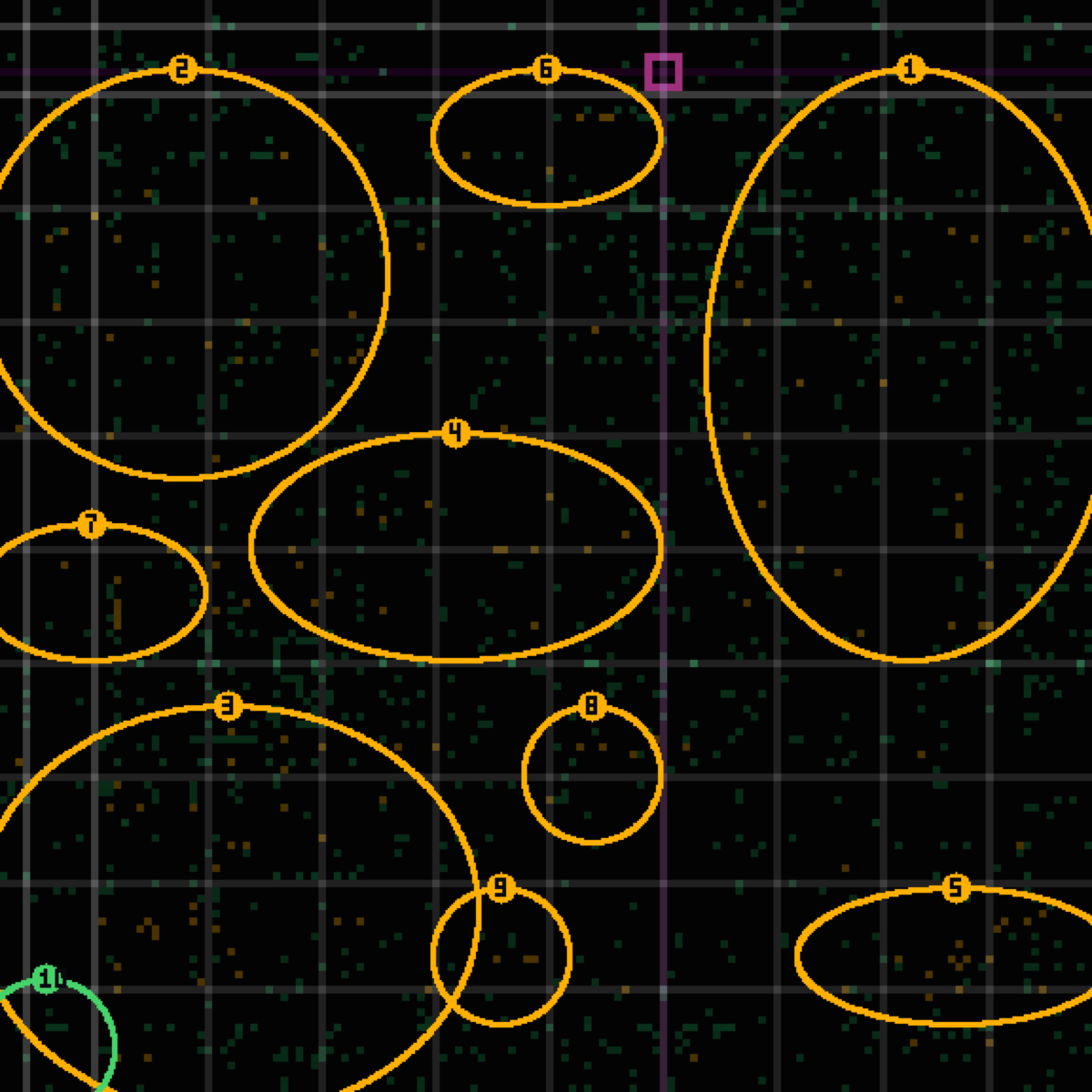
Open this commit's attestation — verify it yourself →
Why we believe this matters: the difference between what a system says it is doing and what it is doing has weight — that gap is where every AI failure and every uninsurable liability lives. But the same measurement, read the other way, is the most personal thing in the book: it means you are not about to be averaged out by a generalist. That is what today's passage was doing, and it is why the receipt above exists: the gap is measurable, so it is priceable.
Rice’s theorem says nobody can prove your agent is good. We have never claimed to. We made where it went countable instead — and there are two doors on the next page, only one of them yours.
Yes. A decidable, still-semantic spec boundary for every autonomous deterministic AI agent.
If it’s debatable, it’s not insurable. If it’s not insurable the roads don’t get built, so the cars don’t get better either — for every semantic case that actually matters.
And because this is the business of AI: buy at iamfim.com. You will sleep like a baby. For the discerning sceptic — fork github.com/wiber/thetacog-mcp and redpill your CLI in far fewer than twenty-one questions.
What does this mean for me? →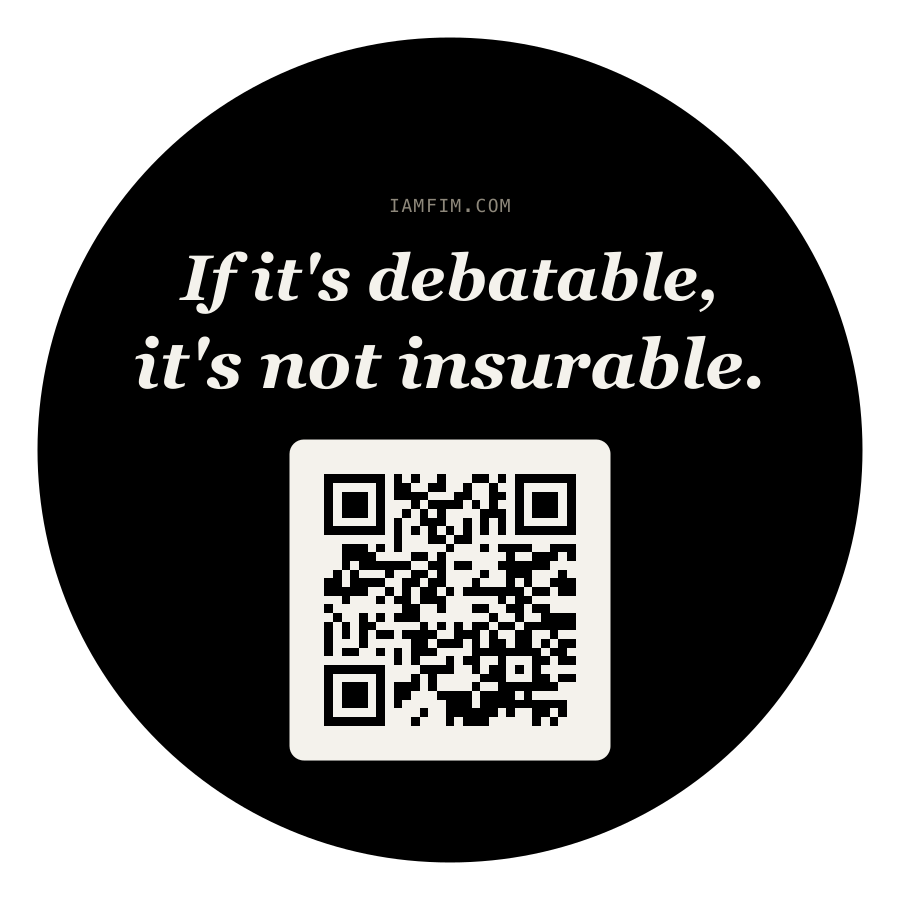
Markets do not underwrite safety. They underwrite checkability. The count is live.
1764 ships Lloyd’s Register A1 condition, not seaworthiness → cargo underwritten
1866 boilers a stamp on the metal conformance, not safety → factories financed
1903 cars the driver’s licence a bound operator → the road opened
2026 agents ????????????????? ????????????????? → exclusions written
|
The whole argument, on a disc that fits on a laptop lid. It is going to print.
|
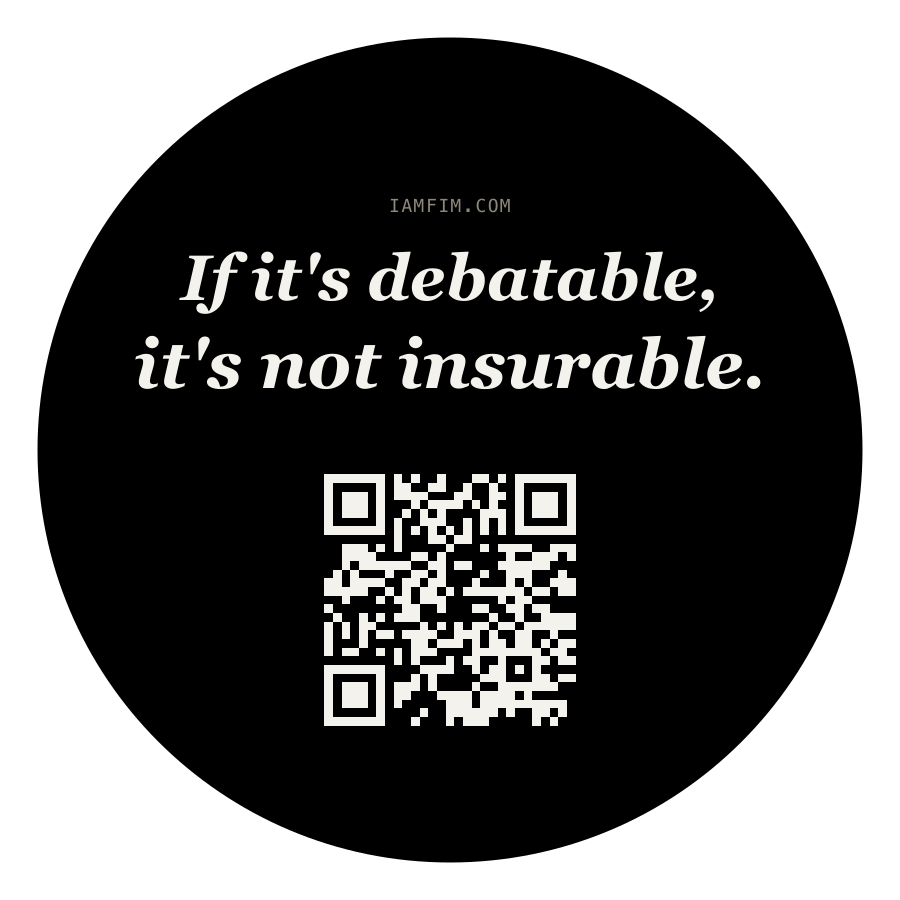
We published three of our own bugs and left them open. Fork one, fix it — that is the
entire application. No CV.
|

|
Do you worry about $1.2B in AI liability? If the property is trivial, software can check it — and why are you paying to check trivial properties? If it isn’t trivial, Rice’s theorem says nobody can. So we fixed the math.
The one thing that actually helps: hit reply. A reply is the only
move a mail provider counts as a human being — it is what puts the next one in your inbox
instead of a tab. Type anything: a correction, an idea, one word.
|
thetadriven.com/book
ThetaDriven · Elias Moosman · elias@thetadriven.com