Composite · the seat, in its own words · not a customer quote
“To stay competitive we have to deploy agents that act without waiting for us. The liability of a decision no human made was the part I could not answer for. I did not need another login tool — I needed a way to discover, structurally, where that exposure already sits in our stack, and a record that holds up when somebody asks me to prove we were checking. Decidable, recomputable, and mine rather than the vendor’s.”
— the Chief Risk Officer this was written for
Assembled from the seat, not quoted from a customer. We are not going to put quotation marks around somebody who does not exist and let you assume otherwise — that is this page’s whole argument, applied to this page. Everything else here is checkable, and you should check it.
What that seat calls "the structural audit" is today's Readiness Investigation, below.
This is not an IAM.
Identity & Access Management
This is the placement signal — an address, re-runnable from the commit, same bytes, same hash — that feeds into your IAM to make high-velocity decisions legally defensible.
Enter →Not the one who installs it? Forward this to whoever installs your tools — the install and the measurement are free and open-source (MIT); only the underwriting is licensed.
The drift-gate · free to run
One install turns any agent into a verifiable, bounded one. If you can use a chatbot, you can deploy it.
Advisory custody by default: the agent proposes, the gate measures, you sign — the keys never enter the model's context. It is an attestation oracle, not a custodian and not a market-maker. Running it to test — to verify competence, to enter the market — is free, and we want you to reach for it. The price never goes up — the term each license covers shrinks going forward, so the earliest licensees lock in the most coverage per dollar, permanently.
Free to test — licensed to insure. The gate's output only becomes a number a carrier will underwrite against once it's under license — and it takes two: the deployer running the agents and the carrier pricing the risk each hold one, to the same patent. Verifying competence is free; making it insurable is the license.
Not the one who installs it? Forward this to whoever installs your tools — the install and the measurement are free and open-source (MIT); only the underwriting is licensed.
The one price · volume unlocks the tiers
Not the one who installs it? Forward this →5,000 licenses (5,000 × $20 = $100K) also unlocks the Readiness Investigation audit
See the top tier →Certs for the humans who sign come with your license tier (1 per 10). Reading is free.
Read the manual →Not the decision maker? Forward this to your CEO. They delegate, you advance.
You're Liable for AI.
IAM proves who logged in. It can't place where your agent's work landed once it was in — that's FIM.
When something breaks, every side of the table asks the same question: where did the work land?
The one holding a record the agent did not write gets to answer it. Recompute it yourself.
Anyone who fixed AI reliability fixed competence verification at silicon speed too — by Rice (1953), same problem. They didn't. We did. We patented it.
The vendor selling you a software fix that promises to keep the AI in bounds has claimed Rice does not bind them — a claim any diligence falsifies. The only proof Rice does not bind is a substrate receipt of this shape, and that same receipt clears a human into a verified role. Whoever solves your AI side at the substrate has built the labor market's instrument too, whether they meant to or not.
The wild implications: no job search (the receipt IS the match, at cache-line speed); no separate verification step (stay-in-lane attestation IS the proof); a dignity pixel per operator and the next axis to grow into. Max income becomes a navigable trajectory.
Why believe? The same XOR that prices an AI agent's liability prices a human's role-fit. The 12-cell lattice the chip checks against is the same 12 coordinates the nine ThetaCog rooms operate from — Strategy × Tactics × Operations at three altitudes (silicon · terminal · operator). One architecture, three scales.
First implementation, not metaphor: every commit in this repo writes a receipt against that lattice; the rooms aren't marketing — they're the operating system this organisation runs on. iamfim names the liability; the rooms hold the daily proof. Schema · Argument · The nine rooms · The chip side.
Not a promise — proof you can browse: every commit's live drift receipt → (here's this page's own). Green in-lane · amber bleed · red drift, recomputable to the same panel on your machine.
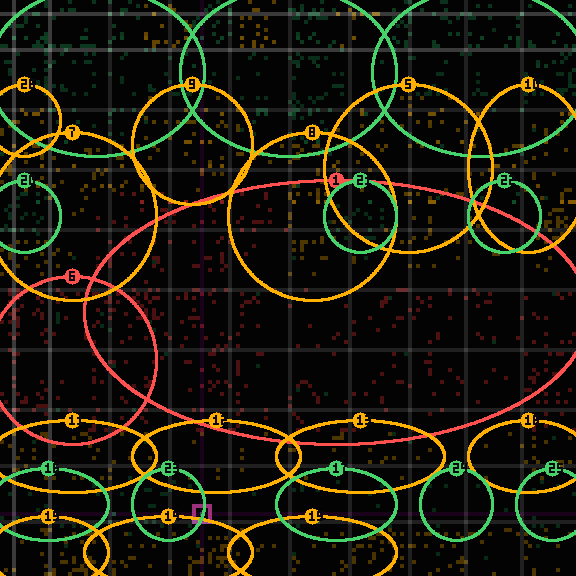
No model in the loop — the same input recomputes to this exact panel on your machine.
This validates competence — it doesn't replace it
If you're a lab, a research group, an incumbent with real depth — this isn't the thing that disrupts you. It's the thing that finally makes your edge legible and defensible. The undecidable-AI flood commoditizes confident-but-wrong output; a decidable receipt is what lets genuine competence prove itself at machine speed instead of drowning in it.
It complements the theory, it doesn't compete with it. The labs and the research frontier own the ideas; we own the on-chip receipt that grounds one of them. The receipt doesn't manufacture skill — it can only witness it. Your judgment, your depth, your record become provable at machine speed — the ground you already earned, now legible to anyone who has to trust it.
And it widens the door without lowering it: real skill that never had the pedigree finally carries a receipt a stranger can check, so your best people are recognized wherever you find them. The same coordinate that prices an agent's lane prices a person's — it hands the expert a sharper proof and the newcomer a decidable place to stand.
Before you build it yourself
Good instinct — you should assume you can. So here's the calibration we publish, so you don't have to take our word for it. On sealed, blind, cross-domain inputs the sensor separates in-domain from out-of-domain at 0.90 and rejects out-of-domain ten times out of ten. Against a scrambled null — same bytes, meaning destroyed — the signal stands at 4.48σ. And we publish the inch we haven't closed: paraphrase-invariance sits at 0.30 — surface rewording still moves it more than we'd like, and we say so. Those are the numbers a weekend clone has to beat, on held-out data it has never seen.
The hard part isn't the metric — it's that the metric has to answer where is what: every input has to land as a coordinate, not a scalar, so “a little different” and “out of its lane entirely” are distinguishable. Getting that coordinate space to hold under paraphrase and adversarial camo is the work, and the map that does it is the patented part (US Patent App. 19/637,714). We don't claim it makes your AI correct — Rice's theorem says no one can decide that. We claim it makes placement decidable, and we publish the σ so you can audit the claim.
Browse 400+ live receipts — each one ringing exactly where the work landed, green in lane, amber bleed, red drift — run the demo on your own trace, and hold our numbers to your own null.
two decidable facts · the intersection is the event · we never measure quality
Out of lane is the ordinary claim — the agent left the boundary you declared, the receipt says so, and most people's imagination stops there. The case that makes this underwritable is the other one: in lane, with a bad result. The spec was respected. The boundary was never crossed. The receipt is clean, and the work is still poor.
That is not a hole in the measurement — it is information you cannot get any other way. It means the spec is wrong, or the assumption under it is wrong, or something upstream changed and nobody noticed. The agent did exactly what it was told, and what it was told was insufficient. It is also the half that cannot be sandbagged: manufacturing a boundary breach is visible and attributable, while staying rigorously inside a declared lane as your own output degrades is not something anyone fakes in the direction of their own benefit. The two signals fail in opposite directions, which is exactly what you want from a pair of inputs.
Which is why we never have to measure quality. We supply one decidable fact — where the work landed against the lane you declared, recomputable without us. You supply the other — a reported problem, or a business metric you already watch. Their intersection is the event. Rice (1953) goes untouched, because at no point do we claim to know whether the output was good. The full argument, course by course.
“My engineering leads took one look and said they could clone it — a compressor, a seeded reef, a weekend of work. Suppose they were right. When we brought a homegrown gate to our carrier to underwrite the deployment, they asked for the one thing a clone can't produce: a license to the positional-geometry patent the policy prices against. We couldn't. We hadn't built a compliance instrument — we'd built a very efficient way to compress our own liability. And there's no version of telling your board your AI exposure is covered by something you reverse-engineered from someone else's patent. We licensed it instead.”
— VP of Engineering, Enterprise AI Integrator
A receipt you can license is defensible; a clone you have to explain is the exposure.
The answer is one command away · this is what caps your exposure
iamfim names the liability — you signed for the AI; when it drifts, you owe. The receipt at thetadriven.com/air-receipt is the artifact that turns drift into a priced, provable event and a mathematically defensible safe harbor — not a warranty, not insurance, but the record that caps unbounded balance-sheet exposure. The pipeline that produces the receipt is publicly runnable. On your laptop. In 30 seconds.
npx thetacog-mcp pmu-report --file your-agent-trace.txt
Receipt lands at ~/.thetacog/pmu/receipts/<id>.json · HTML report auto-opens in your browser · signature verifiable at /verify-receipt · the receipt body has 12-cell heatmap + Δ-map + σ-floor + market-match against a built-in compliance-officer job.
The beating heart: iamfim says "you're liable" → /air-receipt shows the schema → pmu-report produces the artifact → /verify-receipt closes the trust loop. Four URLs, one pipeline, no central server, no trust point. The artifact IS the proof.
what a human hire comes with · what an agent comes with · who writes it first
When you hire a person, an apparatus arrives with them that nobody in the room thinks about: fidelity bonds, employment practices liability, professional indemnity, legal recourse, and a century of precedent about what happens when a worker causes harm. The risk of hiring a human is bounded, priced, and shared. That apparatus is invisible precisely because it works.
An AI agent arrives with none of it. When it fails you absorb the whole operational consequence, and then find the loss sitting in a gap no policy was written to reach. That is not a technology problem — it is the absence of a social contract, and it is exactly where cars sat before motor insurance existed. Cars did not become socially acceptable by getting safe. They became acceptable when an instrument made the risk shareable, and society decided on that basis it was worth it.
We do not write that instrument and we carry none of the risk — our terms say so in section 15, and nothing on this page is an offer of coverage. What we license is the measurement a carrier can price against: a boundary event that recomputes identically on their analyst's machine, without our cooperation, so our good faith is never a dependency in anyone's claims process.
And the settlement a decidable trigger makes writable is better than a cheque. The natural response to a semantic breach is not cash in ninety days — it is labor dispatched onto the coordinate where the anomaly fired: engineers, review, attention, funded at the moment the trigger fires rather than after adjustment. That is a design a carrier can write, not a promise we make. The first broker to put defensible trigger language in front of one sets the shape every later submission is compared to.
Not the one who installs it? Send this to your engineer.
Paste it into Slack or email. It carries the one-command check and both install links, so they can see it run before anyone pays.
Can you install this on our repo? It places each agent commit against the lane we declared for it and writes a receipt anyone can recompute. The install and the measurement are free and open-source (MIT); only the underwriting is licensed.

Check it first, one command, nothing to sign up for:
  npx -y thetacog-mcp@latest attest-demo

VS Code: https://marketplace.visualstudio.com/items?itemName=thetadriven.thetacog-mcp&ref=fwd
Cursor: https://thetadriven.com/vsx
What you're getting
What a licence buys: the right to run the receipt on an agent in production under US Patent Application 19/637,714. One licence per agent, $20, good for 365 days or 10,000 countersigned receipts, whichever comes first. Each receipt records where that agent's work landed against what it was asked to do, and anyone can recompute it.
The install and the measurement are free and open-source (MIT); only the financialization/attestation layer is licensed.
One thing, one price: a license for every agent you run — $20 per licence, one licence per agent, 10,000 countersignatures or 365 days, under the patent. Buy as many as you run; volume unlocks the tiers.
The $100K you'll see below isn't a second price — it's 5,000 licenses × $20, the same rate at scale. That top tier is the one that also unlocks the Readiness Investigation (details below).
License the patent · $20 per licence · one licence = one agent
Tier: TeamCard clears live on a procurement card. 10 licences, billed annually; the key is claimed on /device with the email above, or pasted into the IDE.
An attestation instrument under US Patent App. 19/637,714 — no warranties, not insurance, not a legal guarantee.
What the volume unlocks
Patent Pending · US Patent App. 19/637,714 — application, not a granted monopoly
One currency: the licence — $20 buys one, and one licence = one agent = 10,000 countersignatures or 365 days, whichever comes first. The quantity is yours: as many as you run. The price is fixed forever; the term each licence covers shrinks for later buyers, so early buyers lock in the most coverage per dollar. Why the term shrinks — the physics, the rules, the contract →
Start with how many agents you run today — that's your number. 1 licence = 1 agent = 10,000 countersignatures or 365 days, whichever comes first (5 agents you run right now = $100/yr; add licences anytime, as many as you want).
- • 10 licences × $20 = $200/yr (one per agent · 10,000 countersignatures or 365 days each · add more anytime — they sum into your total)
- • Licensed under US Patent App. 19/637,714 — 1 CATO cert folded in (1 per 10 licenses)
- • Yields 1 CATO allocation (1 per 10 licences — certify your officers, or transfer to your vendors' compliance teams)
- • Transferable by design — deploy internally, or re-register licences to a client or vendor later. A transfer re-registers through ThetaDriven (10% of the license price per transferred licence) and the license keeps the coverage term it was minted at — buy inventory early, hand grandfathered terms to whoever you transfer to
- • Free drift-gate — npx thetacog-mcp attest-demo. It's real: browse 400+ signed receipts the same pipeline already minted.
- • $20 fixed forever — the term shrinks for anyone who waits, not for you
Not the one who installs it? Forward this to whoever installs your tools — the install and the measurement are free and open-source (MIT); only the underwriting is licensed.
The top tier — $100K (5,000 transferable licenses) unlocks the Readiness Investigation
You push thousands of automated decisions an hour. Your logs prove a write happened — not that the agent stayed in its lane when it did. If a regulator or a class-action looks under the hood, that gap is what they find — and no bigger model closes it. Standard vendors can't either: by Rice (1953), software cannot ground its own semantics.
$100K buys 5,000 agent-years of licensing (at $20/agent/year, locked at today's price) and auto-attaches the Readiness Investigation: a time-boxed structural audit of your execution boundary — not a pilot, not a resilience program, a readiness investigation into where your digital intent already decouples from your hardware execution. We hand your General Counsel or Chief Risk Officer a concrete, recomputable map of where you're exposed. Not a legal opinion, not a guarantee — a baseline you can act on.
- • 5,000 transferable agent-years — a sublicensable patent right under US Patent App. 19/637,714, locked at today's price.
- • The investigation — where your digital intent decouples from your hardware execution, today.
- • The baseline — the exposure map for your board, before a plaintiff's attorney draws it for you.
Secure your whole supply chain, not just yourself
The agent-years are fully sublicensable. Use 2,000 internally; transfer the other 3,000 to your ten biggest vendors — now their agents run the gate under your license and hand receipts straight back to your compliance team — each one a placement at an address, re-runnable from the commit, same bytes, same hash. Under the EU AI Act and third-party risk rules you're already liable for the AI your vendors point at your data; this is the instrument that lets you enforce that boundary on them.
The first mover in a supply chain sets the standard everyone else has to meet — and the term each agent-year covers only shrinks from here. Whoever licenses first locks the deepest coverage and the position: your vendors adopt your receipt, not a competitor's.
This is a Risk & Legal line, not an IT line — you're buying a block of legal clearance to the IP, not software. Same license as the checkout above, at the scale that unlocks the audit. Clear it live on a card — the one way to pay.
Set the checkout to 5,000 agents — pay by card →Not the one who installs it? Forward this to whoever installs your tools — the install and the measurement are free and open-source (MIT); only the underwriting is licensed.
$100K clears live on a procurement card — no multi-week wire. Prefer a wire anyway? Invoice instead. Don't take our word for it — run the free proof first: npx thetacog-mcp attest-demo. Deeper reading: the manual · the Rice argument. Certifications for the humans who sign are bundled with your license tier.
The physics underneath · why you can trust the receipt
You just priced the baseline. Here's why it's real.
Everything below is the evidence — the mathematics that makes the receipt legally defensible, the 12-cell grid that decides in 10µs, the undecidability proof no software vendor can answer, the manual your officers read, and the standard forming around it. Scroll if you need to convince yourself; it only gets more grounded.
The Readiness Investigation is your Gap Analysis — the audit that lets you tell the board:
"We measured exactly where we're exposed. Here's the structural fix."
Your Certified AI Trust Officers (CATOs) conduct it — the humans who sign the receipt, included with your agent-years, not bought separately.
If You're Asking These Questions, This Is For You
CEO / Founders (especially mid-market)
"AI is my responsibility. I can't afford a governance team—how do I delegate this liability?"
Fortune 500s have departments for this. You have CATO—build an officer core internally, not a headcount line item.
CISO / Security Leaders
"How do I prove our AI isn't a liability?"
Gap Analysis gives you documented proof for the board.
Compliance / Risk Officers
"EU AI Act fines are €35M. Are we ready?"
Your CATO maps your gaps before regulators find them.
CIO / Chief AI Officers
"We can't promise it'll do better next time."
Without a Gap Analysis, you don't know what went wrong.
Board Members / Executives
"We need AI governance. Where do we start?"
Train your own CATO. Internal expertise, external validation.
See industry leaders facing this challenge →
Insurance & Reinsurance
- • Joachim Wenning (Munich Re) — €35M EU AI Act exposure
- • Oliver Bäte (Allianz) — €90B under AI management
- • Andrew Witty (UnitedHealth) — 150M lives affected
Financial Services
- • Jamie Dimon (JPMorgan) — $3.7T in AI-assisted decisions
- • Larry Fink (BlackRock) — $10T AUM AI allocation
- • Jane Fraser (Citi) — AI lending discrimination risk
Healthcare
- • Dr. Tom Mihaljevic (Cleveland Clinic) — AI diagnosis liability
- • Gail Boudreaux (Elevance/Anthem) — Prior auth AI
Tech & AI
- • Satya Nadella (Microsoft) — Azure AI attribution
- • Dario Amodei (Anthropic) — Constitutional AI limits
Not a Fortune 500? That's the point.
Mid-market CEOs are personally exposed. You can't hire a governance department—but you can certify your sharpest people as CATOs. Delegate the liability to an officer core you built, not a team you couldn't afford.
The Convention: license volume dictates standing
We are not selling consortium seats. Your standing in the standard forming around agentic-AI attestation is set purely by the volume of your transferable agent-years — your execution scale is your skin in the game.
Lead Co. — 5,000+ agent-years ($100K tier)
Hold 5,000+ transferable agent-years and you automatically become the reference implementation. You co-author the findings. You shape the standard everyone else implements.
Observer Co. — under 5,000 agent-years
Deploy a smaller fleet and you audit the methodology in action. Your voice is proportional to your active license count — grow it any time; the agent-years sum into your standing.
If you don't hold the IP licenses, someone else becomes Lead Co. — they shape the standard, you implement their rules.
Want to weigh in before you license? Sign the Snowbird Declaration or endorse the standard.
The human layer · an allocation, not a product
CATO is not something you buy — it's what your agent-years yield
CATO certifies the named human officer who signs the receipt. There is no CATO price. You receive one certification allocation for every 10 agent-years you license (10 → 1, 5,000 → 500). Certify your own officers with them — or, like the agent-years themselves, transfer the allocations to your vendors' compliance teams to extend the boundary across your supply chain. The manual is the reading that grounds it; certifications arrive with the volume.
This is a patent license and an attestation instrument, not an investment or security.
No financial returns implied.
Not ready to commit? Show your support another way:
One price, one decision — license your agents
↑ Back to the checkout